
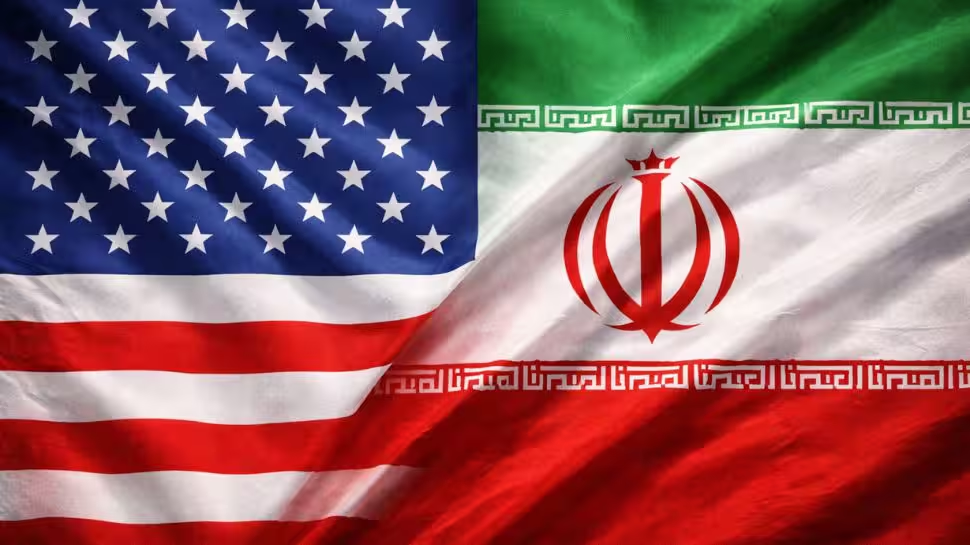
Diplomacy or Double-Cross? Why US is expanding its military presence in Middle East amid Iran talks | Explained | world news

As US-Iran negotiations are set for a second round in Geneva, after Oman talks, while back in Washington, President Trump sends two massive aircraft carriers—the USS Gerald Ford and USS Abraham Lincoln, like floating cities loaded with jets and missiles, ready to strike if talks flop.
It all kicked off last month when Trump’s 60-day deadline for Iran to ditch its nuclear program came and went with no deal. That’s when the first carrier showed up, with thousands of soldiers, anti-missile gear, and warships to block Iran’s rockets, Houthi rebels, and uranium tricks.
Things heated up fast, talks shifted to Oman after Turkey talks failed, zeroing in on bombs while Iran demands to keep enriching uranium.
Add Zee News as a Preferred Source
Then boom, the US shoots down an Iranian drone near USS Abraham Lincoln, warns ships away from the Strait of Hormuz.
By February 13, carrier number two, the USS Gerald Ford, comes into the picture. Iran’s Foreign Minister, Abbas Araghchi, says Oman talks are a ‘promising start’ but full of ‘threats.’
Trump fires back, saying, “Fear is a powerful motivator in difficult Iran talks.” The Pentagon warns of “offensive and defensive actions,” and Trump hints at “something very tough” unless Iran drops missiles and rebel support.
Does US pressure help in negotiations? Or a sneaky trap leading to war? With ships surrounding the Middle East, one wrong step could light the whole region on fire.
A time bomb waiting to explode?
Why line up warships now? It’s Trump’s classic ‘peace through strength’, flexing muscle to scare Iran into a deal.
With the classic US move of power flex, the US surged the USS Abraham Lincoln carrier first, now joined by the USS Gerald R. Ford, turning the Arabian Sea into a show of force with jets, destroyers, and weeks-long strike power.
It’s not war prep for fun, it’s leverage to make Tehran sweat over its missiles, Houthi buddies, and uranium games.
Iran-US talks roundup
US-Iran indirect talks restarted, in Muscat, Oman, mediated by Sayyid Badr bin Hamad Al Busaidi, eight months after the US Operation Midnight Hammer crippled Iran’s nuclear progress.
Iran limited the agenda to nuclear issues, rejecting US demands to address ballistic missiles, proxy support like Hezbollah and Houthis, or dissident killings, while Iranian Foreign Minister Abbas Araghchi called it a “good start” with more rounds likely.
President Trump labeled the session “very good” but pushed for a deal within a month, warning of ‘traumatic’ consequences otherwise, as Secretary Marco Rubio and Vice President JD Vance voiced doubts over Iran’s Supreme Leader’s non-involvement and stalled progress.
A second round of talks in Geneva, amid Iran’s insistence on uranium enrichment rights and missile ‘defensiveness’, contrasting US calls for full dismantling. No major breakthroughs yet, deep rifts persist despite eased tensions.
What’s next for Iran?
With the next round of negotiations around the corner, US negotiator Steve Witkoff will keep pressing Iran to drop nuclear work, stop enriching uranium, and cut missiles, but Iran’s Abbas Araghchi won’t budge on their ‘right to defend’.
US Marco Rubio wants a deal in a month, or things get “traumatic,” backing it with those two big carriers in the Arabian Sea.
Will the world witness another ship clash in the Strait of Hormuz, Houthi attacks, or bigger protests in Iran?

Comments are closed.