
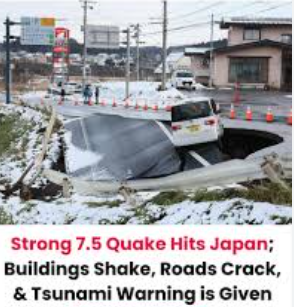
Disaster: Japan issues a “huge” temblor and tsunami alert after a 7.5 quake hits its north coast

Virendra Pandit
New Delhi: Japan on Monday issued a special advisory warning of an increased risk of a “huge” earthquake and tsunami after a powerful 7.5 magnitude earthquake struck off its northern coast, triggering panic and evacuations, the media reported.
The quake hit off the Sanriku coast at around 4.53 pm local time at a depth of about 10 kms. A tsunami of about 80 cm height was detected at Kuji port in Iwate prefecture within an hour, while another port recorded waves of about 40 cm, early reports said.
After the quake, the Japan Meteorological Agency issued a special advisory, saying “the likelihood of a new, huge earthquake occurring is relatively higher than during normal times.”
Alerts remained in place with warnings of waves up to 3 meters, although the Pacific Tsunami Warning Center later said the threat “has now passed.”
Officials stressed that the advisory is not a prediction but urged residents to remain prepared while continuing daily life.
The Cabinet Office of Japan and the weather agency said there is a 1 per cent chance of a mega-quake of magnitude 8.0 or stronger along the northern coast within the next week following the earlier tremor near the Chishima trough. A similar advisory was issued in December after another major quake, though no large event followed.
Evacuations
The magnitude temblor measuring 7.5 on the Richter Scale were powerful enough to sway high-rise buildings as far away as Tokyo, several hundred km from the epicentre. In Hokkaido, waves were seen swelling close to the shore, prompting residents to move to higher ground.
TV footage showed panicked people evacuating to parks and elevated areas. Evacuation advisories were issued for more than 128,000 residents across Iwate and three other northern prefectures.
Authorities urged people to stay away from coastal areas and rivers and warned of possible aftershocks for about a week.
No major damage, yet
Despite the scale of the quake, officials said no major injuries or damage had been reported so far, including at power stations. The Nuclear Regulation Authority confirmed that nuclear facilities were operating normally with no abnormalities. Transport services were disrupted, with several bullet train operations in northeastern Japan suspended temporarily. The Tohoku, Yamagata and Akita Shinkansen lines were among those affected, along with some services in Tokyo.
Japan’s seismic risk
Japan is among the world’s most seismically active countries, accounting for more than 10 percent of earthquakes globally with a magnitude of six or higher. On an average, a magnitude 7 or stronger quake occurs about every 16 months.
The latest developments come 15 years after the 2011 Tōhoku earthquake and tsunami, a magnitude 9.0 catastrophe that killed more than 22,000 people and displaced nearly half a million, many due to tsunami damage and the Fukushima nuclear crisis.

Comments are closed.