
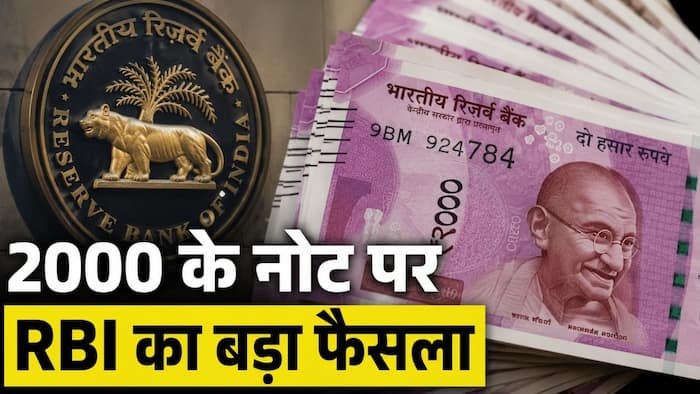
Do you also have ₹2000 notes left? RBI released latest update; Know how and where notes can still be exchanged

If you still have ₹ 2000 notes lying in your safe, some corner of your house or in your piggy bank, then a very important update has come out for you from the Reserve Bank of India (RBI). Often there is a fear in the minds of people that whether their notes have now become completely junk? So the answer is – no. RBI has clarified that ₹2000 notes are still legal tender. Although the deadline for exchanging these notes in banks has ended long ago, the Reserve Bank has still kept the option of exchanging notes and depositing it in the account open for the convenience of the general public. Let us know everything related to this latest decision of RBI. More than 98% of the notes returned to the banking system According to the latest report released by the Central Bank, ever since the historic decision was taken to withdraw ₹ 2000 notes from circulation in May 2023, more than 98% of the notes have returned safely to the banking system. At present, there are very small quantities of ₹2000 notes left in the market, which RBI is continuously making efforts to bring back. Now not in banks, notes will be changed at these 19 places. The last date for depositing or exchanging ₹ 2000 notes in common commercial banks (like SBI, PNB, HDFC) has already ended on 7 October 2023. Therefore, now you cannot change these directly by going to any normal bank branch. For this, RBI has designated 19 issue offices across the country. You can exchange your notes by visiting these 19 offices, where the total value of the note will be directly credited to your bank account. RBI has issue offices in these 19 cities of the country: Ahmedabad, Bengaluru, Belapur, Bhopal, Bhubaneswar, Chandigarh, Chennai, Guwahati, Hyderabad, Jaipur, Jammu, Kanpur, Kolkata, Lucknow, Mumbai, Nagpur, New Delhi, Patna and Thiruvananthapuram. Office Timings: You can visit these offices during working days between 10:00 AM to 6:00 PM. Keep in mind that these offices remain closed on the second and fourth Saturdays of the month, all Sundays and government holidays. You can also send notes through post office sitting at home. If you do not live in the above 19 cities or are unable to go to the RBI office, then there is an option for you through India Post. You can go to any post office in the country and send your ₹2000 notes directly to the issue office of RBI through insured post. As soon as the notes reach the RBI office through post, an amount equal to their value will be transferred directly to your specified bank account. Is any ID proof required to exchange notes? According to the official guidelines of RBI, there is no need for any kind of document or identity card (like PAN card, Voter ID etc.) to go to the issue office to exchange notes. You can get your notes exchanged in a very easy process without any paperwork. Limit: You can exchange ₹2000 notes directly over the counter for other denominations (like ₹500, ₹200, ₹100 notes) up to a maximum of ₹20,000 at a time. Why were ₹2000 notes discontinued? History: After the historic demonetization of 8 November 2016, when the old ₹ 500 and ₹ 1000 notes were discontinued, this large note of ₹ 2000 was introduced to immediately meet the huge shortage of cash in the market. When did the printing stop: When ₹ 500 and other small notes came in sufficient quantity in the market, RBI had completely stopped the printing of ₹ 2000 notes from the year 2018-19. Danger of fake notes: One of the main reasons for banning this big note was the growing network of fake currency. According to a report, in the first two years of demonetization, out of all the fake notes detected in the country, about 56% of the share was of fake ₹2000 notes alone.

Comments are closed.