
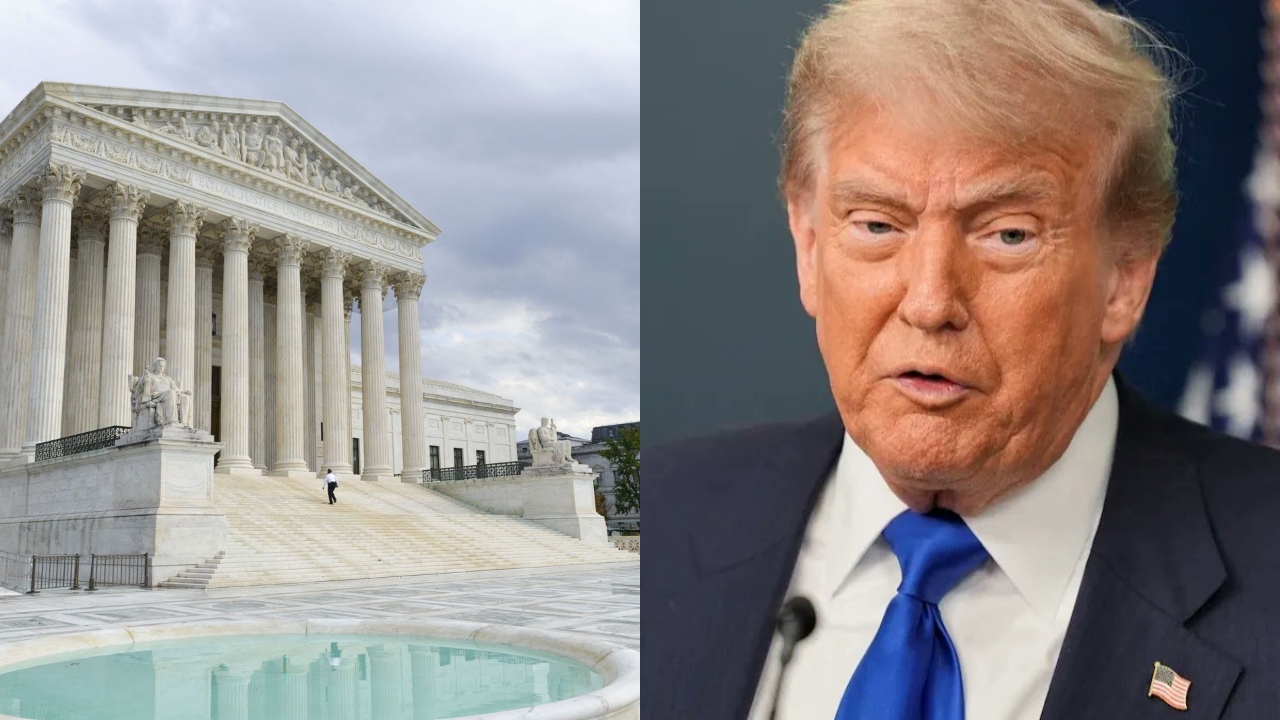
What will happen to Trump’s tariffs after the Supreme Court’s decision? Will the Trade Act of 1974 save ‘trade war’?

The US Supreme Court’s decision on tariffs is a big turning point for its politics and the global economy. US Supreme Court President donald trump Declaring the tariffs imposed under IEEPA 1977 illegal, it made it clear that the President cannot impose unlimited trade taxes in the name of emergency powers. But will this end Trump’s ‘trade war’? no way. According to The Guardian, Trump is now preparing to implement a 10% global tariff with the help of the Trade Act of 1974. In such a situation, the question is whether this law will prove to be a legal shield for them or will it create a new controversy? This is the real story of this decision.
What was said in the court’s decision?
The US Supreme Court ruled with a majority of 6-3 that President Donald Trump has misused his powers under IEEPA 1977. This is illegal. According to the court, Congress’s approval is necessary before imposing the tariff. No President has done this till now. Tariffs were imposed by the President without getting approval from Congress. He announced the tariffs on ‘Liberation Day’ last April. The tariffs set at different rates include dozens of countries, from war-torn Syria and impoverished Lesotho to the UK, China, Canada, Mexico, Japan and EU countries.
Why does IEEPA 1977 not give right to tariff?
IEEPA (International Emergency Economic Powers Act) was created to deal with national emergencies. The court clarified that this law allows economic sanctions, but does not give the right to impose comprehensive tariffs. Lower courts had also earlier confirmed the same conclusion.
Will Trump roll back the tariffs?
No. A few hours after the Supreme Court’s decision, Donald Trump made it clear in the press conference that the trade war will continue. “We have other ways, lots of other ways,” he said.
The Trade Act of 1974: The New Weapon?
The Trump administration is now taking recourse to Section 122 of the Trade Act of 1974. Section 122 of the Trade Act allows the President to impose tariffs up to 15%, but for a maximum of 150 days. According to US Treasury Secretary Scott Besant, the basis for solving “international payments problems”, tariff revenue in 2026 could remain almost the same as before.
Will the Trade Act of 1974 ease Trump’s troubles?
The law allows the imposition of tariffs, but requires investigation and hearings. There is a time limit for how long the tax can remain in effect.
Why did Congress’ surveillance increase?
It is also possible to use provisions like Section 232 on the basis of national security, but this process is long and complicated.
What is the impact on existing trade deals?
Trump indicated that some deals would remain in place, some would be replaced with new tariffs. His State of the Union speech next week may clear the policy direction. Richard Rumbelow, international business director of Britain’s Make UK, has called for clear guidance.
When Trump was asked whether existing trade deals with other countries, including India, would be affected, he said, “Many of them remain in place. Some will not remain and will be replaced with other tariffs.” Trump’s annual State of the Union speech next week could reveal more about his next steps.
Will there be tariff refunds?
It is estimated that tariff revenues last year were between $240–300 billion. Studies show that 90% of the burden was borne by American companies and consumers. Supreme Court Justice Brett Kavanaugh called the refund process a “mess.” Trump clearly said – “No discussion on refunds.” Despite this, the Supreme Court’s decision will have a wide-ranging impact. There will be uncertainty in the supply chain. Whereas companies are waiting for long-term plans.
international market instability
Although the Supreme Court has blocked IEEPA, the Trade Act of 1974 gives Trump limited but alternative powers. The Supreme Court’s decision has certainly dealt a blow to Trump’s tariff agenda, but has not completely stopped it. The Trade Act of 1974 may provide temporary relief, but legal and political challenges will remain. Will this power struggle between Congress and the Court affect the economy in 2026?

Comments are closed.