
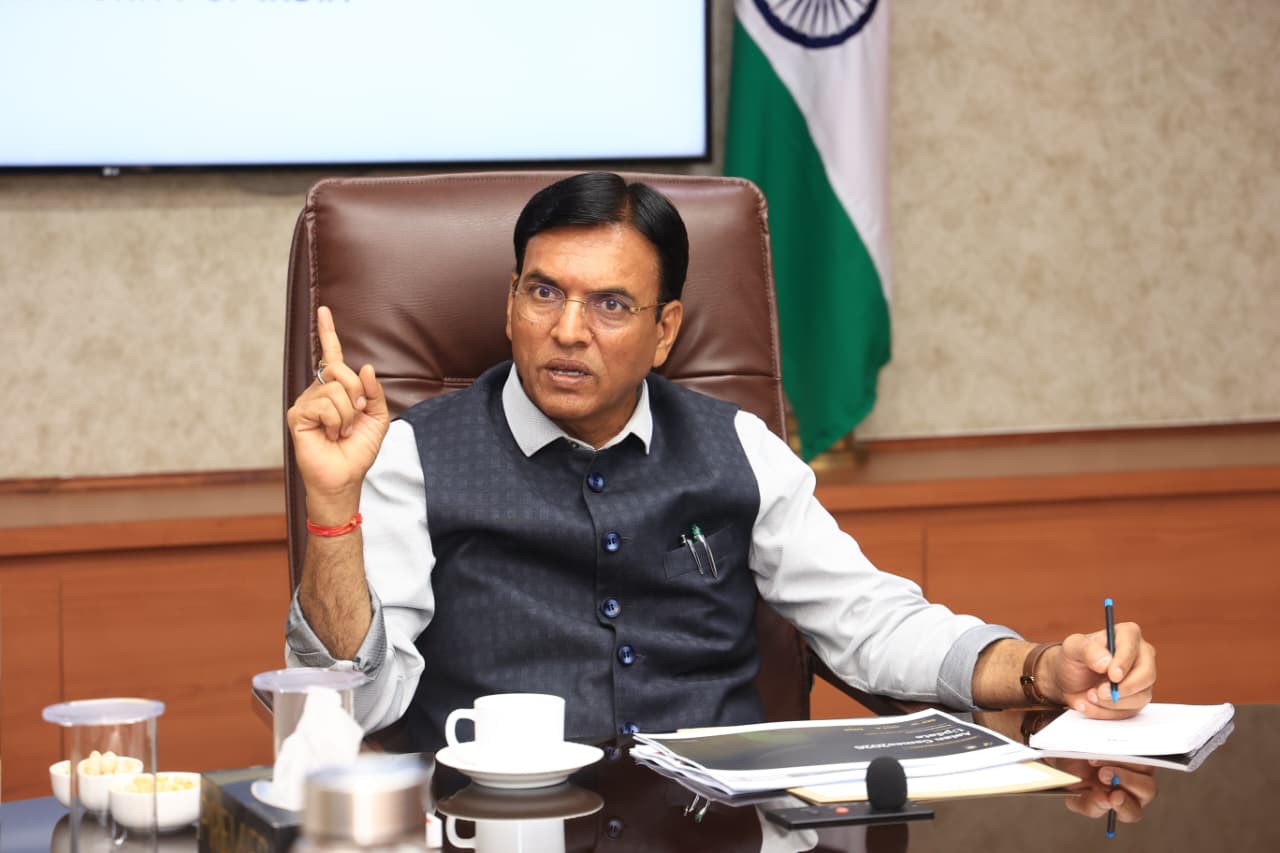

New Delhi, 5 March 2026: Union Minister of Youth Affairs and Sports, Dr. Mansukh Mandaviya on Thursday chaired a high-level meeting at the Sports Authority of India (SAI) headquarters to review India’s preparations for the 2026 Asian Games to be held in Aichi-Nagoya, Japan from September 19 to October 4. Senior officials from the Ministry of Youth Affairs and Sports, SAI and other stakeholders met Dr. Mandaviya had highlighted the country’s preparedness ahead of the event, ensuring that athletes get all possible support to perform at their best in this continental showcase.
The 15-member committee formed to review the preparations for the Asian Games 2026, comprising Shri Hari Ranjan Rao, Secretary, Ministry of Youth Affairs and Sports, PT Usha, President of the Indian Olympic Association, Asian Games Chef de Mission Shri Sahadev Yadav, Deputy Chef de Mission Sharath Kamal and others, has reviewed the functioning of the training, logistics, athlete welfare and competition preparedness planning. To do this, four meetings have been organized from December 2025 till now. The committee is overseeing the strategic roadmap for India’s campaign at the Games.
Speaking during the meeting, Dr. Mansukh Mandaviya had reiterated the government’s commitment to the welfare and performance of athletes. “Our athletes are our top priority. Every possible support from training and sports science to logistics, kit support, food support and medical care will be provided so that they can prepare without any disruption and perform at their best at the Asian Games. Our aim is to ensure that they do not suffer at all and remain focused on increasing our medal tally at the competition.”
The Union Minister also stressed the need for coordinated efforts among all stakeholders, and said that structured preparation, strong support systems and timely planning will play a vital role in India achieving new milestones at the 2026 Asian Games.
As part of the preparations, nodal officers for the AG Technical Handbook have been appointed by each NSF (National Sports Federation) to explain and educate their respective NSF players, coaches and support staff on sport-specific technical details to ensure optimal performance at the Games. Teams will be finalized well in advance to ensure athletes get ample time for focused preparation and efforts are also being made to strengthen the capacity of support staff, including medical teams, while seamless coordination with Indian embassies abroad will be ensured for logistical convenience. Federations have been given the freedom to plan exposure tours and competition schedules in advance. In sports where operational planning is more challenging, support will be organized across multiple locations with dedicated support staff deployed at each location. Special attention is also being given to aspects of adaptation like food and environmental conditions, in which measures to create a competitive environment in India before the Games are also being examined.
The nation aims to surpass the historic tally of 106 medals achieved at the Hangzhou Asian Games 2022 with strategic planning, dedicated preparation and joint coordination among all stakeholders. More than 700 Indian athletes are expected to compete in 40+ sports at the 2026 Games.
It was highlighted during the meeting this morning that the Aichi-Nagoya Asian Games follows a unique five-cluster competition model, in which athletes will compete in multiple prefectures rather than a single Olympic-village style event. The venues are spread out in clusters such as Aichi, Gifu, Shizuoka and the airport-expo zone, requiring detailed planning for travel, logistics, medical support and athlete recovery.
To help athletes adjust to the living conditions of the Games, special congested container units will be set up at the SAI regional centers in Patiala and Bengaluru, allowing athletes to familiarize themselves with the container-style living arrangements expected during the Games. Officials said the move would help athletes acclimatize early and avoid disruptions during competition.
The meeting also reviewed the four-day recce visit of the IOA delegation in January, which inspected major competition venues, athletic facilities and logistics infrastructure in Japan. Based on the findings, cluster-wise planning is being implemented with dedicated logistics officers, medical teams and support staff assigned to each cluster to ensure seamless operations for Indian athletes.
Several athlete-focused measures were discussed to ensure smooth preparation months before the Games. This includes appointing the chief medical doctor for the contingent, finalizing the Indian food options for the athletes with the help of appointed SAI culinary staff and ensuring that the athletes receive their official kit well in advance. The importance of discipline-wise performance reviews, early team finalization and capacity building of support staff including medical and recovery teams was also discussed.
The next committee meeting is scheduled for March 20, where final discussions will be held on contingent size, logistics, travel arrangements and operational preparedness as India moves into a crucial phase of its preparations for the continental sporting extravaganza.
Also read: More than 30 lakh enumerators, supervisors and officers will be involved in population census 2027.

Comments are closed.