
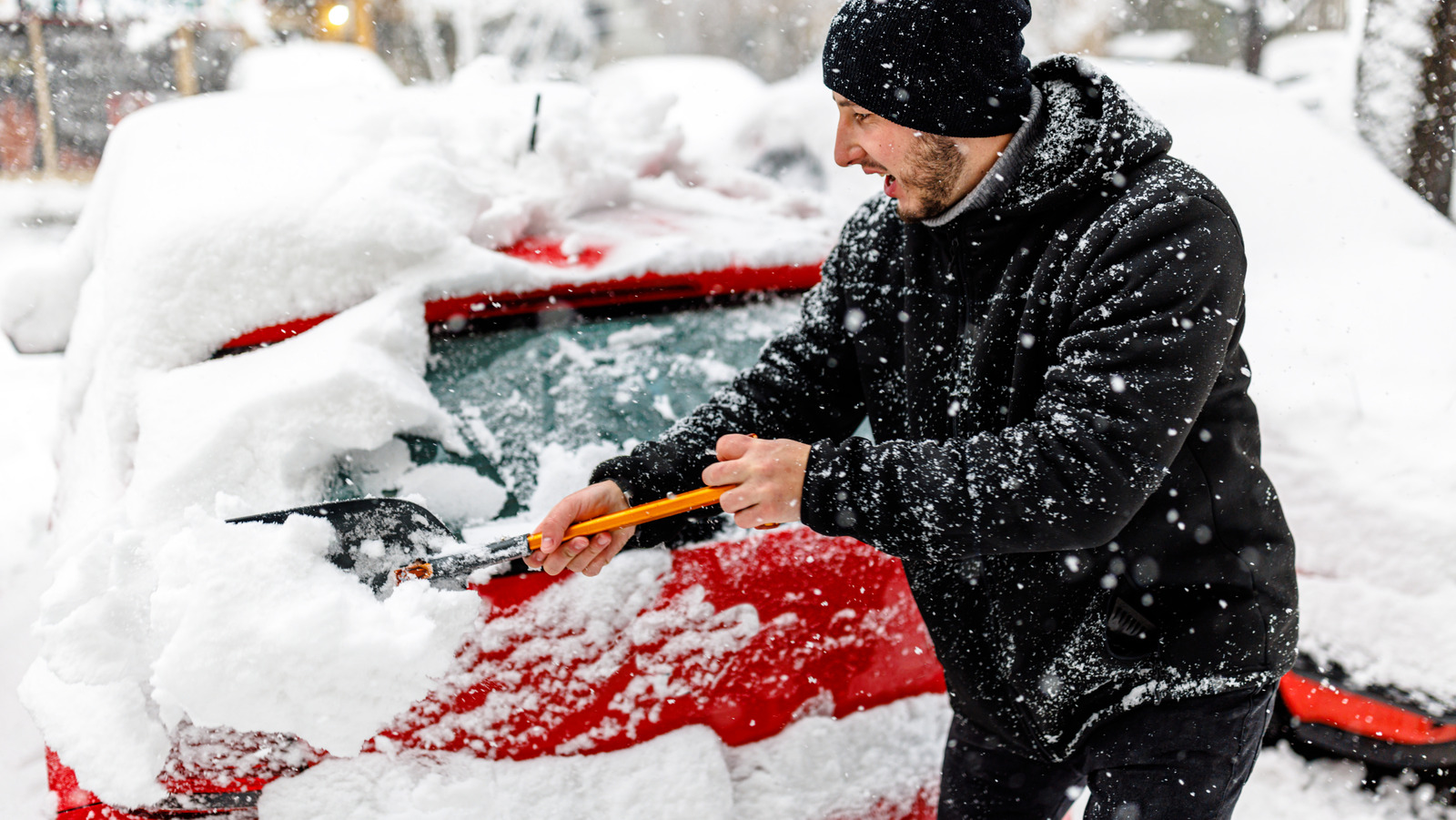

It’s 6:15 AM when you rush outside to begin the early morning ritual of warming up your jalopy, because absolutely no one likes to slide into an ice-cold seat. Except, on this particular morning, you’re confronted with a layer of snow resting peacefully across everything. Hopefully, you’ve already prepared yourself (and your car) for these frigid conditions to avoid any potential issues down the road. Regardless, you’d better “embrace the suck” as Marines are fond of saying, and take the extra time to remove all that snow on your car — even the white stuff piled atop the hood, roof, and trunk — because it may be illegal not to.
That’s right, laws in eleven states will make you regret not doing so, especially if an “ice missile” you failed to clean off injures someone. The states that can fine and/or dole out a ticket for driving with snow on your car are: Alaska, Connecticut, Georgia, Massachusetts, Michigan, New Hampshire, New Jersey, Pennsylvania, Rhode Island, Tennessee, and Wisconsin. Fines can vary from state to state, and the amounts can range widely. For instance, Pennsylvania can charge you $50 simply for not removing the snow, but if a chunk comes loose and causes damage, you could pay as much as $1,500. In New Jersey, driving around with snow on your vehicle might only result in a fee of $25 to $75 (per offense), but if it falls off and causes any damage, it can shoot up to $1,000.
Other states have rules about snowy vehicles too
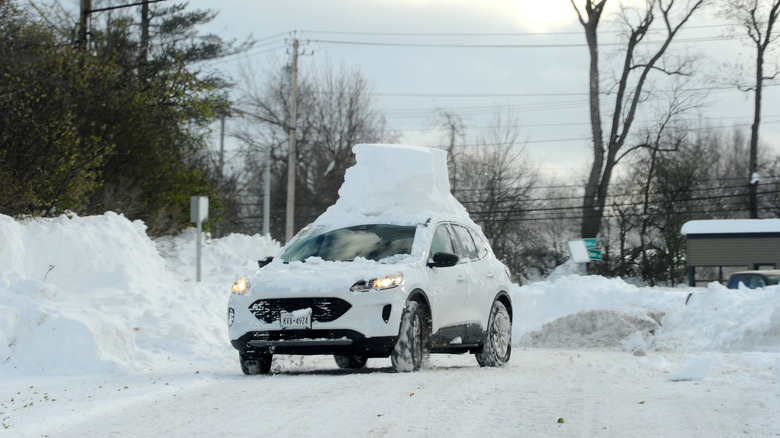
Other cities and states may not have specific laws on the books, but they can still get you. Ohio, Kentucky, and Indiana will issue citations for reckless or careless driving if the snow obstructs your view, covers brake lights or turn signals, or falls off the car while moving.
The same holds for the state of New York, which, according to its Vehicle and Traffic Law (Section 1212), says you can be charged with reckless driving if you do so in such a way that “unreasonably interferes with the free and proper use of the public highway or drive in a manner that unreasonably endangers users of the public highway.” Meanwhile, in the City of New York, drivers are required to clear any snow that’s three inches or more. Even if falling snow doesn’t cause any damage, fines can reach $850, depending on the circumstances.
Ultimately, the issue revolves around the safety of everyone on the road. In New Hampshire in 1999, an “ice missile” roughly nine feet long dislodged from a semi-truck and sailed into a box truck, which then swerved into Jessica Smith’s car and killed her. “Jessica’s Law” went into effect in 2002, requiring every driver to clear snow and ice from their vehicles (regardless of type). First-time offenders are fined between $250 and $500, while subsequent offenses can cost as much $1,000. Be sure to take the time to remove the snow, even if you don’t have a scraper.

Comments are closed.