
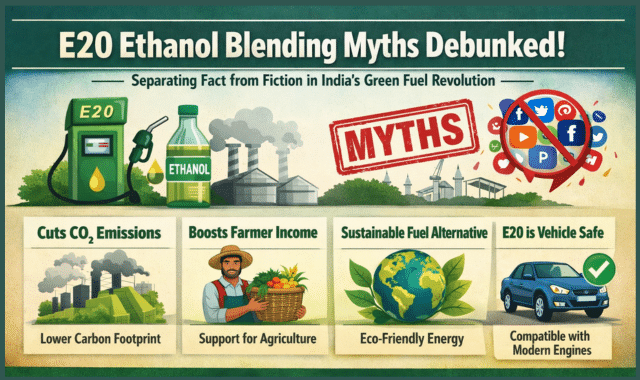

India’s push to 20% ethanol blending in petrol (E20) has delivered massive wins for farmers, the economy and the environment.
Yet social media is flooded with dramatic claims — from “10,000 litres of water per litre of ethanol” to “your engine will corrode, and insurance will be void.”
The Ministry of Petroleum & Natural Gas has now issued a clear, point-by-point rebuttal, separating fact from fiction.
1. The “10,000 Litres of Water” Myth
Claim: Producing 1 litre of ethanol consumes 10,000 litres of water.
Reality: This figure wrongly attributes the entire water footprint of paddy farming to ethanol. Farmers grow paddy mainly because of MSP and FCI procurement for food security. Only surplus rice (after national food needs are met) is used for ethanol. Modern distilleries use just 3–5 litres of processed water per litre of ethanol and operate on Zero Liquid Discharge (ZLD) technology. Maize — now supplying over 40% of ethanol — requires far less water and is being actively encouraged through higher MSP.
2. The “Untested Experiment” Myth
Claim: E20 is a risky new experiment on Indian citizens.
Reality: Ethanol has powered vehicles for over a century. Henry Ford’s 1908 Model T ran on ethanol. The USA uses E10 as standard fuel, Brazil mandates E27 (planning to go higher), and countries like Canada, Thailand and Japan have adopted blending programmes. India’s E20 rollout follows proven global best practices.
3. The “Drastic Mileage Drop” Myth
Claim: E20 will slash your vehicle’s mileage.
Reality: Extensive ARAI field trials (40,000 km on cars, 20,000 km on two-wheelers) found only marginal impact. Mileage depends far more on driving habits, tyre pressure and maintenance. Ethanol’s higher octane rating actually improves acceleration and ride quality in city driving.
4. The “Engine Damage & Corrosion” Myth
Claim: E20 damages engines and corrodes parts.
Reality: A comprehensive 2014 ARAI study (with IOCL, IIP-Dehradun and SIAM) found no issues with drivability, metal or plastic compatibility for E20. Only certain older vehicles may need earlier replacement of some rubber parts. Carbon monoxide emissions dropped up to 50% in two-wheelers.
5. The “Insurance & Warranty Void” Myth
Claim: Using E20 will void your insurance or vehicle warranty.
Reality: Both insurance companies and SIAM (on behalf of all automakers) have confirmed that E20-compliant fuel does not affect warranty or insurance validity. PIB Fact Check also labelled this claim false.
6. The “Ants & Bees on Fuel Caps” Myth
Claim: Ants and bees are attracted to E20 because it contains sugar.
Reality: Fuel-grade ethanol undergoes fermentation and distillation that remove all sugars. It also contains denaturants that repel insects. BPCL confirmed there is zero scientific basis for these viral claims.
7. The “Government Called E20 an Experiment in Court” Myth
Claim: The government told the Supreme Court that E20 is just an experiment.
Reality: The court case was only about contractual ethanol procurement rules — not the merits of the blending programme. The Attorney General’s office issued a clarification on 30 June 2026 stating this interpretation is incorrect.
8. The “Water in Fuel Tanks” Myth
Claim: E20 causes water to enter vehicle fuel tanks.
Reality: Water entry is undesirable for any fuel. Modern vehicles and retail outlets already have safeguards (silica gel traps, proper sealing) to prevent this — regardless of ethanol content.
9. The “Sugarcane Juice Mixed in Petrol” Myth
Claim: Viral videos show sugarcane juice being poured directly into petrol.
Reality: These videos are fake. Fuel ethanol is produced through industrial processes and meets strict quality standards. Blended petrol does not separate at room temperature.
10. The “Ethanol Plants Harm Farmers & Environment” Myth
Claim: Ethanol plants deplete groundwater and hurt agriculture.
Reality: The opposite is true. Plants require environmental clearance and must follow Zero Liquid Discharge norms.
Programme achievements (ESY 2014-15 to May 2026):
- ₹1.90 lakh crore+ in foreign exchange savings
- ₹1.60 lakh crore+ paid directly to farmers
- ~930 lakh metric tonnes CO₂ reduction
- Over 310 lakh metric tonnes crude oil substituted
Ethanol blending rose from 1.5% in 2013-14 to 20% in December 2025 — ahead of schedule.
Comments are closed.