

Petrol bunk owners are now voicing concerns of a sheer lack of clear guidelines and testing equipment to verify the quality of E20 (20% ethanol-blended) petrol. This comes after the government directed strict action against non-compliant fuel sales. The complete roll-out of E20 means that even a minor compromise in storage or distribution can lead to large amounts of fuel getting wasted and in huge financial losses for bunk owners. They are now seeking standard operating procedures (SOPs) and equipment to check fuel quality at the retail level.
The Petroleum Ministry issued a directive on July 8, asking states to take strict action against dealers selling adulterated or non-compliant petrol. In many recent incidents, the fuel dispensed by some bunks were found to be non-compliant in terms of quality. Claims of adulteration have also been increasing.
The order called for coordinated inspections and surprise checks at bunks. These will involve district authorities, enforcement agencies, oil marketing companies (OMCs), and testing laboratories. The motive will be to ensure fuel quality.
This stringent approach puts petrol bunk owners in a difficult position. They say that they are expected to ensure fuel quality, but do not have the right tools or guidelines to do so. They are now demanding a standard operating procedure (SOP) from oil marketing companies and other authorities. This set of step-by-step instructions will help petrol bunk staff to carry out routine checks on stored fuel.
According to Hindustan Timesat least a dozen dealers have told the publication that the marketing discipline guidelines (MDG) currently in force, are very strict. These demand them to check the quality of the fuel coming from the depots before taking it to the storage tanks, and further commencing the retail sales.
Bunk owners say that they only have ‘resources’ to check the density. ‘We have no clue about the exact percentage of doping of fuel’ Monty Sehgal, spokesperson, Petrol Pump Dealers Association, Punjab, told the publication.
He said that the government’s July 8 directive could lead to harassment of dealers. Dealers receive their stock from state-owned Oil Marketing Companies. Private players, he says, are exempted. Sehgal also added that bunk owners do not have any equipment to check the quantity and quality of ethanol blended into the fuel.
Another major concerns is the absence of clear guidelines from oil marketing companies and other regulatory bodies regarding the same. Dealers haven’t received any formal SOP to check ethanol content from bodies like the Bureau of Indian Standards (BIS). This adds further to the confusion and uncertainty.
India’s move towards E20 petrol was rather quick. The E20 target was achieved ahead of its planned timeline. However, the blending program has lately been creating several unpleasant headlines.
Many have reported engine and vehicle malfunctions, and put the blame on ethanol-blended petrol. In many cases, the actual cause was found out to be the use of contaminated or adulterated fuel. Cases of fuel contamination have been rising rapidly. The blending seems to have hastened it. Ethanol’s hygroscopic nature (ability to attract water) is the reason for increased chances of contamination.
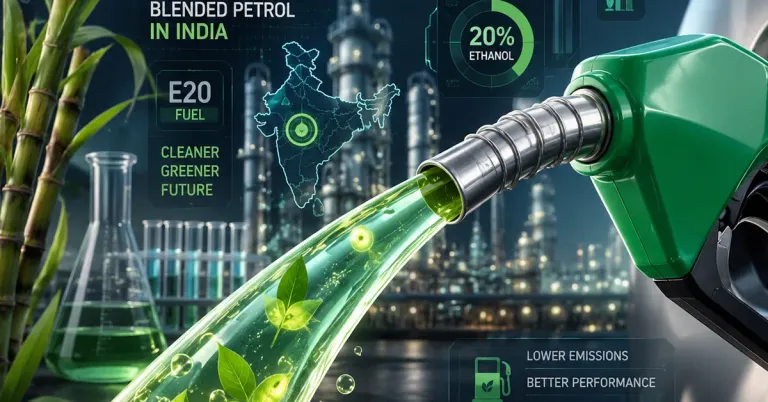
Petrol is stored in underground tanks, at bunks. In many cases, these tanks were originally designed to store pure petrol or lower blends. E20 petrol can get easily contaminated if water or moisture comes in contact with it. In such cases, the ethanol in E20 will bind with water molecules and form a separate layer. This will then sink to the bottom of the tank. This process is called phase separation.
Dispensers draw fuel from the bottom of the tank. This ethanol-water mix will get sucked into dispensers, before the upper layer of pure petrol. This can cause engine damage and vehicle malfunctions.
Petrol bunks buy fuel through a structured system of advanced payments. If phase separation happens in the storage tanks, the entire stock will get contaminated and unusable. This may cause huge financial losses for the bunk owners. Now, most bunks have intensified testing their tanks for water content and possible chances of contamination. Proper SOPs from oil marketing companies and other authorities will help make this process more efficient, and easier.
Source: HT
Comments are closed.