
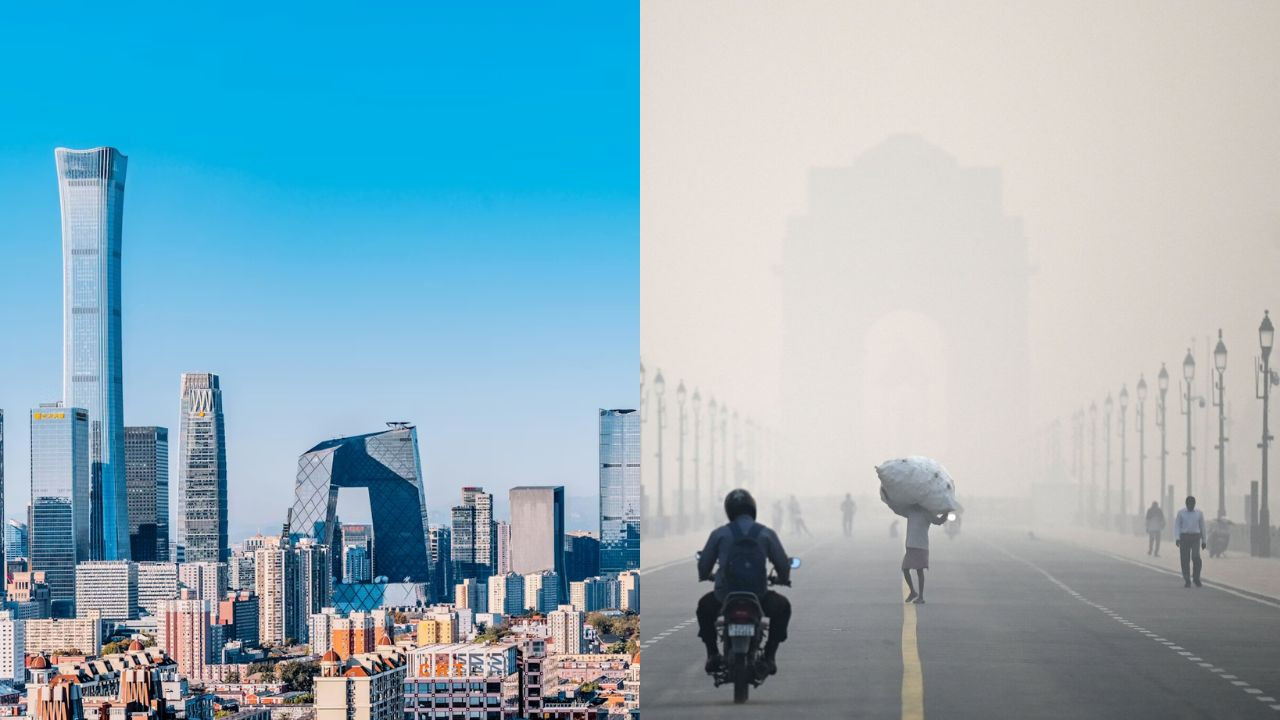
Earlier, the air of Beijing was also poisonous like Delhi, then how did China do wonders? Why is Delhi failing again and again?

New Delhi: There was a time when China’s capital Beijing was counted among the most polluted capitals of the world. The situation was so bad that Beijing started being called the smog capital globally. But in the last 10 years the picture has completely changed. Today, Beijing’s air is cleaner than ever before and this change is not a miracle, but the result of strict policies and consistent implementation.
On the other hand, India’s capital Delhi is struggling with severe air pollution despite all efforts. It has become clear that not only Delhi, but also the surrounding states will have to come together to find a solution, because sooner or later this problem becomes a problem for the entire region. In such a situation the question arises what should be done? Experts are brainstorming at their level, but the most practical way is to understand Beijing’s model. After all, how did Beijing clean the air and why was Delhi left behind?
When Beijing was called ‘smog capital’
Once upon a time, densely populated China was called ‘Bicycle Kingdom’. The popularity of bicycles was so great that in common Chinese families, three things were considered most dear. Bicycle, wrist watch and sewing machine. But as the country moved from bicycles to automobiles and combustion engines, its pressure on the environment, society and economy started increasing.
The most serious impact of this change was seen in Beijing. Rapidly increasing population, influx of vehicles and industrial expansion shook the ecosystem of the capital. Toxic air and dense smog brought Beijing international infamy. The situation worsened so much that China had to take tough decisions and these decisions later proved to be a game changer for it.
China became serious on pollution after 2013
On one hand, China became the world’s largest automobile producer and consumer, and on the other hand, it started struggling with the ill effects of increasing oil consumption and pollution. According to a report, Beijing recorded a 64% reduction in fine particulate pollution and 89% reduction in sulfur dioxide since 2013. Now this model is being adopted in other cities of China also.
Beijing’s big decisions against pollution
Beijing worked on many fronts simultaneously to deal with air pollution, something like this:-
1. Coal to gas policy
According to the report, Beijing implemented a ‘coal to gas’ policy since 2005 and cut coal consumption by about 11 million tons by 2017. If the use of coal reduced, pollution also reduced. This lesson is important for Delhi-Noida and surrounding areas also.
2. Industrial Treatment System Upgrade
China modernized high-capacity terminal treatment facilities and implemented ultra-low emissions standards. This had a direct impact on industrial pollution.
3. Control of pollution caused by vehicles
Controlling vehicle pollution has long been part of Beijing’s policy. Now people consider it not just a rule but a moral responsibility. On the contrary, as soon as the strictness is imposed in Delhi, people are seen running to get pollution checked.
4. Focus on quality of vehicles and fuel
Special attention was paid to the standards of new and old vehicles, as well as the quality of fuel. Laws were made strict and their compliance was also ensured. If the same strictness is implemented in the entire NCR, then the effect can be seen.
5. Shifting of polluting companies
Those companies in and around Beijing, which were expected to cause more pollution, were shifted. Measures were taken to minimize emissions through new technology. The same thinking will have to be adopted in Delhi-NCR also.
6. Traffic Management and Economic Incentives
Traffic management was improved and economic incentives were given to adopt cleaner alternatives.
Result: Vehicles increased, pollution decreased
The effect of all these steps was that the number of vehicles in Beijing increased three times in the last two decades, but there was a huge decline in total pollutant emissions. Between 2013 and 2022, pollution caused by activities like burning of coal, vehicles and crops was controlled to a great extent.
Figures that tell the story themselves
Analysis of Beijing’s air revealed that:
66.5% reduction in PM2.5
88.7% reduction in SO2
58.9% reduction in NO2
Nearly 50% reduction in PM10
Today, 21.8 million people of Beijing are breathing relatively clean air.
Lesson for Delhi
Strict rules like not giving fuel to vehicles without valid pollution certificate are now being implemented in Delhi. But the experience of Beijing shows that it is not enough to just make rules, but it is necessary to implement them consistently and honestly. If Delhi and the entire NCR learn from Beijing’s model, then perhaps the capital can breathe freely once again.

Comments are closed.