
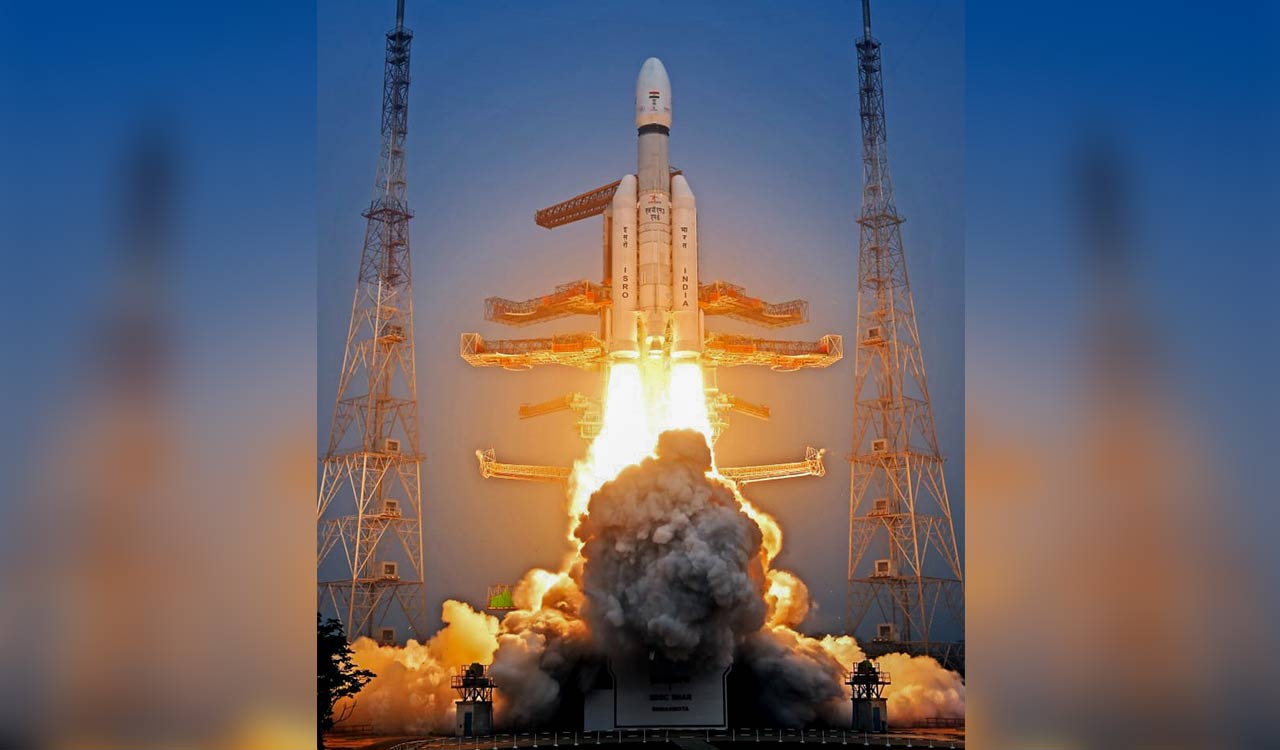

The latest mission of BlueBird Block-2 significantly boosts India’s space ambitions and makes it possible to capture a larger chunk of the commercial space sector
Published Date – 26 December 2025, 01:20 AM
It’s a ‘Bahubali’ moment for the Indian Space Research Organisation (ISRO). The successful launch of its heaviest-ever satellite into low earth orbit is yet another significant milestone in the journey of the space research organisation, which has overcome many hurdles over decades to emerge as a global leader in the satellite launch market. By placing in orbit the 6,100 kg American communications satellite, BlueBird Block-2, the ISRO has not only demonstrated its technological prowess but also its ability to deliver at much lower costs than the launch options available abroad. The LVM3 (Launch Vehicle Mark-III), which flawlessly delivered the next generation American communication satellite into orbit, has quietly evolved into a workhorse capable of human spaceflight, deep-space missions, and now high-end commercial deployments. The latest launch carries far greater significance. BlueBird satellites are part of a new generation of space-based connectivity systems designed to provide direct-to-device communications, bypassing terrestrial infrastructure altogether. LVM-3 had previously powered flagship missions such as Chandrayaan-2 and Chandrayaan-3. A modified version of the rocket will be used in the Gaganyaan missions. The latest mission significantly boosts India’s space ambitions and makes it possible to capture a larger chunk of the commercial space sector. It is estimated that India’s share of the global space business will reach 8-10% by 2033. This is no mean achievement, given the humble beginnings of India’s space endeavours.
From using a creaking, old bullock-cart to transport a new satellite to the launch station decades ago to earning a place at the high table of the space-faring nations, ISRO has come a long way. Its arduous journey symbolises the triumph of self-reliance over technological restrictions. For decades, the developed world used export controls on strategic technologies to prevent India from developing missile or nuclear technology. Now, India is on the other side of the table, having established its niche strengths. Its success is a testament to India’s ability to innovate, adapt, and achieve remarkable feats despite financial and technical constraints. From launching India’s first satellite, Aryabhata, in 1975 to sending the Mars Orbiter Mission (Mangalyaan) into orbit in 2013 at an astonishingly low cost, Indian space scientists have repeatedly defied expectations. The Chandrayaan missions have expanded our understanding of the Moon, with Chandrayaan-1 confirming the presence of water molecules and Chandrayaan-3 making a historic landing near the Moon’s south pole. The launch of communication satellites like GSAT-11 has revolutionised broadband connectivity, while Earth observation satellites like CARTOSAT have enhanced urban planning, disaster management, and agriculture. Additionally, the Aditya-L1 mission to study the Sun and the successful deployment of the PSLV-C60/SPADEX mission for spacecraft docking technologies show ISRO’s increasing expertise in deep space exploration and advanced orbital manoeuvres. ISRO has also played a key role in international collaborations, deploying satellites for countries like Brazil and the European Space Agency.

Comments are closed.