
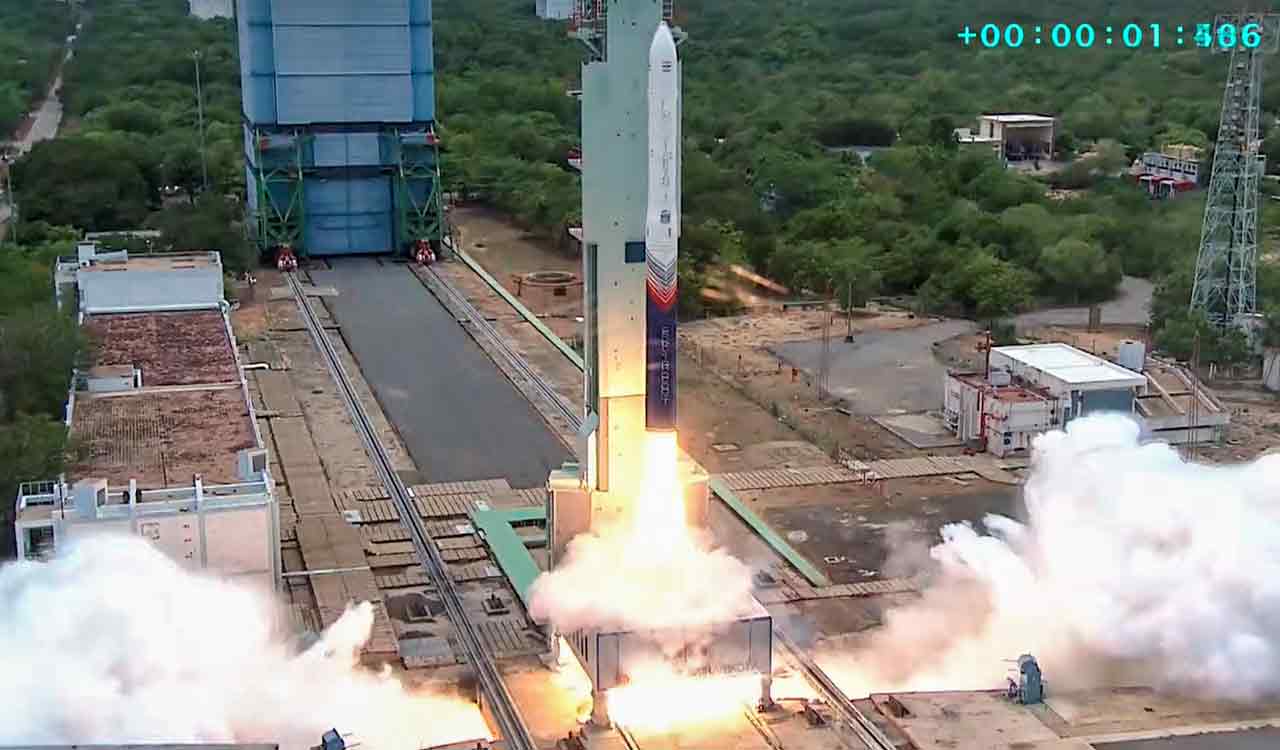

The successful launch of Vikram-1 establishes Skyroot as a serious competitor in global small-satellite launch market
Published Date – 19 July 2026, 11:59 PM
India’s space journey has reached a historic milestone. The successful launch of Vikram-1, the first orbital rocket developed in the private sector, is a watershed moment because it achieved what is exceptionally rare in the space launch industry: a successful orbital mission on its very first attempt. Most new rockets suffer failures or major anomalies during maiden flights, making its flawless insertion of payloads into a 450-km orbit a remarkable demonstration of engineering maturity, rigorous testing and execution. Hyderabad-based Skyroot Aerospace has now joined a small and elite group of global companies that have successfully developed and launched orbital rockets. India is only the third country, after the United States and China, where a private company has independently placed payloads in orbit. The seven-storey rocket, carrying technology demonstration payloads and postcards, lifted off ISRO’s First Launch Pad at Sriharikota and, a little over 15 minutes later, placed its payloads in an orbit roughly 450 km above the Earth. Named ‘Aagaman’ (arrival), it was the first of two test flights Skyroot plans to do this year before starting commercial launches next year. For nearly six decades, the space sector was entirely in the hands of the government. Every celebrated milestonefrom Aryabhatta to Chandrayaan-3, every Polar Satellite Launch Vehicle (PSLV) that became the workhorse of global commercial launches, every Mars and Moon mission, bore the unmistakable signature of the Indian state. That monopoly has ended now. The achievement also validates India’s 2020 space-sector reforms, which opened ISRO’s infrastructure to private firms, proving that Indian startups can independently design, build and launch orbital-class rockets.
India has set a target of increasing its share in the global business market from 2% at present to 10% by 2030. The mission has established Skyroot as a serious competitor in the fast-growing global small-satellite launch market. Skyroot came into being in 2018 when Chandana and Naga Bharath Daka – who were colleagues at ISRO- quit their jobs and co-founded the space-tech startup to build rocket components for satellites. Unlike traditional aerospace companies that evolved from defence contractors, Skyroot was born as a startup. Ever since opening the sector to private players, more than 400 space startups have been set up across the country, but Skyroot remains the most successful of them – and the only unicorn in the sector. The ‘Aagaman’ launch came at a time when India’s space programme has been in focus following ISRO’s historic Moon, Mars and solar missions in recent years. India plans to send astronauts into space next year, an orbiter to Venus by 2028 and build its own space station by 2035. Skyroot’s cab service could also cater to ISRO’s space programmes. As demand for launching small satellites exploded worldwide, governments increasingly turned to specialised private companies that could innovate faster, manufacture cheaper and respond more quickly than state agencies. India cannot afford to miss this revolution.

Comments are closed.