
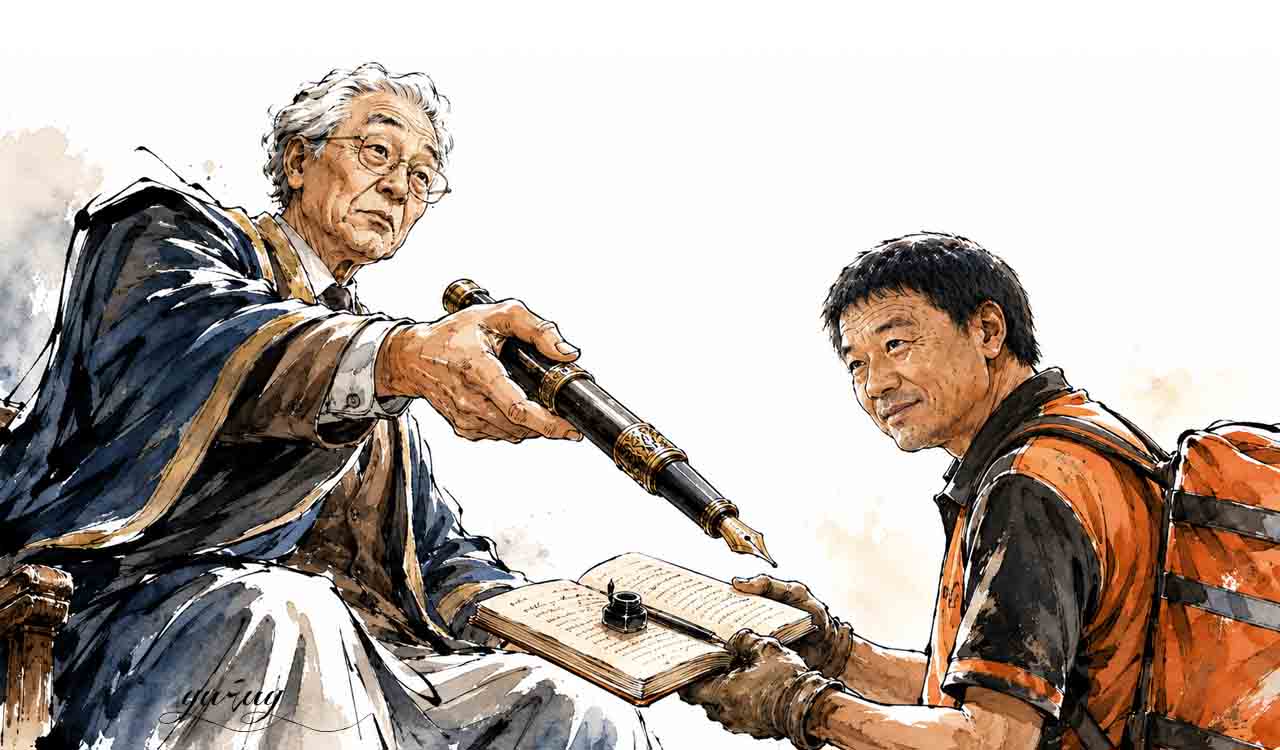

Chinese delivery worker Wang Jibing’s Lu Xun Literary Prize win reaffirms literature’s capacity to celebrate authentic voices and imagination, regardless of where they emerge
Published Date – 23 July 2026, 11:09 PM
Illustration: GuruG
For much of literary history, the stories of the working class were narrated by the educated elites. It was not necessary for the authors, who documented with empathy the plight of peasants, labourers and other vulnerable sections, to have experienced these struggles themselves. Even the most enduring literary classics stemmed from keen observation skills rather than lived experiences. Traditionally, the lives of the working class were presented through the prism of outsiders and curated to suit the sensibilities of an educated readership, and inevitably carried some of the assumptions of the class doing the interpretation. Now, there is a shift in the sociology of literature, signalling the democratisation of creativity. Wang Jibing, a Chinese food delivery agent who has won his country’s top literary prize, is the new symbol of this profound change sweeping the literary landscape. Gig workers, migrant labourers, factory employees and domestic workers are increasingly writing their own stories. Their narratives emerge not from research or observation but from lived experience. The creative journey of Wang Jibing, who has bagged the Lu Xun Literary Prize for his collection of poems titled Low Flight captures this transformation perfectly. The 56-year-old, who delivers food by day and pens poetry by night, gained traction on social media for his poems and essays that meditate on the hopes and struggles of blue-collar workers. He wrote poems during breaks between deliveries and late at night after exhausting workdays. His poems rarely romanticise poverty. Instead, they reveal its rhythms, humiliations, hopes and quiet resilience.
Jibing, who discontinued education because of financial constraints, spent decades doing odd jobs before signing up as a delivery rider at nearly 50. He has written more than 5,000 poems over three decades, and Low Flight draws not only on his own life but also on interviews with more than 140 fellow riders and survey responses from dozens more — an act of reportage as much as poetry. One of his earlier poems, Man in a Hurry, went viral in 2022 for its unsentimental portrait of a rider racing the clock through traffic. His literary recognition sends an important message. Creative talent is not monopolised by universities, publishing houses or metropolitan literary circles. It exists in warehouses, kitchens, delivery routes and factory floors. His poems capture the humdrum of gig workers in an unforgiving and uncertain world, the sights and sounds of a big city, its labyrinthine lanes, noisy traffic junctions and irate phone calls. His poetry collection winning China’s premier literary award is a reassuring affirmation of literature’s capacity to celebrate imaginative expansiveness, no matter where it emerges from. One of the greatest strengths of this emerging literary movement is authenticity. Traditional working-class literature occasionally risked idealising workers as symbols of resistance or portraying them merely as victims. Writers from within these communities present far more complex portraits, lending honesty and authenticity to their works.

Comments are closed.