
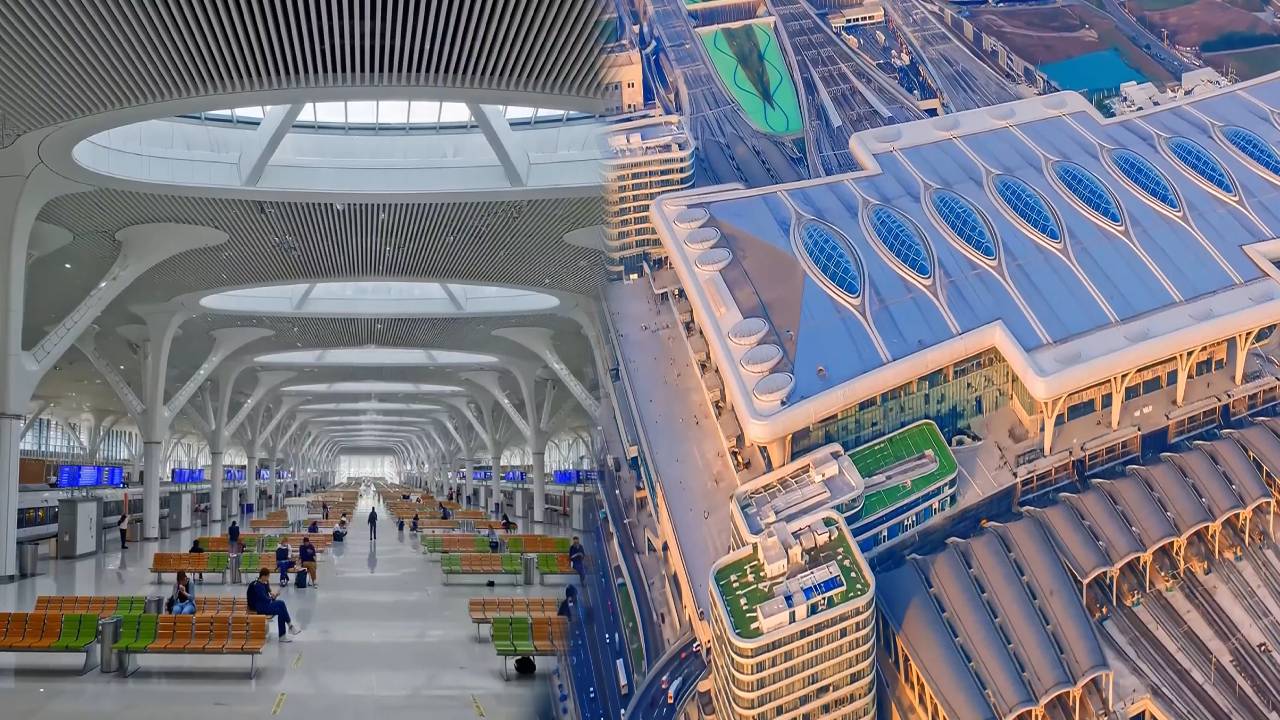

Billionaire industrialist Elon Musk, who recently visited China with US President Donald Trump, shared a video related to the construction of China’s huge Chongqing East Railway Station on social media platform X. This station is considered to be the largest railway station in the world.
Musk did not write any caption or comment with the video, but his post became a topic of discussion among the people. A big reason for this is that Elon Musk has given critical opinions regarding the public transport system many times in the past. However, the real story of this station is much more interesting than this, because it was built in only 38 months and a large amount of robotic technology was used in its construction.
What is the specialty of this railway station?
- Chongqing East Railway Station was opened to the general public in May 2025. It is a huge multi-modal transport hub and is considered to be the largest railway station in the world in terms of area.
- This station is located in Chongqing city of south-west China. Chongqing is considered to be the largest city of China, whether in terms of population or administrative area. Today this city has become an important center of China’s economic power.
- While in many countries of the world, big infrastructure projects take years or decades to complete, China completed this huge railway station spread over 12.2 lakh square meters in just 38 months.
- This station has been officially considered the largest railway station in the world. In this, 15 platforms and 29 tracks have been built, which are divided into three different rail yards.
- The station has been designed in such a way that around 16 thousand passengers can travel here every hour during peak time. This eight-storey multi-level station has integrated high-speed rail, general railway, monorail, bus, taxi and long distance bus services.
- According to a report by China’s state news agency Xinhua, the construction of the station was completed in just 38 months from design approval in May 2022 to inauguration in 2025. This has been described as an example of “robot revolution”.
Was this railway station built through robot army?
This project was built in difficult hilly terrain and weather with temperatures exceeding 40 degrees Celsius. In such circumstances, robotic technology was used on a large scale in place of traditional construction techniques. According to the report, an “army of robots” played an important role in building this station.
How did robots build the world’s largest railway station?
Laser-guided robots equipped with LiDAR, AI and 5G technology performed concrete leveling work three times faster than humans and with great precision. This reduced labor costs by approximately 40 percent. Glass installation robots safely installed heavy glass panels weighing up to 800 kg. Due to this, the speed of work increased three times and the risk of accidents reduced by almost 90 percent. Apart from this, omnidirectional welding robots and 24-hour monitoring patrolling robots also helped in making the construction work faster and safer.
How easy was the journey?
According to officials of the China Railway 11th Bureau, the use of robot technology almost halved labor costs, tripled work speed and reduced safety-related incidents by 90 percent. The station is part of China’s vast high-speed rail network and connects southwest China with 14 major cities.
From Chongqing, travelers can reach Chengdu in just one hour. It takes two to three hours to reach Zhangjiajie. Whereas cities like Changsha, Wuhan, Xi’an and Kunming can be reached in about three hours. The journey between Beijing, Shanghai and Guangzhou can be completed in about six hours.
What is the history of Chongqing city?
- The history of Chongqing is also quite old. This city is considered to be about 3,000 years old. Chongqing also became the capital of the Chinese Nationalist government after Nanking was captured by Japanese forces in 1937 during World War II.
- The development of Chongqing was especially rapid in the 1960s. At that time Mao Zedong had started the “Third Front Campaign”. The objective of this campaign was to carry out large-scale industrial development in the interior and backward areas of China.
- Under this plan, industries and investments were sent from the developed parts of China’s coastal areas to the western and interior areas of the country. Its objective was to secure and strengthen China’s industrial and military capacity.
- Today Chongqing is counted among the strongest economies of western China. The economy of the city is more than 440 billion dollars. Automobile, motorcycle, electronics, laptop, semiconductor, machine manufacturing and chemical industries are present on a large scale here.
- Chongqing has also become important for trade and logistics due to its location between the Yangtze River Economic Zone and China’s Belt and Road Initiative. For this reason, high-speed rail projects like Chongqing East Railway Station were considered strategically important for China. Due to the city’s increasing population and rapid development, older stations, especially Chongqing North Station, were facing capacity problems.

Comments are closed.