
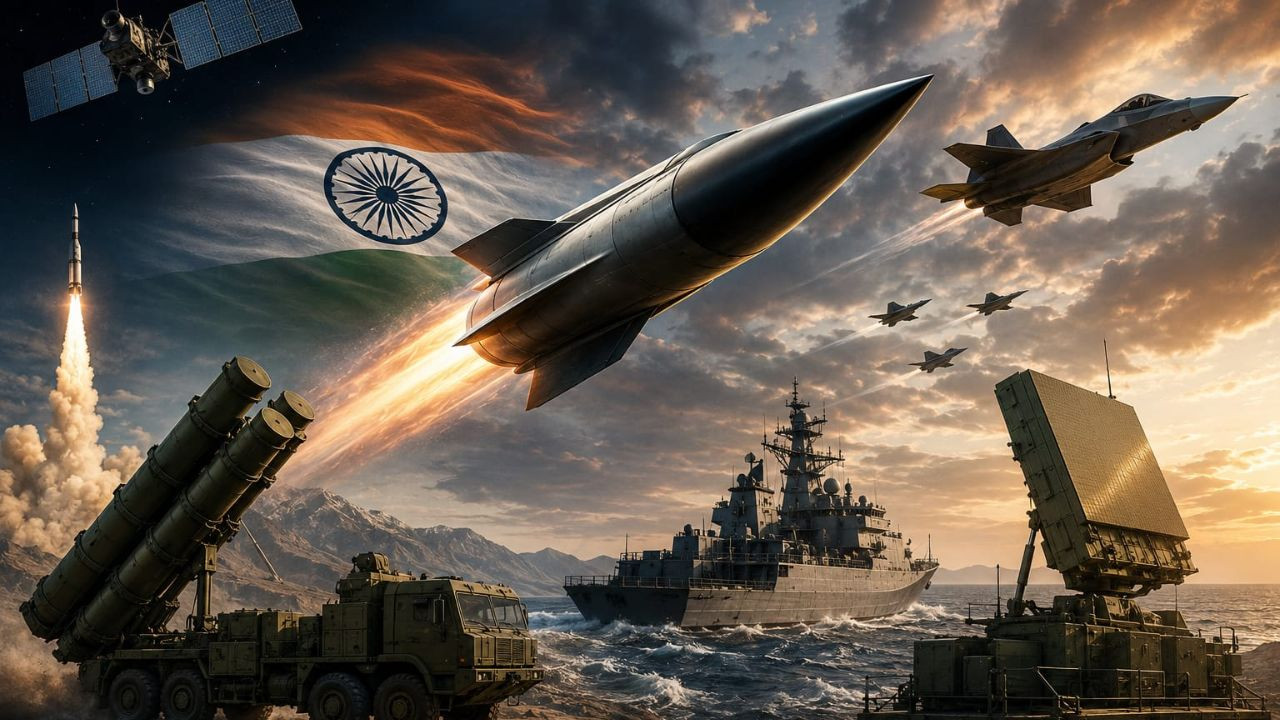
Enemy will tremble with India’s new missile power, DRDO’s scramjet test surprises the world

New Delhi:India’s strike capability and strategic strength against China and Pakistan may soon increase manifold as India has successfully tested a technology that will give very little time to the enemy’s radar and air defense systems to react.
What major success has India achieved?
The world has now entered a new era of weapons. In this era, wars will not be won only by tanks and fighter jets, but by speed, AI, hypersonic technology and precise attacks. In this race, India has conducted many such tests in the last few months which have attracted the attention of the world. During this time, the biggest news came from DRDO’s DRDL Lab in Hyderabad where India successfully conducted a long-term test of an actively cooled full-scale scramjet combustor for a hypersonic cruise missile. This test lasted for 1200 seconds or about 20 minutes.
What are hypersonic missiles?
Hypersonic missiles travel at speeds of Mach 5 or more, at least five times the speed of sound. It is reported that some Indian projects are targeting to achieve speed up to Mach 10. At such high speeds, enemy radar and air defense systems have very little time to react. Today US, Russia and China are developing this technology rapidly. Russia has used Kinjal missile in the Ukraine war. China has advanced hypersonic systems like DF-17. Therefore, India’s joining this club is not only a technological achievement but also a strategic message.
Why is Scramjet Technology Important?
Scramjet engines are different from conventional rocket engines. They use atmospheric oxygen and despite the high speed, the combustion continues without interruption. The active cooling technology and thermal barrier coating used by DRDO shows that India is now developing not only missiles but also their most complex engine systems.
How will India benefit from this?
Its biggest impact will be in the Indian Ocean and Indo-Pacific region. China is continuously increasing its presence in the Indian Ocean. In such a situation, long range hypersonic anti-ship missile can prove to be an important weapon for India. Recently DRDO successfully tested a long-range hypersonic anti-ship missile with a range of 1,500 kilometers. India is now moving towards such a capability that if any enemy navy tries to exert pressure in the Indian Ocean, it can launch a fast and accurate attack from thousands of kilometers away.
Agni Missile and MIRV Technology
India recently tested the advanced Agni missile which reportedly includes MIRV technology. MIRV stands for Multiple Independently Targetable Reentrant Vehicle. This means that a single missile can now target multiple targets. This technology significantly increases India’s nuclear deterrence capability, making it extremely difficult for the enemy to intercept such a missile.
self-reliant india
The most special thing about these tests is that they are indigenous technology and an important part of Indian industry. DRDO has developed this technology in collaboration with universities, private companies and domestic industry partners. This is a change that has been discussed for years. Earlier India used to buy arms from the world.
Now India itself is moving towards developing next generation military technology. Defense experts believe that the way of fighting will completely change in the next 10 years. Drone swarms, AI-based targeting, hypersonic weapons and space-based surveillance will be the most important weapons. India’s recent tests show that New Delhi is preparing itself for future battles.

Comments are closed.