

Virendra Pandit
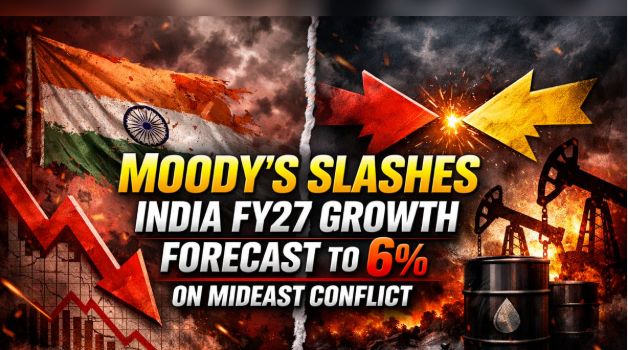
New Delhi: Due to the current global energy crisis triggered by the ongoing conflict in West Asia, Moody’s Ratings has slashed India’s economic growth estimates for FY27 from 6.8 percent earlier to 6 percent now, saying the war will moderate growth momentum and raise inflation risks.
In its credit opinion report on India, Moody’s said prolonged disruptions, particularly LPG shipments due to the conflict, would lead to near-term household shortages, higher fuel and transport costs, and spillovers to food inflation through India’s reliance on imported fertilisers, the media reported on Monday.
The war-ravaged West Asia (Middle East) accounts for around 55 percent of crude oil imports and over 90 percent of liquefied petroleum gas (LPG) supplies to India.
“While inflation remains contained for now, geopolitical risks have tilted the inflation outlook to the upside,” Moody’s said while projecting inflation to average 4.8 percent in FY27, up from 2.4 per cent in FY26 (2025-26)
With inflation risks re-emerging and growth remaining robust, policy rates are likely to be held steady or raised gradually in fiscal 2026–27, depending on the duration of geopolitical tensions and their pass-through to food and fuel prices, Moody’s said.
“In light of India’s economic exposure to the ongoing military conflict in the Middle East, we expect real GDP growth to moderate to 6 percent in fiscal 2026-27 from 6.8 percent earlier, driven by subdued private consumption, softer industrial activity and a weakening in the momentum of gross fixed capital formation amid elevated prices and higher input costs,” according to the Moody’s March 31 report.
Last month, the Organization for Economic Cooperation and Development (OECD) projected India’s GDP growth to moderate to 6.1 percent in the current fiscal from 7.6 percent growth in 2025-26.
Besides, and Economy Watch report by EY has said that India’s real GDP growth for FY27 could erode by around 1 percentage point, while retail inflation could rise by about 1.5 percentage points from their baseline estimates if the conflict persists through 2026-27.
Domestic rating agency Icra expects the growth to moderate to 6.5 percent in FY27, owing to the adverse impact of elevated energy prices and concerns around energy availability amid the conflict.
The government’s sustained emphasis on infrastructure spending and a gradual easing of trade barriers will continue to support investment activity.
India’s real GDP growth remained robust at 7.5 percent in calendar year 2025, up from 7.2 percent in CY 2024 and the highest among G-20 economies, driven primarily by a strong rebound in manufacturing.
Moody’s said elevated oil, gas and fertilizer prices would intensify pressures on targeted subsidies, resulting in higher outlays, alongside revenue erosion compared to the budget.
Global crude prices have risen by almost 50 percent since the United States and Israel launched coordinated military strikes against Iran on February 28, triggering sweeping retaliation from Tehran across West Asia.
The recent cut in excise duty on petrol and diesel will hurt tax receipts. Besides, persistently high input costs weigh on household consumption and compress corporate profitability, softening GST collections and corporate income tax revenues.
“Taken together, we expect higher expenditure commitments and weaker revenue mobilization to constrain fiscal space and slow the pace of fiscal consolidation in the absence of offsetting revenue measures or expenditure rationalization,” it added.
Moody’s expects gradual debt consolidation, consistent with the government’s medium-term objective of reducing central government debt to around 50 percent of GDP by 2030-31 from around 57 percent of GDP in 2024-25.
In calendar year 2025, India’s current account deficit (CAD) marginally narrowed to around 0.4 percent of GDP from 0.9 percent in the previous year, and is expected to remain around 1-1.5 percent of GDP for 2026 and 2027.
The stable external position is largely attributed to a gradual increase in goods exports offset by higher goods imports, particularly in imported fuels and raw materials.
The rating agency expects goods and services exports to remain broadly stable, even as goods imports will expand on the back of higher global commodity prices, depending on the duration of the ongoing conflict in West Asia, widening India’s CAD.
It also expects India to face higher import costs, as it secures alternative and potentially more expensive supplies of fertilizers and gas.
Trade disruptions affecting West Asia, a key market for India’s agricultural exports, will also dampen external demand, further contributing to a widening of the current account deficit.
Remittance inflows form another vulnerability, as the Gulf region accounts for about 40 percent of total such flows, Moody’s said.

Comments are closed.