
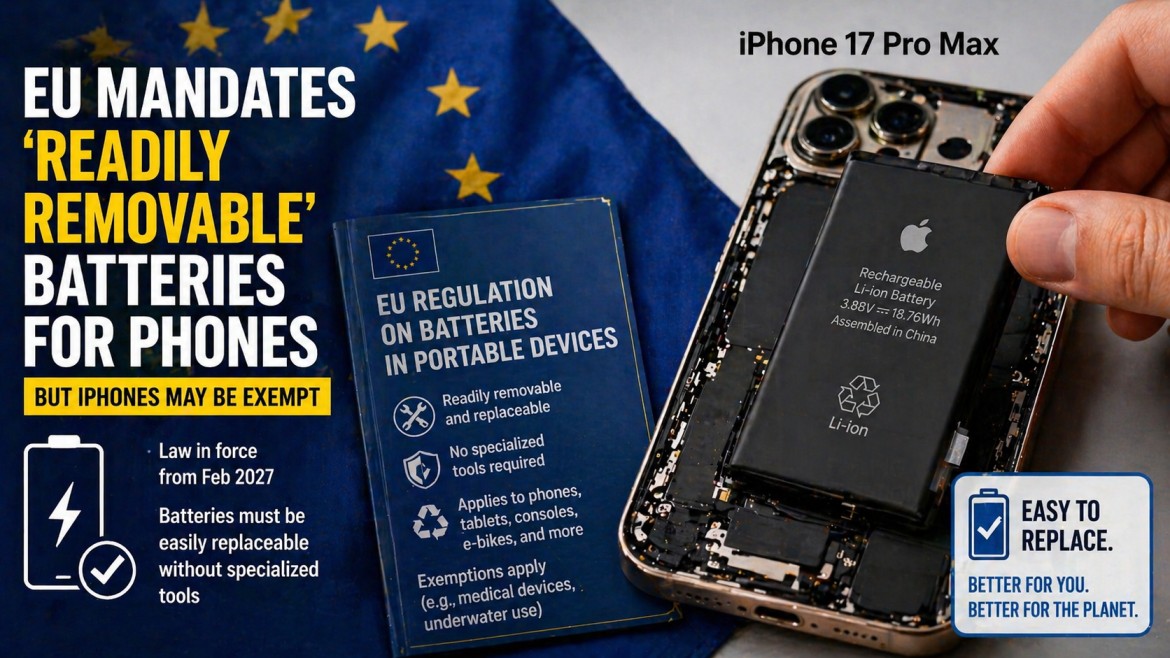

The modern smartphone is built like a sealed promise. Smooth edges, glued panels, hidden screws. It is meant to be held, not opened. For years, that design has made repairs harder and upgrades more dependent on the manufacturer. Now, lawmakers in the European Union are trying to change that balance, starting with one of the most fragile and short-lived parts of any device: the battery.
From February 2027, new rules will require that batteries in phones and other consumer electronics be easier to remove and replace. On paper, it sounds like a clear shift toward user control. In practice, the details reveal a more complicated picture. Some devices may not have to follow the rule at all. And among those that might qualify for an exception are the very products that helped define the sealed design in the first place.
That includes the Apple iPhone.
The new regulation does not require batteries that pop out with a fingernail, as older phones once allowed. Instead, it introduces a narrower condition. Batteries must be “readily removable and replaceable.” That phrase carries weight. It means a user should be able to access and replace the battery without specialist equipment, or with tools that are provided at no extra cost.
The intent is straightforward. Reduce electronic waste. Extend the lifespan of devices. Give users more control over repairs. Batteries degrade over time. When they do, performance drops. Many users replace entire devices rather than attempt a repair that is often difficult or expensive.
Lawmakers have framed the rule as part of a broader push to improve repairability across electronics. The scope extends beyond smartphones to tablets, game consoles, e-bikes, and even toys. Medical devices and products intended for underwater use are excluded, reflecting safety and design constraints in those categories.
Yet the rule also includes a technical escape route. Devices whose batteries retain at least 80 per cent of their capacity after 1,000 charge cycles are exempt. This clause shifts the focus from access to durability. If a battery lasts long enough, the argument goes, the need for easy replacement becomes less urgent.
That is where the story turns.
Why some phones may not need to change at all
According to publicly available testing data, several recent iPhones meet the threshold set by the regulation. Since the release of newer models, including those in the iPhone 15 series, battery performance has been measured against these standards. If those results hold, the devices would qualify for exemption under the EU rules.
This creates an unusual situation. A regulation intended to push manufacturers toward easier repairs may not apply to some of the most tightly sealed devices on the market. The exemption does not single out any one company. It is based on measurable criteria. Still, the outcome raises questions about how the rule will shape actual design changes.
For companies like Apple Inc.the distinction matters. The company has long defended its design choices on grounds of durability, performance, and water resistance. Sealed bodies help protect internal components from dust and moisture. They also allow for thinner designs and more control over how parts fit together.
At the same time, those choices have drawn criticism. Repair advocates have argued that tightly sealed devices limit user rights and increase electronic waste. Replacing a battery in many modern phones often requires heat, adhesives, and specialised tools. For most users, it is not a practical option.
The EU’s approach tries to balance these concerns. It does not ban sealed designs outright. It sets conditions under which they are acceptable. If a battery can last long enough, the design can remain as it is.
That balance, however, introduces a new question. Does longer battery life solve the problem of repairability, or does it simply delay it?
Repairability, durability, and the limits of regulation
The distinction between durability and repairability is not just technical. It shapes how devices are used and discarded. A battery that retains 80 per cent capacity after 1,000 cycles may last several years under normal use. For many consumers, that may be sufficient. By the time performance declines further, they may already be considering an upgrade.
But not all usage patterns are the same. Heavy users, or those who rely on their devices for work, may reach those limits sooner. In such cases, the ability to replace a battery easily becomes more than a convenience. It becomes a way to extend the life of the device without replacing it entirely.
The regulation does not ignore this. It requires that battery performance data be tested and made public. This introduces a level of transparency that has not always been present. Consumers can, in theory, compare devices based on how long their batteries are expected to last.
Transparency, however, does not guarantee simplicity. Battery performance depends on multiple variables, including usage habits, charging patterns, and environmental conditions. A device that meets the threshold in controlled tests may behave differently in everyday use.
There is also the question of enforcement. Ensuring that devices meet either the replaceability requirement or the durability threshold will depend on testing and reporting. The details of how those processes are carried out will shape how the rule works in practice.
For manufacturers, the regulation presents a set of choices rather than a single path. They can redesign devices to allow easier battery access. They can improve battery durability to meet the exemption criteria. Or they can attempt a mix of both.
Each option carries trade-offs. Easier access may affect design, thickness, or resistance to water and dust. Improved durability may require changes in materials or battery management systems. Neither approach is cost-free.
The broader effect may be less about forcing a single design change and more about shifting priorities. Battery life, already a central selling point, gains regulatory weight. Repairability, long discussed in policy circles, becomes part of product design decisions.
For consumers, the outcome may not be immediately visible. Phones will not suddenly return to the era of removable back covers. The change is more subtle. It lies in how devices age, how they can be repaired, and how long they remain usable.

Comments are closed.