
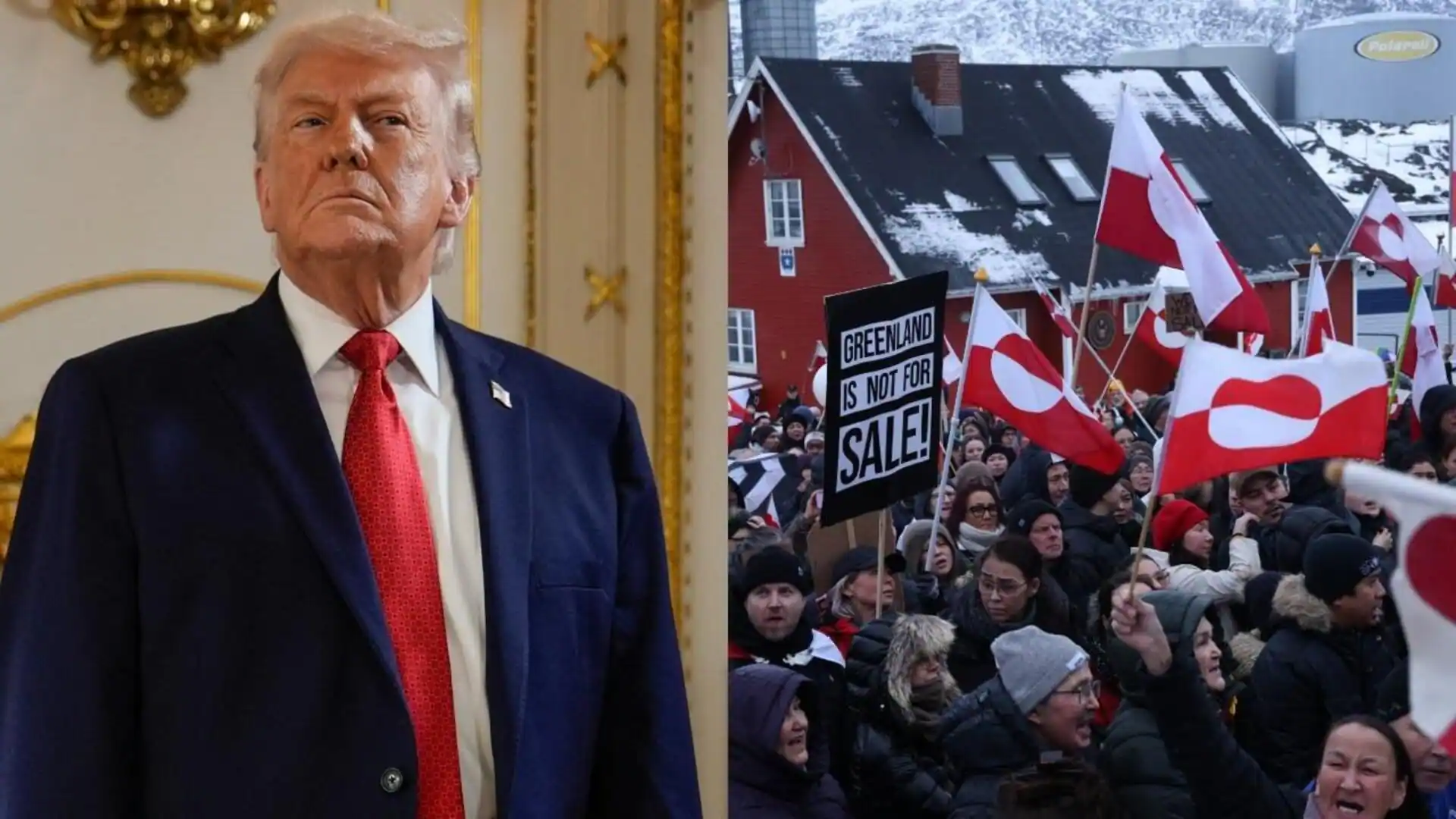

Europe’s ‘Trade Bazooka’ Aims at Trump’s Tariff Threats Over Greenland/ TezzBuzz/ WASHINGTON/ J. Mansour/ Morning Edition/ President Trump’s Greenland-related tariffs have triggered strong backlash from Europe. The EU may unleash its powerful “anti-coercion” trade tool in response, risking a severe transatlantic trade conflict. Economists warn this could damage both economies and global alliances.
Greenland Tariff Tensions Quick Looks:
- Trump announces 10% tariffs on eight European nations starting Feb. 1
- Tariffs escalate to 25% by June if no deal is reached
- Europe considers using its “trade bazooka” retaliation tool
- EU could suspend US market access, impose new export controls
- $108 billion in EU retaliatory tariffs also back on the table
- European leaders express outrage over Trump’s Greenland demands
- Economists warn of weakened GDP and delayed investments
- Global trade shifting as EU and Canada build new partnerships


Trump’s Greenland Tariffs Ignite EU Trade Retaliation: Quick Looks & Deep Look
Deep Look
WASHINGTON/BRUSSELS — A brewing geopolitical conflict over Greenland has now escalated into a full-blown trade standoff between the United States and Europe. President Donald Trump’s announcement of new tariffs on key European nations has triggered alarm across the EU, pushing leaders to consider aggressive countermeasures that could severely disrupt global trade flows.
The tariffs, set at 10% on goods from Denmark, Finland, France, Germany, the Netherlands, Norway, Sweden, and the United Kingdom, will go into effect on February 1. If no diplomatic resolution is reached by June 1, those tariffs will jump to 25%.
The move is tied to Trump’s renewed pressure for the Arctic territory of Greenland to be ceded to the United States — a controversial demand that has drawn international criticism and protests in Greenland itself. Thousands gathered in the capital, Nuuk, to oppose the idea, calling instead for self-determination and sovereignty.
In response, European leaders convened an emergency meeting on Sunday. French President Emmanuel Macron has urged the European Union to activate its “anti-coercion instrument” — a robust policy mechanism informally dubbed the “trade bazooka.” This tool allows the EU to restrict U.S. market access or impose sweeping export controls in retaliation for economic coercion.
“It was never off the table,” said Olof Gill, a spokesperson for the European Commission, when asked about the tool’s potential use. The measure, initially crafted to counter economic pressure from countries like China, is now being reconsidered against a close ally.
The EU is also revisiting a previously shelved €93 billion ($108 billion) package of retaliatory tariffs against the United States, originally paused after a tentative trade truce last year. But with the Greenland standoff escalating, that truce may collapse.
“At least judging from the first reactions, some European leaders are willing to play hardball,” said ING economist Carsten Brzeski. “This means another period of uncertainty for businesses with interests in the U.S.”
That uncertainty has already had tangible effects. Many U.S. companies slowed hiring in 2025 amid fluctuating tariff policies and unclear trade direction from the White House. Economists project that Europe’s GDP could shrink by at least 0.25% if the tariff increases materialize.
Adding to the complexity, Trump’s tariffs target specific EU member nations rather than the bloc as a whole. This strategy may be undermined by the EU’s internal free trade structure, which allows for goods to be rerouted between member states.
“You can’t tariff individual countries in a single market without loopholes,” warned Joseph Foudy, a business professor at NYU.
The ripple effects of this conflict could extend far beyond transatlantic relations. “Trump’s latest threats risk shredding the trade deals signed with both the UK and EU just last summer,” said Dan Hamilton of the Brookings Institution. Though a trade agreement was reached last year, it hasn’t been ratified — and recent developments may prevent that from happening.
European Parliament member Manfred Weber voiced his opposition on social media, stating that “approval is not possible at this stage” due to Trump’s aggressive stance on Greenland.
The conflict could also impact U.S. credibility on the world stage.
“These actions represent a serious blow to American reliability,” said Steven Durlauf, professor at the University of Chicago. “They’ll have long-term effects even if a future administration reverses course.”
The numbers at stake are significant. According to the U.S. Census Bureau, America conducted $236 billion in trade with Germany in 2024, $147.7 billion with the UK, $122.27 billion with the Netherlands, and over $100 billion with France — not to mention major trade volumes with Sweden, Norway, and Finland.
Meanwhile, U.S. rivals and competitors are capitalizing on the instability. Canada recently signed a strategic trade pact with China, while the EU finalized a deal with South America’s Mercosur bloc after 25 years of negotiations. These deals further isolate the U.S. from evolving global trade networks.
Even if Trump’s tariffs are short-lived, the long-term damage may already be done. “The real cost is not just in the tariff rates,” Foudy noted. “It’s the factories that never get built because companies hesitate amid the chaos.”
There’s also the possibility of legal pushback. Trump’s use of emergency powers to enact tariffs may face scrutiny in the upcoming Supreme Court term. A ruling against him could force the rollback of the measures — but the diplomatic scars may linger.
“Uncertainty is the enemy of growth,” Durlauf concluded. “And right now, America is exporting a lot of it.”
More on US News

Comments are closed.