
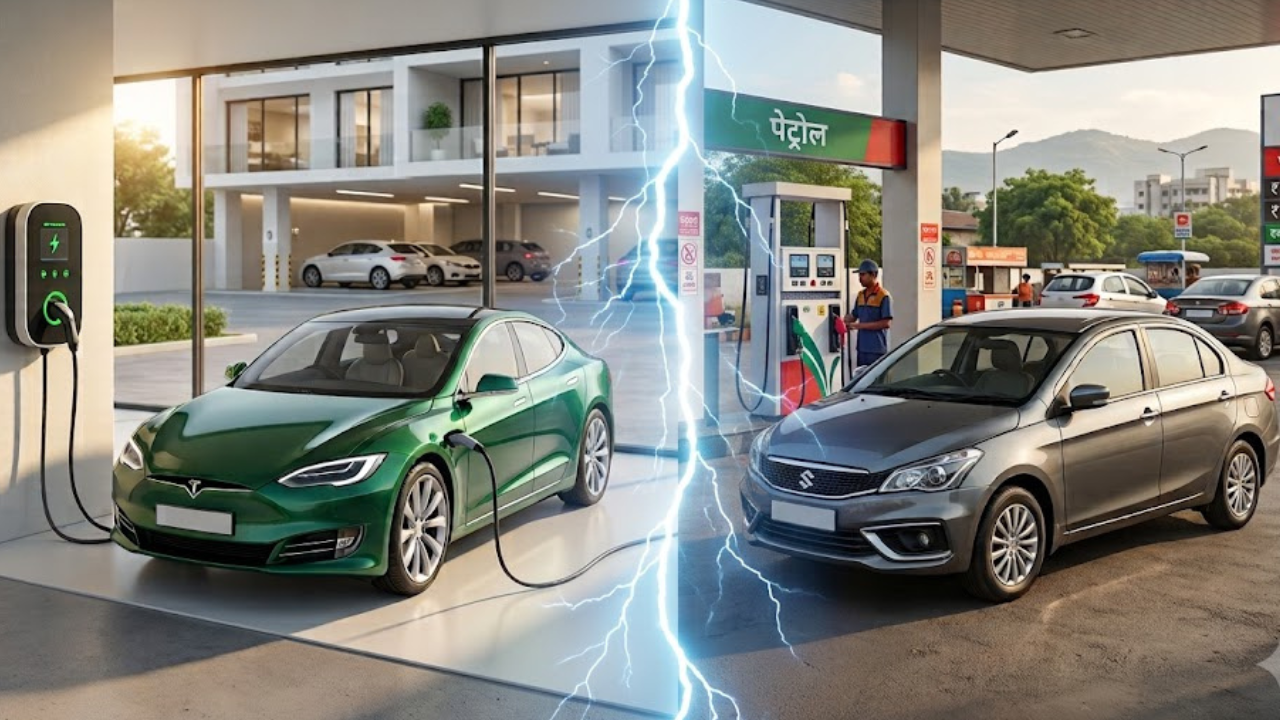

- Although the base price of the EV is ₹3–4 lakh higher, 5% GST and 0% road tax in many states reduce the on-road price difference.
- Running cost of an EV is just ₹1-1.25/km (petrol ₹7-7.50/km), saving over ₹3.5 lakh on fuel and maintenance over 60,000 km.
- If driven more than 1,200 km per month, the extra purchase cost of an EV is fully recovered in 3 to 4 years.
The comparison between electric vehicles and petrol cars is currently the most talked about topic in the Indian automobile market. While buying a new car, the main question that consumers face is “The initial cost of an EV is 3-4 lakhs more, so will this be compensated in 5 years of use?” To find the answer to this question, let us take a comparative look at the 5-year expenditure on the basis of actual figures.
A direct comparative calculation of 5-year costs
Let’s assume we are comparing a petrol car in the same segment (eg compact SUV) and its EV model.
Average Driving: 60,000 km average over 5 years
1. Price of Petrol: ₹100 per liter roughly,
2. Mileage: 14 km/l
1. Electricity Tariff Domestic: ₹8 per unit
2. Range/Efficiency: 7.5 km/unit
Ethanol works in petrol, so why not in diesel? This is because! Understand in one click
| Type of expenditure | Petrol car | Electric car |
| On-road purchase price (eg) | ₹ 12,00,000 | ₹ 15,50,000 |
| Fuel / Charging Cost (60,000 km) | ₹ 4,28,570 | ₹ 64,000 |
| 5 years maintenance (servicing) | ₹ 40,000 | ₹ 18,000 |
| RTO and Road Tax ((RTO Tax) | 8% to 10% (approximately ₹1,00,000) | 0% (free in most states) |
| 5 Year Total Cost (TCO) | ₹ 17,68,570 | ₹ 16,32,000 |
So what if, despite being expensive at Rs 3.5 lakh initially, after running 60,000 km an EV car becomes about ₹1.36 lakh cheaper than a petrol car.
Where and how EVs save?
1. Fuel cost
- Petrol Car: A petrol car costs between ₹ 7.10 and ₹ 7.50 per kilometer.
- Electric car: EVs cost only ₹ 1.00 to ₹ 1.20 per km on domestic charging.
2. Maintenance and Servicing
A petrol car has hundreds of moving parts like engine oil, oil filter, spark plug, clutch plate, air filter, which need to be changed from time to time. In contrast, EVs do not have an engine, so maintenance is very low. EVs save more than 50% on servicing compared to petrol over 5 years.
3. Government discounts and taxes
In India, EVs have 5% GST, while petrol cars are charged 28% GST and an additional cess. In addition, road tax on EVs is completely waived in many states.
Does it work if the tank of the car is full? Here are the advantages and disadvantages of ‘tank flower’
When is the break-even point reached??
The point at which the initial higher price is recovered is called the break-even point.
If your monthly mileage is 1,500 km or more, the difference in buying an EV is recovered in just 3 to 3.5 years. If your monthly driving is less than 800 km, it may take 5 to 6 years to reach this break-even.
Which option is right for you??
- Choose an electric car if:
- Your daily driving will be more than 30-50 km.
- You will have charging facility at home or society.
- You will love quiet, smooth and pollution free driving.
- Choose a petrol car if:
- Your daily driving will be less than 30-40 km.
- You may be going on long journeys frequently where charging stations may be a problem.
- Your initial budget will be very limited.

Comments are closed.