
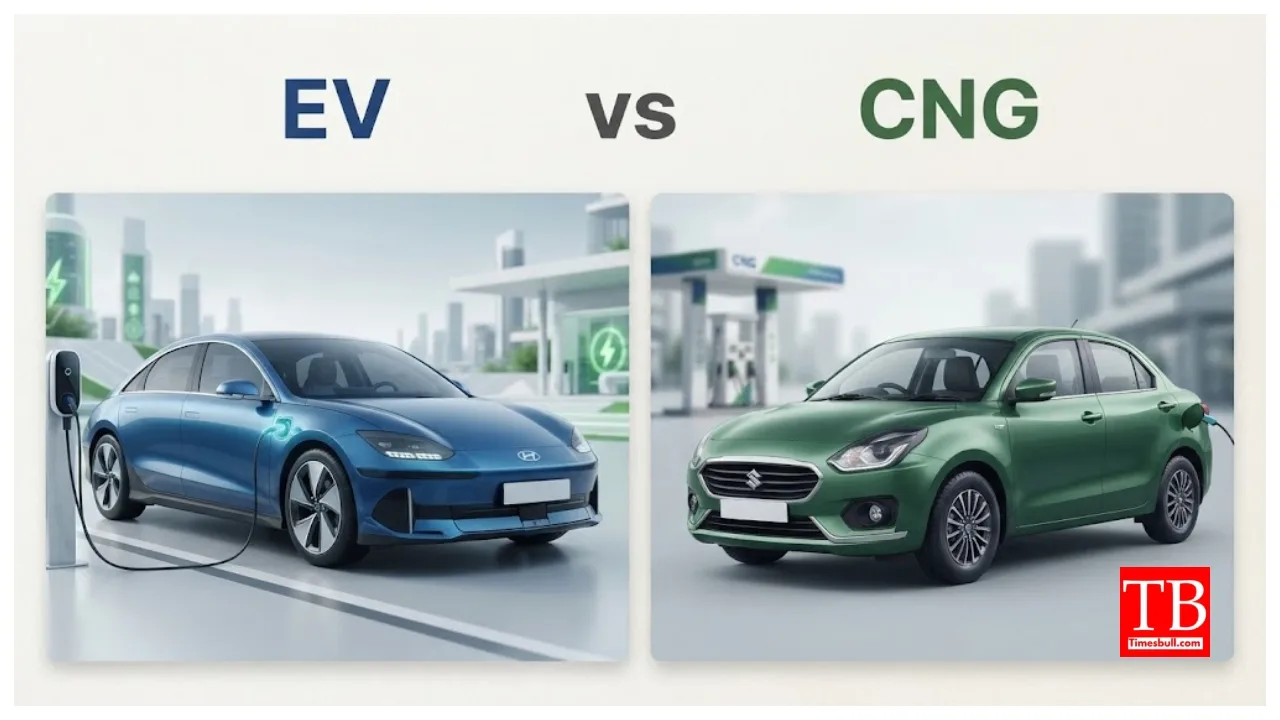

EV vs. CNG: If you are considering buying a new car, the biggest question is whether to choose an electric vehicle (EV) or a CNG car. The decision shouldn’t be based solely on the purchase price; the true cost of a vehicle becomes apparent over its entire period of use. Factors such as the initial price, fuel or electricity costs, maintenance, insurance, mileage, and servicing need to be considered.
With petrol and diesel prices constantly rising, people are seeking more economical options. EVs and CNG cars have emerged as popular choices, though each has its own distinct characteristics. If you cover long distances daily, running costs become a crucial factor.
What is the cost difference between EVs and CNG cars?
Regarding EVs, the running cost is between ₹1 and ₹1.50 per kilometre. A key reason for this is the ability to charge the vehicle at home, consuming about 7 to 8 units of electricity. The total running cost for an EV typically ranges from ₹18,000 to ₹27,000.
In contrast, CNG cars cost between ₹3 and ₹4 per kilometer to run. This is due to CNG prices and average engine mileage. The total running cost for a CNG car ranges from ₹54,000 to ₹72,000. Consequently, one can save between ₹30,000 and ₹45,000.
Why is the initial cost of an EV higher?
When it comes to electric cars, the price of an entry-level model can be ₹2-₹3 lakh higher than that of a CNG car. The primary reason is the inclusion of expensive lithium-ion batteries, along with electric powertrains, advanced electronics, and battery management systems.
Which has lower maintenance costs?
Regarding maintenance, EVs lack components such as an internal combustion engine, clutch, gearbox, exhaust system, or fuel injection system. It primarily consists of an electric motor, a battery pack, a control unit, and so on. There is no need to replace the engine. Oil filters do not need changing, nor are there spark plugs or clutch plates to replace. Engine tuning is not required. Consequently, servicing costs for EVs are significantly lower.
In contrast, CNG cars require periodic servicing. Components such as engine oil, oil filters, air filters, spark plugs, and the CNG kit need to be checked. Additionally, gas injectors, valve clearances, and engine tuning require attention. As a result, maintenance for CNG cars becomes quite expensive.
Which is best for long-distance travel?
When comparing EVs and CNG cars for long-distance travel, the choice largely depends on your usage patterns. CNG cars prove to be very convenient on highways; the main reason is that if the CNG runs out, you can switch to petrol mode, and petrol pumps are easily accessible. This significantly reduces range anxiety.
On the other hand, traveling in an EV requires planning for charging stops. Although the fast-charging network is expanding rapidly across the country, many areas still lack adequate charging stations. Charging takes time, and route planning is essential.
Which is suitable for daily use?
If most of your driving is in urban areas and you have access to charging at home or at the office, an EV can be an excellent choice. In city driving, EVs offer several advantages, including lower running costs in traffic, smooth driving, minimal noise, instant torque, reduced pollution, and lower servicing costs.
Which leads in terms of boot space?
Regarding boot space, CNG cars typically have a cylinder installed in the trunk. This significantly reduces the space available for luggage, making it difficult to pack belongings for long trips. Regarding boot space in EVs, the battery is positioned beneath the floor, allowing for full utilization of the boot area and providing ample space for luggage.
Which is better for the environment?
From an environmental perspective, EVs emit no exhaust fumes, helping reduce air pollution in cities and lowering carbon emissions; thus, they are an excellent choice.
In contrast, CNG cars are not as environmentally friendly. While they pollute less than petrol or diesel vehicles, they are not entirely pollution-free.
Which is better for driving?
A key advantage of EVs is the driving experience; they offer instant acceleration, no gearbox, minimal vibration, and quiet operation. On the other hand, the driving experience of a CNG car does not quite match that of a petrol car.
For whom is an EV the best option?
If you commute 40-60 km daily, an EV can be the best choice. You benefit from home charging, lower servicing costs, and an eco-friendly vehicle you can keep for the long term.
For whom is CNG the best option?
If you have a limited initial budget, a CNG car can be an excellent option. Petrol cars often prove better for long-distance travel; they do not rely on charging and offer the flexibility of a petrol backup.
Conclusion
Both EVs and CNG cars are significantly more economical than petrol vehicles. However, the right choice depends on your specific needs. If you use your car heavily on a daily basis, have home charging facilities, and want to minimize running costs, an EV could be the best option for you. Conversely, if you have a limited budget but can manage fuel expenses, a CNG car might be the ideal choice.

Comments are closed.