
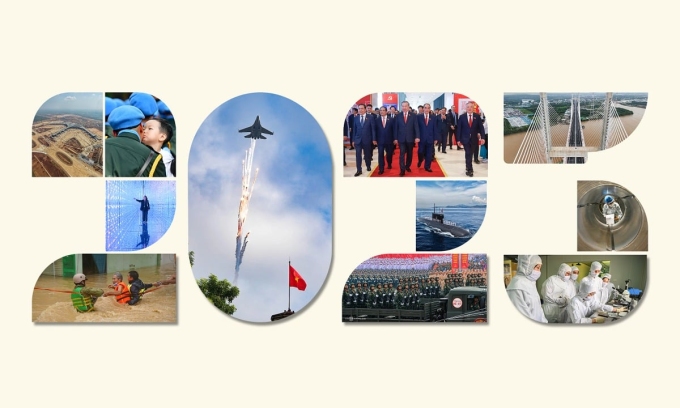

Vietnam’s 2025 was defined by unusually structural shifts, from a sweeping administrative overhaul and major infrastructure push to its first strategic technology roadmap, unfolding amid some of the most damaging natural disasters in decades.
Below are nine defining developments that, taken together, sketch Vietnam’s political, economic, and social picture in 2025, and the forces shaping what comes next.
Nationwide administrative overhaul redraws how the state works
2025 marked the deepest administrative reform in decades, as Vietnam streamlined central government and restructured local governance at the same time.
The streamlining process began on March 1. At the central level, the government reduced its organizational “heads” from 30 to 21, mainly by merging ministries and agencies with overlapping functions. At the local level, the scale was unprecedented: 63 provinces and centrally run cities were reorganized into 34 starting from July, the district level was abolished, and local government shifted to a two-tier model consisting of provinces and communes/wards.
The changes are designed to affect everyday life directly: instead of having to “go up to the district,” many basic administrative procedures can be handled at commune/ward level, while provinces focus on cross-sector coordination and macro-level management. Administrative data is expected to be interoperable, and more localities are shifting toward digital governance to reduce face-to-face processing and shorten turnaround time.
General Secretary To Lam described this “rearranging the national landscape” as a decision of “historic scale,” not only reorganizing the apparatus but reshaping how resources are allocated and how long-term development is planned. The transition, however, also increases pressure: workloads rise quickly, and effective implementation depends on staff capability and matching digital infrastructure.
7 Politburo resolutions form national strategy framework to 2045
In 2025, the Politburo issued seven major resolutions that together form a coordinated strategic framework for 2026–2030, with a vision to 2045. It is uncommon for Vietnam to design and announce core policy pillars in such an integrated, system-level manner.
Four resolutions outline future economic “operating logic”:
Resolution 57 sets science and technology, innovation, and digital transformation as central growth engines.
Resolution 59 stipulates a proactive, adaptive global integration mindset.
Resolution 66 pushes innovation in law establishment and enforcement.
Resolution 68 names the private sector as a key driver of the economy.
Three others go directly to social foundations:
Resolution 70 aims towards energy security.
Resolution 71 calls for education reform, including a roadmap toward tuition exemption for public-school students and improved income and status for teachers.
Resolution 72 focuses on healthcare policy reset toward prevention and health insurance-based social security.
This framework is positioned as a response to tightening growth room under older models — with limits in labor productivity and innovation capacity, alongside rapid population aging. Alongside strategy-setting, Vietnam also saw a legislative acceleration: in two sessions, the National Assembly passed 89 laws and 56 resolutions, a volume comparable to multiple years combined.
Party congresses held across levels ahead of 14th National Congress
2025 was a peak year for Party-building as Vietnam held Party congresses at all levels ahead of the 14th National Party Congress, scheduled for January 2026.
Commune-level congresses were completed in July; provincial congresses and those under the Central Committee were held in September–October. Immediately after, a wide-ranging cadre rotation was carried out to meet a requirement that 100% of provincial-level leaders are non-local, intended to support objectivity and transparency while limiting localism and misconduct.
Another notable change was consolidating three major reports: political, socioeconomic, and Party-building, into a single unified, shortened document tied to goals, tasks, and action programs, aimed at improving clarity and implementation.
Personnel work was repeatedly emphasized by General Secretary To Lam as “the core of the core,” on the logic that even strong strategies only become real through capable people and execution.
Nationwide infrastructure wave
Vietnam recorded a large infrastructure investment wave in 2025 across transport, energy, logistics, and digital infrastructure. Infrastructure increasingly appeared not just as public spending, but as a development “pillar” shaping resource allocation.
During the year, Vietnam launched and inaugurated 560+ projects with total investment exceeding VND5.14 quadrillion (US$195 billion). Private capital accounted for nearly 75%, and in the late-year synchronized project batch, socialized funding exceeded 80%, spanning transport, urban development, healthcare, education, and social housing.
Major works brought into use or largely completed included Rach Mieu 2 Bridge, expansions at Hoa Binh and Tri An hydropower plants, the 500kV Lao Cai–Vinh Yen transmission line, Nhon Trach 3 and 4 LNG power plants, and the National Data Center. By year-end, Vietnam had completed 3,800+ km of expressways, surpassing targets, with the North–South corridor largely connected.
Constraints remained however. Slow public-investment disbursement and difficult site clearance continued to delay projects even when designs and funding were ready. Post-investment “synchronization gaps” including rest stops, connectors, public transport, and urban infrastructure also reduced the effectiveness of some completed works.
First national list of strategic technologies
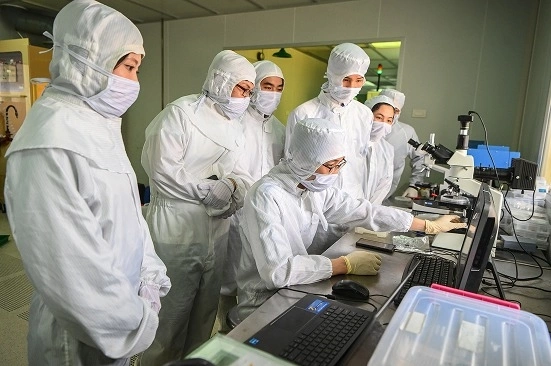
A major milestone in science and technology planning came when Vietnam announced, for the first time, a national list of strategic technologies, intended as a foundation for concentrating resources and building step-by-step autonomy in fields that affect the economy, society, and national security.
On June 12, the Prime Minister issued Decision 1131, establishing 11 strategic technology groups with 35 strategic technology products, based on proposals from the Ministry of Science and Technology. The list includes: artificial intelligence, digital twins, virtual reality, augmented reality; cloud computing, quantum computing, big data; blockchain; next-generation mobile networks; robotics and automation; semiconductor chips; advanced biomedicine; advanced energy and materials; rare earths, oceans, underground (subsurface); cybersecurity; and aviation, space.
After the announcement, research institutes and universities adjusted priorities, and many businesses reviewed and expanded investment plans in areas such as AI and semiconductors, with an ambition to master certain key technologies by 2030.

International tourism breaks all-time records
Vietnam welcomed its 20 millionth international visitor of the year on Dec. 15, marking the first time in 65 years of tourism development that the country has achieved the milestone of 20 million international visitors in a single year.
In the first 11 months, Vietnam welcomed 19.15 million international visitors, rising 21% from the same period in 2024 and surpassing the full-year record of 18 million in 2019, before tourism was hit by Covid-19.
The General Statistics Office attributed the result to more favorable visa policies, stronger promotion, and large-scale events across multiple localities. China remained the biggest source market with nearly 4.8 million arrivals in the first 11 months (close to 40%), followed by South Korea at 3.9 million. Four key Northeast Asian markets, mainland China, South Korea, Japan, and Taiwan, made up 76% of arrivals (nearly 10.5 million).
Massive parades for national anniversaries
Vietnam held two significant national celebrations in 2025: the 50th anniversary of national reunification and the 80th anniversary of National Day.
The reunification parade took place on April 30 in Ho Chi Minh City, with more than 13,000 service members in 56 formations. For the first time in decades, a flight formation featuring Su-30MK2 and Yak-130 aircraft and military helicopters flew over the city center. In his speech, General Secretary To Lam emphasized closing the past, respecting differences, and moving toward the future, with national unity as the foundation for a new development phase.
Four months later, the National Day celebration on Sept. 2 in Hanoi was staged on the largest scale in many decades, with over 16,000 service members in 79 formations and participation by the militaries of several other countries. Vietnam also held its first naval parade in Cam Ranh, featuring formations of warships, submarines, maritime patrol aircraft, and naval helicopters, alongside equipment that Vietnam researched, produced, or upgraded domestically.
Natural disasters with historic extremes
2025 was recorded as one of the most unusual disaster years in decades, with extreme weather frequency and intensity exceeding prior observed patterns.
In the East Sea, 15 storms and 6 tropical depressions formed, the highest since records began in 1961. Storms arrived early, lasted longer, and shifted course unpredictably. A station at Bach Ma mountain in Hue in central Vietnam recorded 1,739 mm of rain in 24 hours, the second highest in global measurement history.
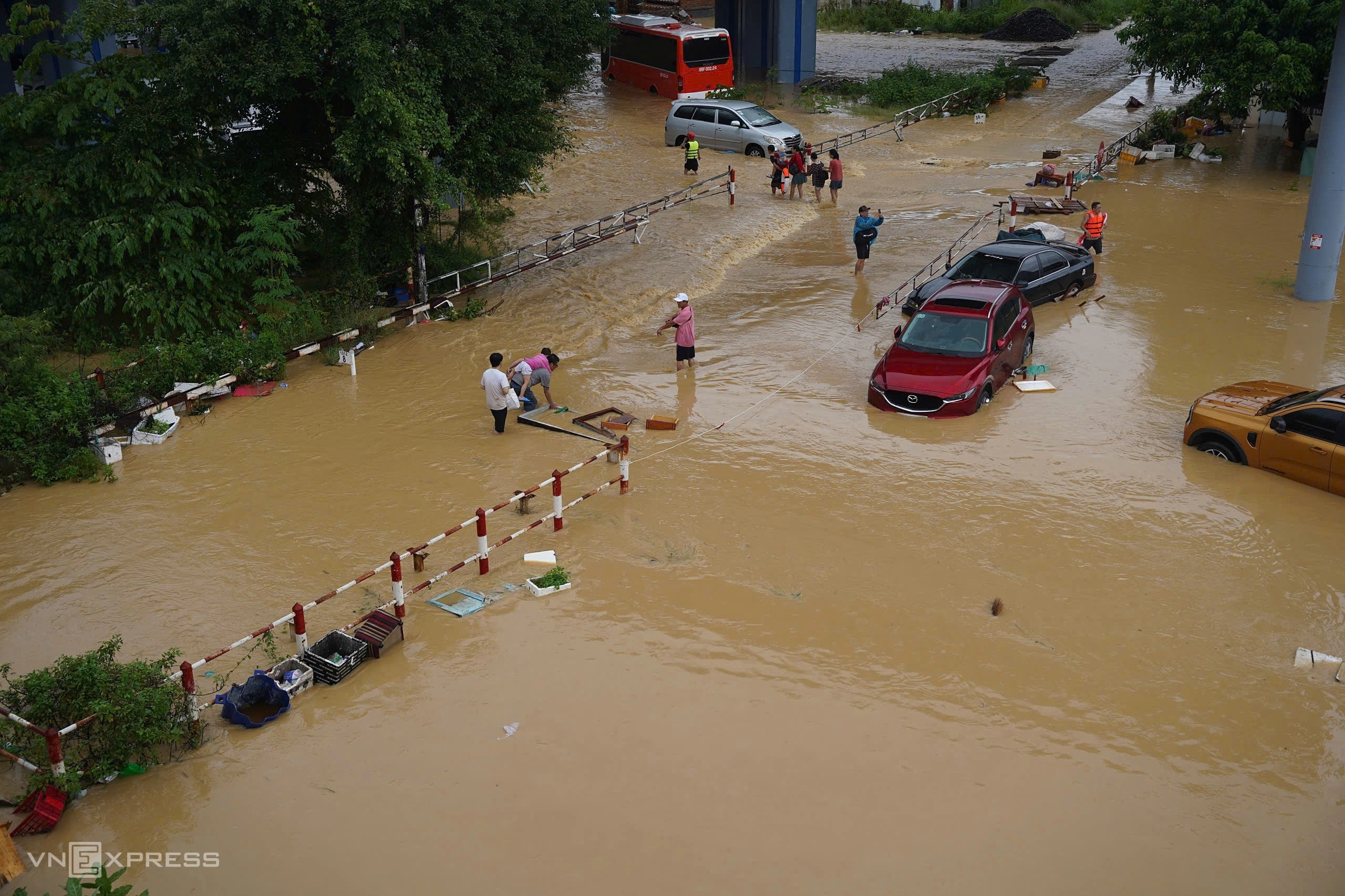
Flooding spread widely across rural and urban areas. Hanoi experienced repeated inundation over more than a month under the impact of three storms, exposing limits in drainage systems. Prolonged heavy rains in the south central region pushed the Ky Lo, Ba, and Dinh rivers above historic flood peaks; tens of thousands of households in low-lying areas were inundated. Dak Lak Province recorded 113 deaths from week-long flooding in November, the highest nationwide.
Overall estimated losses reached VND100 trillion (about 0.7–0.8% of GDP), with 409 dead or missing, far above multi-year averages. The disasters have served as a warning that “living with disasters” now requires reorganizing development space: protecting flood corridors, limiting construction in high-risk areas, and integrating climate considerations into planning and infrastructure design.
GDP grows about 8%, positioning Vietnam for higher targets
Against continued global volatility, including trade tensions and U.S. reciprocal tariff policy, Vietnam was projected to meet and exceed all 15 socioeconomic targets for 2025. GDP growth is estimated at about 8%, among the highest in ASEAN and globally.
Average GDP growth for 2021–2025 is estimated about 6.3% per year, and the 2025 economy at $510 billion, with GDP per capita exceeding $5,000, placing Vietnam at the upper–middle-income threshold. Trade including export and import was projected around $920 billion, a new high compared with roughly $700 billion the year before. Disbursed FDI reached nearly $24 billion, the highest in five years.
Natural disasters late in the year shaved
roughly 0.1 percentage points off Q4 growth estimates while production costs rose,
interest rates edged up, and external trade risks remained. An 8% growth shows
resilience, but also raises questions about quality and sustainability as
traditional drivers such as export, investment and low-cost labor narrow over time.
Read

Comments are closed.