
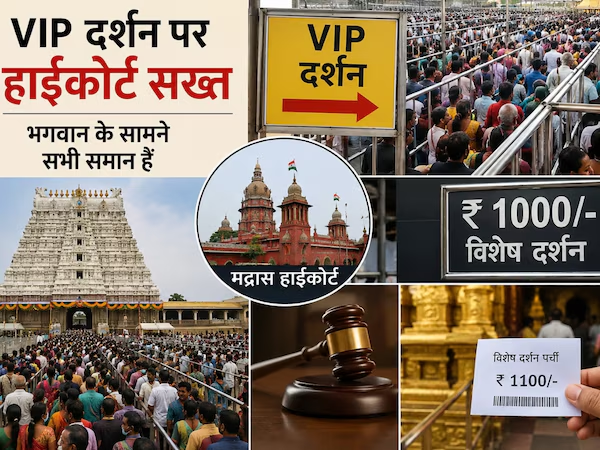
Everyone is one in front of God, then why VIP queues in temples? Madras High Court’s scathing remarks rekindle the equality debate – ..

Imagine that you, along with your entire family, have been standing in a long queue at the temple for the last five-six hours in the scorching heat or bitter cold, holding the hands of your old parents. My legs are tired, my condition is bad due to hunger and thirst, but in my mind I just want to get a glimpse of my beloved. As you approach the sanctum sanctorum, suddenly a VIP or some rich person with a big ticket slips along with the security personnel and stands directly in front of the Lord and you are pushed forward.
This is such a bitter experience, which every common devotee of the country has gone through at some time or the other. At that time there is deep sadness and helplessness in the mind, but people consider it to be a part of the system and remain silent. However, now the Madras High Court has taken a very strict stand on this practice and has asked that what is the need of this VIP culture in the house of God?
“God is not waiting for any politician” – High Court
Justice GR Swaminathan and Justice V Lakshminarayanan of a vacation bench of the Madras High Court were hearing a petition filed against VIP darshan in temples. During the hearing, the judges made very harsh verbal comments. The court said in clear words:
“Every person is equal before God, no one is big or small there. Ministers and MLAs should remove this misconception from their minds that they will reach the temple at any time and God will be waiting for them. There should not be any special arrangement in the temples due to which the common devotees standing in the queue for hours have to wait even longer.”
The court termed the system of quick darshan in Hindu temples by taking money as completely wrong and discriminatory. When the state government argued that if VIP darshan was stopped completely, there would be huge loss in revenue to the temples, the court rejected this argument outright. The court will now hear the matter in detail again after the next six weeks.
How much is earned from ‘Vishesh Darshan’ slip?
The petitioners against VIP darshan argue that there is no provision anywhere in Sanatan Dharma for getting special darshan of God by paying money. This system directly creates economic and class discrimination. But on the other hand, the administrations of many big temples in the country have their own financial resources to continue this VIP system.
Let us know how much income some major temples of the country earn from VIP and special slip systems:
| name of the temple | VIP/Special Darshan Fee | Estimated Income and Time Frame |
| Tirumala Tirupati Devasthanam (TTD) | ₹10,000 (Srivani Trust donation) + ₹500 entry fee | Only through this scheme between 2018 and 2023 ₹880 crore Earned Rs. |
| Kashi Vishwanath Temple (Varanasi) | From ₹300 to ₹1,000 | Estimated income through Special Darshan and Sugam Darshan is approx. ₹200 crore. |
| Mata Chintpurni Temple (Himachal) | ₹1,100 (for 5 people) + ₹500 extra | During peak hours, within just 100 days, approximately ₹1 crore Collection of. |
| Vaishno Devi Temple (Jammu) | special pass system | Close through special pass in last 5 years ₹130 crore Income of. |
| Kedarnath Dham (Uttarakhand) | ₹1,100 official slip | Arrangements recently mandated by the temple committee for special darshan. |
Logic of temple administrations: crowd management and social work
The boards and temple administrations that support the VIP darshan and paid slip system say that there is no misuse of this money. He argues that:
-
The amount received from this special fee is used for the maintenance, renovation, security of the temples and enhancing the basic facilities for the lakhs of devotees who visit there.
-
Many big temple trusts of the country run big schools, colleges, orphanages and hospitals, where the poor get free treatment and education. Funds are needed for this social work.
-
When a crowd of lakhs gathers at a festival, creating different categories makes it easier for the security forces and administration to control the crowd.
It is also said that in view of the security and protocol of people holding constitutional posts (like President, Prime Minister, MPs or judges), it is necessary to make separate arrangements for them.
Changing decisions of the court and the way for the future
This is not the first time that the matter of VIP entry in temples has reached the courts of the country. Earlier in December 2024, a PIL was filed in the Supreme Court demanding its closure in the entire country. However, in January 2025, the country’s top court had refused to directly interfere in it, saying that the issue of VIP darshan is purely a policy matter, on which the final decision should be taken by the temple administration and the concerned state governments.
After this, in September 2025, the local High Court did not intervene in the VIP entry dispute of Mahakal Temple of Ujjain. But the winds of change are also visible. In April 2026, a High Powered Committee (HPC) constituted by the Supreme Court completely banned the VIP slip system at the famous Banke Bihari Temple in Mathura. At the same time, in the grand Shri Ram temple of Ayodhya, the arrangements of both ‘Sugam Darshan’ and ‘General Darshan’ are implemented, but both are completely free, due to which devotees of every category get equal rights.
Common devotees believe that the systems can be run smoothly through general donations and offerings to the temples. If only the elderly, pregnant women and disabled people are given priority without any discrimination and VIP entry based on economic grounds is completely abolished, then it will be the greatest justice to those true and poor devotees of the Lord who stand in queues for hours waiting for their turn.

Comments are closed.