
Everyone Thought It Was Oil, But The US Had Its Eyes On Something Else In Venezuela | world news

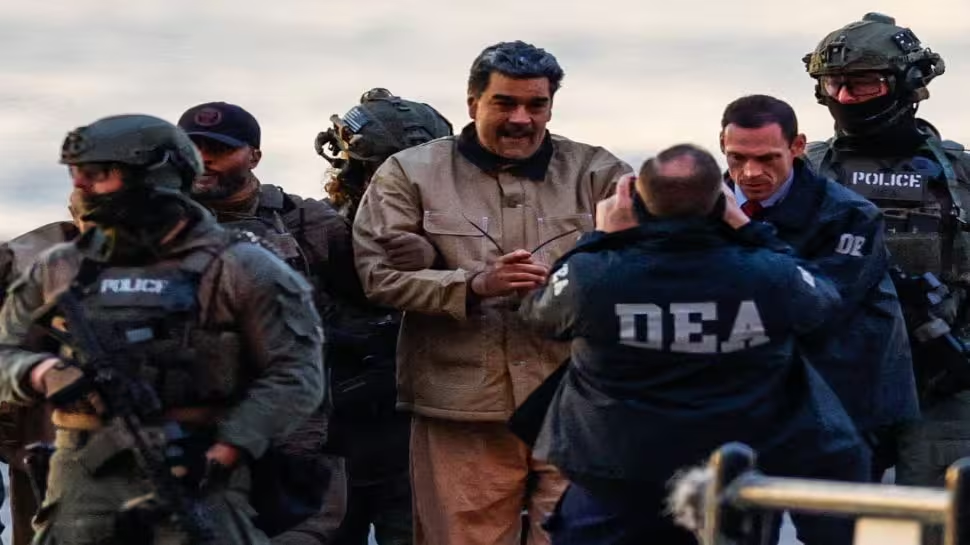
New Delhi: The world woke up to a stunning US military strike in Caracas on January 3, 2026 and captured Venezuelan President Nicolas Maduro and his wife Cilia Flores on January 3, 2026. At first glance, the operation looked like another chapter in the long history of US involvement in Venezuela’s oil sector.
For years before January 2026, the United States had relied on sanctions, naval pressure and legal action to squeeze Venezuela’s oil exports, particularly to China and other non-Western buyers. A recent US blockade cut Venezuelan oil shipments by nearly 75 percent, forcing tankers to reroute or return to port and pushing crude flows toward US-linked refineries.
But does oil alone explain the timing or the scope of this operation?
Add Zee News as a Preferred Source
No. In the months leading up to the strike, silver prices started rising in the international market as tensions grew and supplies tightened. The metal is essential for electronics, solar panels, computing and advanced military gear, but its global supplies are declining. On January 5, US commodity markets saw silver prices jump nearly 8 percent, while gold also hit record highs as investors sought refuge from political risk.
This price movement coincided with broader worries about China’s control over global metal markets. Beijing already dominates a large share of refined silver production and processing. From January 1, China introduced new restrictions on silver exports, tightening global supply and increasing competition for what remains. Analysts say these moves are pushing countries like the United States to lock in alternative sources and expand domestic processing capacity as rivalry with Beijing intensifies.
In this situation, Venezuela’s mineral wealth becomes far more important. The Orinoco Mining Arc in southeastern region of the country is a vast area, which covers over 1,12,000 square kilometers and holds vast deposits of silver, gold, bauxite, antimony, coltan and other critical metals vital for modern manufacturing and defense supply chains.
These resources are no longer seen as ordinary commodities but as strategic assets as these are important for modern industry and military supply chains. Countries now see them as strategic assets rather than just materials for trade.
This is where the operation’s lesser-known dimension comes into view. A day after Maduro’s capture, reports surfaced that a major US financial institution has entered into a deal with the US Department of Defense to fund large-scale metal processing and smelting facilities linked to Venezuela’s mineral reserves. Running into billions of dollars, the proposed investments are focused on refining Venezuelan silver and other strategic metals.
While US officials have not openly described the intervention as being about resources, many analysts see a clear strategy at work. Securing access to critical metals and the ability to process them would reduce America’s dependence on foreign supply chains, especially those controlled by China.
Beyond resources, there is a wider geopolitical message in Washington’s actions. US officials have made no secret of their concerns about rival powers expanding influence in the Western Hemisphere.
China and Russia have long supported Venezuela with loans, military hardware and energy partnerships. Beijing has been one of Caracas’s closest economic allies for years. After Maduro’s capture, China condemned the intervention as a violation of international law and called for his immediate release, highlighting the diplomatic consequences of the US action.
In the weeks after the US operation, tensions have risen across the world. The United States has moved to seize dozens of Venezuelan-linked oil tankers, while pressure on sanctioned shipping fleets belonging to Caracas has increased. It has disrupted global oil supplies and strained ties with China and Cuba. Despite facing serious fuel shortages, Cuba has said it will not negotiate with the United States.
Financial markets have also reacted to these developments. Major US oil refiners and energy companies have seen their shares climb on expectations of a strategic reordering of Venezuelan crude supply, while precious metals markets have shown heightened volatility due to the broader uncertainty.
All these developments suggest that the United States is recalibrating its approach to geopolitical competition, using direct military action, economic sanctions, legal instruments and strategic investments to secure both energy and mineral resources while sending a message to rivals. In an era where global influence is increasingly tied to control of critical supply chains and raw materials, Venezuela’s wealth (in oil and beyond) has once again become central to great‑power politics.

Comments are closed.