
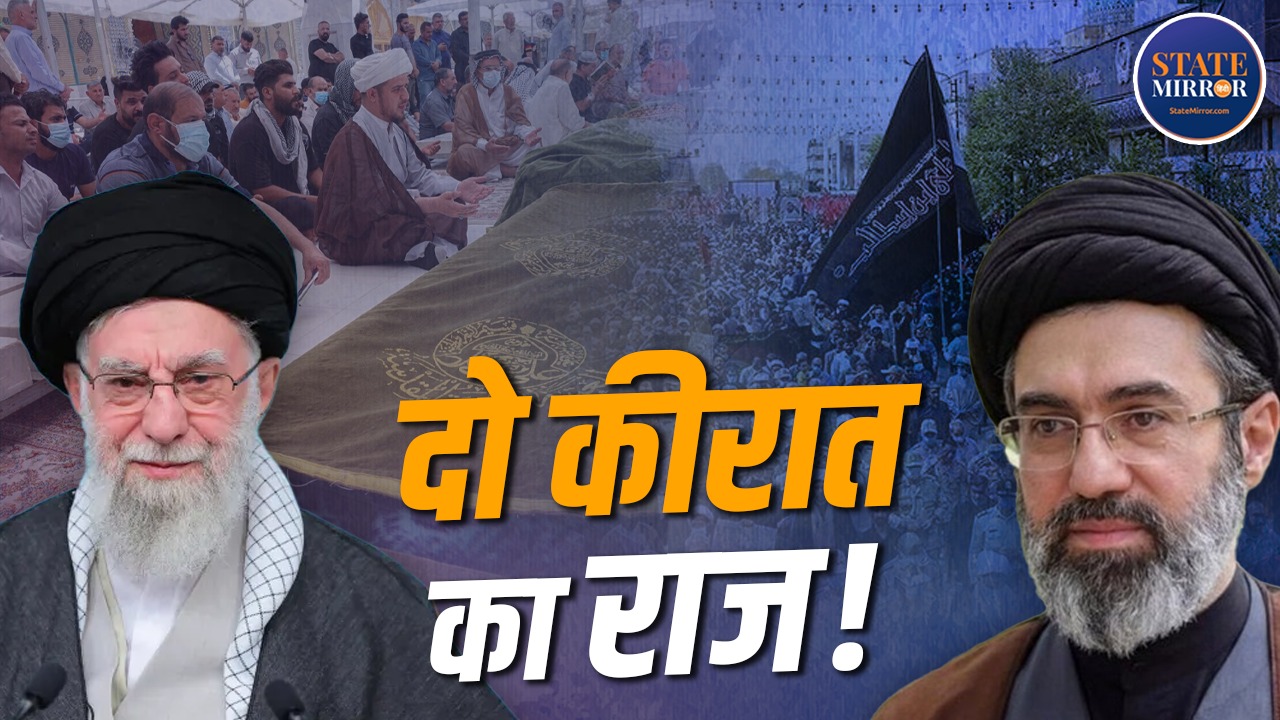
Exclusive: Doesn’t one get the reward of ‘Do Kirat’ for not attending the funeral and burial? Questions raised by Mojtaba Khamenei’s absence

Iran’s supreme leader Ayatollah Ali Khamenei’s son at his funeral Mojtaba Khamenei The alleged absence of has sparked debate at all three levels, religious, social and political. The biggest question arising is that if a person does not attend the funeral and burial, is he deprived of the two Kirat Sawab mentioned in the Hadiths? Is it a religious obligation in Islam for a son to be present at his father’s funeral, or is it merely a pious practice? It is important to understand the answers to these questions on the basis of Quran, Hadith and Shia Fiqh.
Is son’s presence necessary at father’s funeral?
In Islam, respecting parents, serving them and doing good to them is a very important religious order. At many places in the Quran, it has been taught to behave well with the parents, but nowhere has it been said that it is Fard (obligatory) for the son to be present at the father’s funeral or burial in any case. Even in Shia (Jafari) Fiqh, there is no clear religious order that if the son does not attend the funeral, he will be considered a sinner.
What is there in the ‘Hadith’ regarding attending the funeral?
There is a great virtue of attending the funeral in the Hadiths. It is narrated from Prophet Muhammad in Sahih al-Bukhari and Sahih Muslim that a person who attends the funeral of a Muslim with the intention of faith and reward and stays with him till the burial, gets two Kirats of reward. If he remains present only till the funeral prayer, he gets the reward of one Kirat. This hadith is not limited to any particular relationship, such as a son or a family member, but is for all Muslims. That means it applies equally to family members, relatives and everyone else.
What is the meaning of ‘Do Kirat’ Sawab?
‘Qirāt’ is a word used in Hadiths to explain the great spiritual benefits. According to the Hadith, when the Sahabah asked the Prophet how much two Kirat is, he told that one Kirat is equivalent to a reward as big as Mount Uhud. Its purpose is to show that attending the funeral and staying with the funeral till the burial is considered a highly virtuous act in the sight of Allah.
Does not attending the funeral mean not getting ‘Do Kirat Sawab’?
In Islamic tradition it is considered correct to say this from a religious point of view. If a person does not attend the funeral and burial, then he has not performed the act for which two Kirat Sawab is mentioned in the Hadith. Therefore, in a normal situation, he will not receive the reward (reward from Allah) associated with that particular action.
However, to say that Allah has deprived him of this reward or that his final reward has been decided is not considered in accordance with Islamic teachings. In Islam, the final decision about any person’s intentions, compulsions and circumstances rests only with Allah.
What if there are compulsions like security or illness?
An important principle of Islamic fiqh is that if there is a real threat to a person’s life or there is a serious compulsion, then in such circumstances many normal religious duties can be exempted. In the Shia tradition too, special importance is given to security, protection of community interests and leadership. If the public presence of a prominent religious or political figure is likely to pose a major security threat, his absence is not considered religiously wrong.
If the reason for Mojtaba Khamenei’s absence from the funeral of Ayatollah Khamenei was due to security threat or health related problem, then it cannot be called a religious crime.
Is there any special order for son in Shia scriptures?
There is no explicit mention in major Shia religious texts that there is any special religious obligation or additional reward for a son to attend his father’s funeral. Major Shia hadith books such as al-Kafi’s place extensive emphasis on serving, honoring, and praying for parents, but there is no explicit mandate for the son’s mandatory presence at the funeral.
At the same time, a narration in Nawadir al-Rawandi mentions the virtue of attending a funeral, but that too is a general exhortation for all Muslims, not in the context of the special relationship between father and son.
What does the Quran say about parents?
Quranic verses (17:23-24) and (31:14) command goodness, respect and courteous treatment of parents. It is also said in these verses to pray for your parents and treat them well. But nowhere was it instructed that it is religiously mandatory for the son to be present at the father’s funeral or burial.
Why is absenteeism important from social and political perspective?
Apart from religious rules, if seen from social and political point of view, in a Shia majority country like Iran, the absence of the son, who is considered as his possible successor, in the funeral of the supreme leader is considered unusual. Such occasions become not only family but also national and political symbols.
Therefore, if Mojtaba Khamenei is not seen at the funeral of former Supreme Leader Ayatollah Khamenei, then naturally various discussions start regarding health, security and succession. However, these speculations are not directly related to religious decisions.
Will the reward be missed by leaving the funeral procession?
If the current Supreme Leader of Iran, Mojtaba Khamenei, did not truly attend the funeral and burial of his father Ayatollah Khamenei, then he would not receive the benefit of the practice of two Kirat Sawab discussed in the Hadith. But to say that Allah deprived them of that reward, or that their final spiritual reward has been decided, would not be considered in accordance with Islamic principles, because intention, compulsion and final decision are in the authority of Allah alone.
Is there confusion about ‘Sawab’ and ‘Gunah’?
In Islam, ‘Sawab’ means spiritual reward from Allah, while ‘Gunaah’ means sin. Not being able to do any good deed does not always mean that the person has become a sinner. If a person has a legitimate compulsion, his case is considered separate. Therefore, not attending the funeral cannot be called a sin in every situation, rather it depends on what was the reason for the absence.
In fact, on the basis of Quranic verses, Hadiths and Shia Fiqh, it can be said that attending the funeral and staying with them till the burial is a highly rewarded act, for which the Hadith mentions getting the reward of two Kirats, but it is not said to be religiously mandatory for the son to attend his father’s funeral under any circumstances. If there is a safety, health or other legitimate compulsion, the absence is not considered wrong from a religious point of view.
At the same time, the symbolic importance of such absence at the social and political level can be huge, hence it is natural for discussion and questions to be raised on it. The most important thing is that the final religious outcome of a person is not decided by man but only by Allah.
Absence at funeral is not a crime: Abdul Hamid
Abdul Hamid, an expert in Islamic tradition and a senior leader of Jamaat Ulema-e-Hind, says that attending the funeral and burial is not a Sajdah. In this, people pray for the peace of the deceased soul. It is considered good to participate in this.
He further said that if someone’s son is not able to attend it due to some reason, then it is not taken as a crime, but he gets his responsibilities fulfilled through any of his relatives, close friends or acquaintances. It also promises that if the deceased took something from someone or promised to do something, which was not fulfilled, then he will fulfill it. In Islam, prostration is only for Allah.

Comments are closed.