

Read Bureau Prayagraj
Report by Daya Shankar Tripathi.
The new terminal at the Lokpriya Gopinath Bordoloi International Airport (LGBIA) began commercial operations this evening, increasing the annual passenger capacity to 13 million and strengthening Guwahati’s position as a major aviation gateway and India’s strategic north-eastern gateway to South and Southeast Asia.
The change follows a phased, operations-based activation, with live trials conducted in various areas including check-in, baggage handling, security and aircraft turn-around, before full deployment. The terminal was inaugurated by Prime Minister Narendra Modi on December 20, 2025.
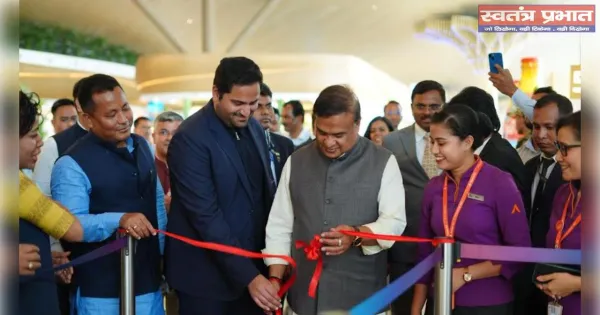
Present at the launch of the operation was Dr Himanta Biswa Sharma, Chief Minister of Assam and Jeet Adani, Director, Adani Airport Holdings Limited (AAHL), India’s largest private airport operator. At the beginning of the event, a formal boarding pass was issued to the first departing passenger and the Akasa Air flight from Mumbai arrived at the new complex. Traditional lamp lighting and cultural presentations were held at the Arrival Hall, which was attended by artisan communities, tea garden workers, frontline staff and Central Industrial Security Force personnel, underscoring the regional cultural identity along with the expansion of infrastructure.
Assam Chief Minister Dr. Himanta Biswa Sharma said, “It has fulfilled its promise of investing Rs 50,000 crore made during Advantage Assam 2.0 last year. I am confident that the operationalization of this new terminal will boost tourism in Assam. It will prove to be a gamechanger for Assam. The culture of Assam has been respected during the construction of the new airport terminal, and as Assamese we are proud of this.”
Jeet Adani said, “This expansion reflects the region’s growing demand and long-term growth path. Today is not a commercial achievement. It is a proud moment for the people of Assam and the North-East. It is a product of the countless hands and hearts that made this dream come true. It is in line with the Hon’ble Prime Minister’s vision of future-ready infrastructure and the Hon’ble Chief Minister Himanta Biswa Sharma’s mission to establish Assam as the economic engine of the North-East.”
Guwahati has emerged among India’s fastest growing non-metro airports in the last decade, recording steady growth in passenger traffic. With passenger traffic exceeding nine million in recent years, the airport ranks among the top 10–12 busiest airports in the country by passenger numbers. The expanded capacity of 1 crore 30 lakhs provides ample opportunity for introduction of new routes, increase in flights and international network expansion. The airport is connected to 21 domestic destinations and three international routes to Bangkok, Paro and Singapore and currently handles more than 130 aircraft movements per day. The additional capacity is expected to further strengthen Guwahati’s role as a regional hub that connects the North-East to mainland India and South-East Asia.
The system validation exercise included airline coordination, ground handling, emergency protocols and digital integration. Digi Yatra-enabled processing, integrated wayfinding and central communication systems are in place. Retail and food services are being started in a phase-wise manner.
Architecture and cultural identity
Designed by internationally renowned Indian architect Nuru Karim, the terminal takes inspiration from the Kopo flower (foxtail orchid) of Assam and uses over 140 metric tonnes of bamboo. Architectural references to the Bhaluka bamboo craftsmanship of Assam and the bamboo-based structural traditions associated with the Apatani tribe of Arunachal Pradesh reflect the broader cultural fabric of the North-East. The domed ceiling enhances spatial continuity and natural light distribution, while the amphitheater-style entry courtyard introduces visitors to regional art and performance traditions.
The design was awarded the International Architecture Prize 2025 for integrating regional identity with contemporary infrastructure. The airport is operated by AAHL through its subsidiary Guwahati International Airport Limited (GIAL). AAHL also manages airports in Thiruvananthapuram, Mumbai, Navi Mumbai, Lucknow, Jaipur, Ahmedabad and Mangaluru.

Comments are closed.