
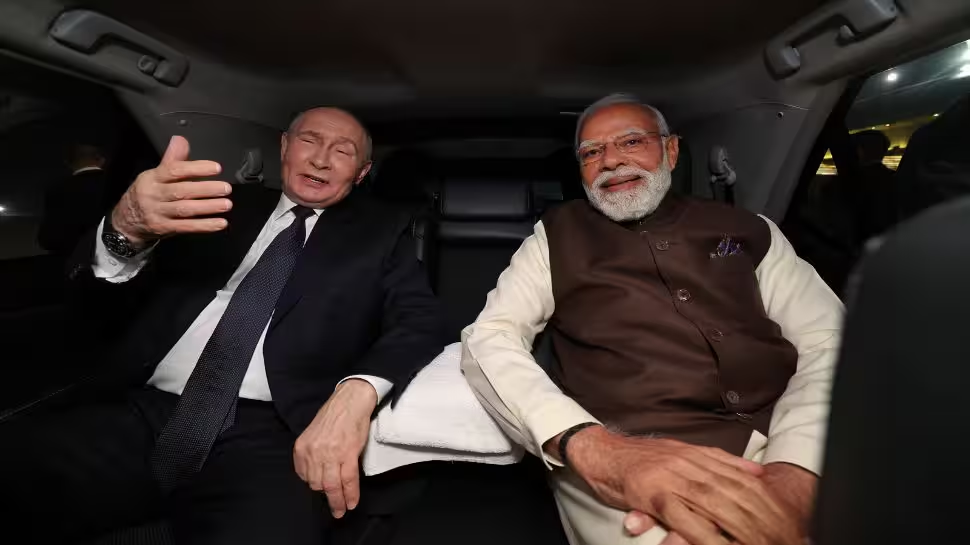

India-Russia Defense Deal: President Vladimir Putin’s two-day visit to India from December 4 could become a defining moment in the long-running India-Russia defense relationship. During this trip, Moscow is expected to formally present its proposal for the SU-57, a fifth-generation fighter jet Russia has long positioned as the centrepiece of its future combat fleet.
For India, the offer comes at a time when squadron numbers are dipping, threats from both the western and northern borders are growing and the Advanced Medium Combat Aircraft (AMCA) project still needs years before a prototype rolls out.
The dilemma before the South Block is whether India should view this offer as a chance to quickly reinforce its combat strength or regard it as a move that could unsettle its long-term indigenous plans.
Add Zee News as a Preferred Source
India’s air power is moving through a phase where every decision carries long-term weight. Aging fighters are retiring faster than replacements can arrive. Tejas production has faced delays, and the AMCA prototype is unlikely before the next decade.
In this situation, the SU-57 offer is a test of India’s ability to act without letting years slip away again.
The Indian Air Force (IAF) remains formidable, armed with sophisticated weapons and platforms that deter hostile action. However, the real concern lies ahead. Several older fleets have reached the end of their service life. The MiG-21 has already retired. Jaguars will soon follow. Indigenous Tejas production is ongoing but slow.
Meanwhile, China has raced ahead with sixth-generation technology, while India’s next major platform, the AMCA, has remained in its early development phase since 2010 and still needs 15-20 more years before induction.
India set ambitious long-term aims through the AMCA, but it did not fully prepare for the short-term reality of maintaining operational readiness. Tejas deliveries are behind schedule, and the AMCA timeline has slipped far into the future. What India needs now is not a temporary patch, but a bridge that strengthens capability until indigenous systems mature.
A military’s strength grows not only from what it possesses today but also from the decisions taken over decades. India’s fighter fleet has suffered because important decisions were delayed, opportunities were lost and crucial projects failed to finish on time. Squadron strength has dipped to 31, far below what the IAF considers necessary.
At the moment, almost all of India’s offensive punch rests on the SU-30MKI and just 36 Rafales. After the Rafale and Tejas inductions, there has been no major leap in combat strength, even as older aircraft continue to retire.
Operation Sindoor played out with remarkable efficiency, but Pakistan has had years to study India’s moves. Another confrontation cannot be ruled out. Aircraft numbers alone do not win wars; India needs modern fighters in adequate strength, backed by advanced weapons.
How India Fell Behind
Around the year 2000, the IAF made it clear that the MiG-21 fleet needed to be replaced with a Medium Multi-Role Combat Aircraft (MMRCA). It was a moment when India could have defined its future air power. But decisions stalled for seven long years until the Request for Proposal (RFP) for 126 jets was issued in 2007.
After the change of government in 2014, India pushed ahead and signed the Inter-Governmental Agreement for 36 Rafales on September 23, 2016. This was only a fraction of the original plan. Instead of seven squadrons, only two were eventually inducted.
France delivered the jets with exceptional speed. The first five Rafales reached Ambala on July 27, 2020 and were formally inducted on September 10, 2020. The final fleet of the aircraft arrived on December 15, 2022, prompting the IAF to post, “The Pack is Complete.”
But the big question still remains: when France was delivering at record pace, why were additional Rafale orders not placed?
If India had ordered two or three extra squadrons during that window, or even soon after, today’s squadron deficit would have been far less alarming. Three full years have passed since the last Rafale arrived, and in that time India could easily have secured 2-3 more squadrons.
Air Defense Cannot Replace Fighters
India has invested heavily in air-defense systems such as the S-400, the MR-SAM and several indigenous platforms, and these played a strong supporting role during the Operation Sindoor. But their abilities remain limited.
Air-defense units can only respond after a threat appears. They cannot enter hostile airspace, dismantle enemy infrastructure or carry the fight across two frontiers at the same time.
Air defense is a shield. Fighter jets are the weapon that wins wars.
Where The SU-57 Fits In
The SU-57 offer comes at a moment when India is under real pressure to restore numbers. The aircraft is a fifth-generation platform, and Russia has indicated willingness to share full technology with India. New Delhi already has decades of experience maintaining and operating Sukhoi aircraft, which makes the transition easier.
Given AMCA’s long timeline, the SU-57 could provide a real boost in the next 5-10 years.
However, a huge order (around 10 squadrons) may squeeze the budget and slow the AMCA’s progress. That would undermine India’s long-term technological independence.
A balanced approach may offer the best outcome. Begin with a smaller initial package (around 4-5 squadrons), include joint production in India, use the deal as leverage for advanced engine and sensor technology critical for the AMCA and train engineers and maintenance teams on cutting-edge systems.
This way, India strengthens today’s capability without compromising tomorrow’s ambitions.
A Decision Future Generations Will Study
Decisions made now will be judged for years. The question “Why did not we act when we should have?” has haunted India’s defense planning for three decades. We may be facing that question again. With drones, cyber warfare and A2/AD systems defining battlefields, air power is becoming even more decisive.
The SU-57 decision must not be reduced to a simple yes or no. It should answer two fundamental questions: can India shift from merely buying platforms to building long-term strategic capability; and can this deal support the AMCA program while giving the IAF the modern fighters it urgently needs?
If the answer is yes, India moves forward. If not, the risk of repeating history is very real.

Comments are closed.