
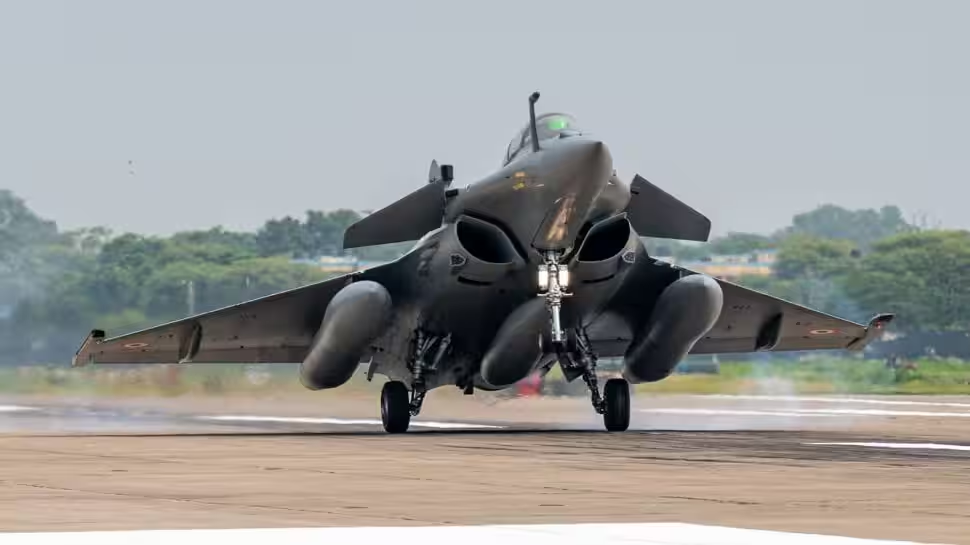
F-3 Rafale Wreaked Havoc During Operation Sindoor… Now Advanced Rafale F5 Is Coming – What Makes It So Deadly | India News

New Delhi: The Indian Air Force (IAF) is preparing to enhance its combat capabilities with the next phase of Rafale fighter jet acquisitions. Leaked information from the French Defense Ministry suggests that India plans to buy 90 Rafale F4 multirole jets, along with an option for 24 next-generation F5 variants.
According to the Eurasian Times, proposals are also progressing for a total of 114 Rafales in the deal.
Why More Rafales Are Critical
Add Zee News as a Preferred Source
At present, the IAF has only 29 fighter squadrons, while operational requirements call for 42.5. Delays in domestic programs have widened this gap.
Meanwhile, Pakistan is upgrading its F-16 fleet from the United States that is expected to remain operational until 2040 and possesses J-10C jets armed with PL-15 missiles.
Islamabad is also eyeing the J-35 fifth-generation fighter. China, on the other hand, fields around 400 J-20 jets.
For India, strengthening the fighter fleet is urgent. Choosing Rafales ensures a uniform fleet, simplifying maintenance and operational readiness. A government-to-government (G2G) deal with France can accelerate procurement. The jets have already demonstrated their combat effectiveness during Operation Sindoor.
Rafale Variants Explained
The F3R: India currently operates 36 Rafale F3R jets acquired under the 2016 deal. These are equipped with Meteor missiles, MICA, Hammer bombs and the SPECTRA EW system, along with India-specific customizations such as Astra missiles and helmet-mounted displays.
F4: This next standard features improved radar, advanced sensors and networked warfare capabilities. It can detect stealth targets and is expected for delivery from 2029.
F5 (Super Rafale): Scheduled for 2030, this variant will feature a higher-thrust engine, hypersonic missiles, drone wingman integration and upgraded EW systems, acting as a bridge between fifth and sixth-generation fighters.
Make-In-India Prospects
French officials state that Make-in-India benefits are possible only if the full order (114 jets for the IAF plus 26 for the Navy) is confirmed, allowing assembly lines to be set up locally.
Dassault already produces fuselage components in India, while Safran is establishing an MRO plant for the M88 engine in Hyderabad. Safran and DRDO are also jointly developing a new jet engine for AMCA with 100% technology transfer.
Geopolitical Implications
While the United States continues supplying Pakistan with advanced weaponry and expanding trade with China, India is deepening defense ties with France, which has never imposed sanctions. New Delhi is also in discussions with Moscow over Su-57 fighters. It reflects a strategy to maintain regional balance.
Countdown Begins
The proposal requires AoN and CCS approval. President Macron is expected to visit India in 2026, potentially marking the official launch of the deal. Once finalized, India would become the largest Rafale operator outside France, with over 175 jets.
Production rates are increasing, and local manufacturing will reduce costs. Rafales also offer a lower lifecycle cost compared to Russian jets, making them a more efficient long-term investment for the IAF.

Comments are closed.