

The changes, unveiled by the Australian government on Tuesday as part of the 2026-27 Federal Budget, set the permanent Migration Program planning level at 185,000 places.
Of this total, 132,240 places are dedicated to the Skill stream. This category covers migrants with expertise, qualifications, or vocational skills in priority sectors such as information technology, engineering, healthcare, and education.
The government plans to prioritize applicants already residing in Australia across both skilled and family visa categories.
For offshore applicants, most of the remaining 55,110 places will go to high-skilled migrants. According to budget documents, this aims to address Australia’s long-term skill needs while helping to “place downward pressure on net overseas migration.”
Policy reforms and streamlining entry
The government is reforming the permanent migration points test, which currently selects almost two-thirds of permanent skilled migrants. The optimized test will seek to better identify younger, better-educated, and higher-skilled migrants who can drive productivity and Australia’s long-term prosperity, according to the budget paper.
Additionally, the Working Holiday Maker (WHM) program will undergo reforms to better control numbers, reduce barriers to work, and provide a fairer visa allocation. This includes expanding the use of ballots to support better program management while introducing measures to reinforce the overall integrity of the migration system.
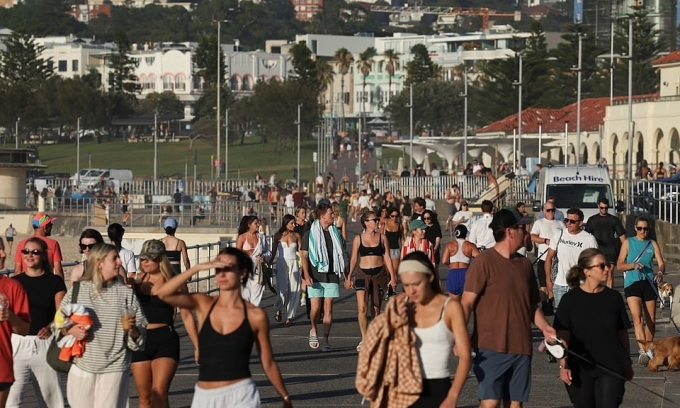
People walk near Bondi Beach in Sydney, Australia, Dec. 19, 2025. Photo by Reuters |
Authorities are streamlining licensing procedures for trades such as electricians and plumbers while expanding the recognition of foreign qualifications and work experience.
According to estimates by Australian broadcaster SBSthese changes could shorten the time it takes for foreign workers to enter the labor market by up to six months, allowing as many as 4,000 additional skilled workers to start contributing to the country each year.
Financial investment
To support these initiatives, the Department of Employment and Workplace Relations will receive A$85.2 million (US$55 million) over four years to accelerate and simplify the recognition of overseas skills.
A significant portion of this funding, A$75.1 million, will establish a new, modern trade skills assessment system starting in 2026-27. This includes building the capacity to integrate occupational licensing into Trades Recognition Australia (TRA) skills assessments.
An additional A$5.6 million will be spent over three years for TRA to deliver a new program of skills recognition for onshore non-skilled visa holders.
Finally, A$4.5 million is allocated over four years to strengthen the regulatory oversight of assessing authorities. The costs for these initiatives will be fully recovered over the medium term through new and existing charging arrangements. The department will also consult on requirements for a skills migration commissioner using existing resources.
The new policy responds directly to recent calls from the Business Council of Australia.
Last month, the council highlighted that processing delays for 55,000 highly skilled permanent residency applicants had left many in uncertainty, even as local businesses continued to face severe labor shortages, as reported by the Australian Financial Review.
As of the end of April, Australia had received a record 425,000 immigration applications.
Of the more than 800,000 international students last year, over 215,000 were enrolled in vocational training programs, a 33% increase from two years earlier, according to data tracked and published by the Australian Department of Education and the Australian Bureau of Statistics.
Comments are closed.