
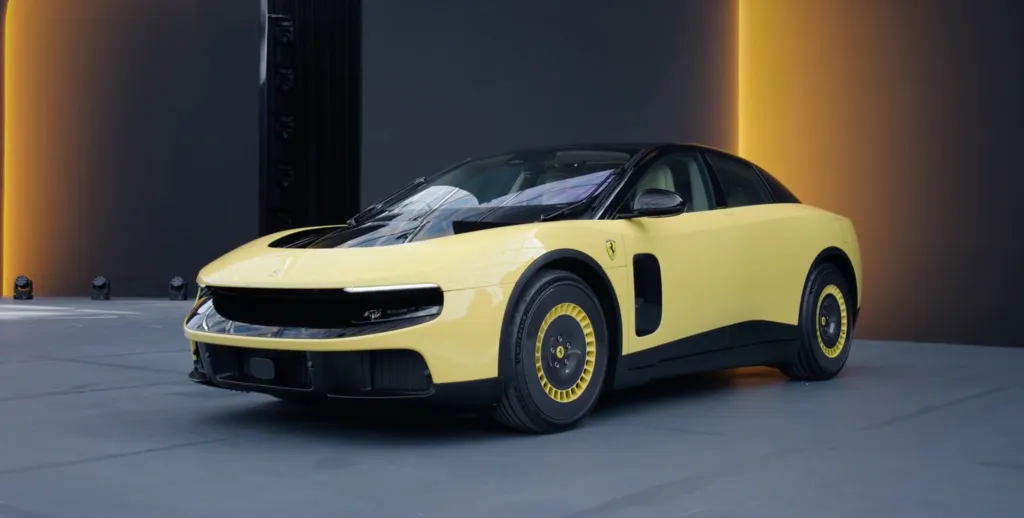

For decades, Ferrari has represented roaring V12 engines, sculpted two-seat supercars, and an emotional driving experience that few brands could match. But the company’s latest unveiling has pushed the legendary marque into unfamiliar territory and not everyone is celebrating.
At an exclusive reveal event in Rome on May 25, Ferrari introduced the Luce EV, its first fully electric production vehicle. Instead of a low-slung exotic coupe, the company showcased a futuristic five-seater electric sedan that immediately divided opinion among enthusiasts, investors, and industry veterans alike.
Within hours of the launch, social media platforms exploded with criticism, while Ferrari’s shares reportedly dropped more than 7 percent on the Milan Stock Exchange as investors reacted nervously to the company’s bold new direction.
A Radical Shift in Ferrari Design Philosophy
The Luce EV marks one of the most dramatic design departures in Ferrari’s modern history. Created in collaboration with LoveFrom, the design collective led by former Apple design chief Sir Jony Ive and renowned industrial designer Marc Newson, the vehicle embraces a clean and minimalist aesthetic rarely associated with Ferrari.
The car features a wedge-shaped silhouette, ultra-thin lighting elements, hidden aerodynamic surfaces, and a cabin dominated by digital interfaces rather than traditional performance-focused controls.
Underneath the futuristic styling, the numbers are undeniably impressive. Ferrari claims the Luce produces more than 1,000 horsepower, can sprint from 0 to 100 km/h in just 2.5 seconds, and reach a top speed exceeding 310 km/h. The company also estimates a driving range of over 530 kilometers.
Priced at around €550,000 in Europe, the Luce enters the ultra-premium EV segment as one of the most expensive electric sedans ever produced.
Fans Say Ferrari Has Lost Its Soul
While the performance figures grabbed attention, much of the conversation quickly shifted toward identity rather than engineering.
Long-time Ferrari enthusiasts criticized the car for abandoning the emotional character that made the brand iconic. Many pointed to the absence of the signature engine soundtrack and the move toward a family-oriented sedan layout as evidence that Ferrari is drifting away from its heritage.
Italian politician Carlo Calenda harshly criticized the vehicle, calling it “an aesthetic and technological insult to anyone who loves Ferrari.” His comments rapidly circulated online and fueled the growing backlash.
Perhaps the strongest reaction came from Luca Cordero di Montezemolo, the former Ferrari president widely credited with shaping the company’s golden era. Montezemolo openly warned that Ferrari risks “destroying a myth” and reportedly expressed hope that the famous Prancing Horse badge would not appear on the vehicle.
His remarks struck a nerve with traditionalists who see Ferrari as more than a carmaker. For many loyalists, it represents emotion, sound, passion, and mechanical drama, elements they fear may disappear in the electric era.
A Defining Moment for Luxury Automakers
Despite the controversy, the Luce represents something much larger than a single vehicle launch. It highlights the difficult balancing act legacy performance brands now face as global emissions regulations and consumer expectations push the industry toward electrification.
Ferrari is not alone. Luxury automakers across Europe are racing to reinvent themselves without alienating their core audiences. But the Luce’s turbulent debut shows how emotionally attached customers remain to traditional automotive identities.
Whether the Luce eventually becomes a commercial success or a cautionary tale, one thing is certain: Ferrari’s electric future has officially arrived, and the world is watching closely.

Comments are closed.