
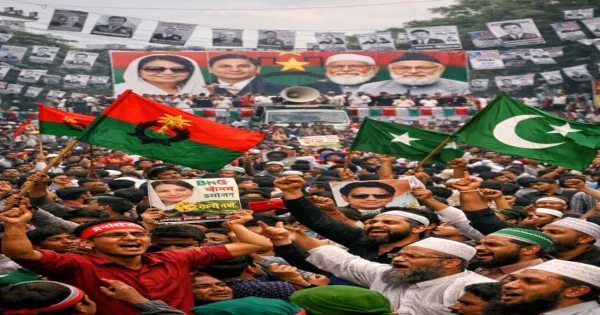
First Hindu MP elected from Dhaka: BNP leadership expected to improve India-Bangladesh relations

Delhi. Senior BNP leader Gayeshwar Chandra Roy of the minority Hindu community won the Dhaka seat in the 13th national parliamentary election of Bangladesh on Friday. According to the news of government news agency ‘BSS’, Roy defeated his nearest rival Mohammad Shahinur Islam of Jamaat-e-Islami by securing 99,163 votes in Dhaka-3 seat. The former minister’s victory from the Dhaka seat comes in the backdrop of alleged persecution of members of the minority Hindu community in the country. The community has faced a series of attacks, some of which have been fatal, since the killing of youth leader Sharif Osman Hadi in December.
BNP’s Hindu leader wins from Dhaka constituency
India has been expressing concern over attacks on minorities, especially Hindus, in Bangladesh. Moreover, the lone Hindu candidate fielded by the radical Islamic party Jamaat-e-Islami faced defeat in Khulna-1 constituency.
In this election contest, Krishna Nandy got 70,346 votes, while Bangladesh Nationalist Party (BNP) candidate Aamir Ejaz Khan got 1,21,352 votes. The 13th parliamentary election in Bangladesh will elect a government that will replace the interim government led by Mohammad Yunus. The BNP is headed for a sweeping victory in the parliamentary elections and is set to return to power after a gap of two decades.
Indian Prime Minister Narendra Modi, who on Friday morning congratulated Bangladesh Nationalist Party (BNP) President Tariq Rahman after his victory in the national elections, is likely to make personal efforts to develop relations with the neighboring leader. India’s discomfort with the government led by Mohammad Yunus has been well known.
Relations reached a low point when suspicions were raised that the current regime had organized protests outside Indian missions in Bangladesh, including incidents of assault. However, analysts do not expect too much increased affinity immediately, but rather a measured and systematic approach. At the same time, there is little possibility of Rahman showing much speed in improving relations with India.
Anti-India sentiment has long been a powerful political weapon in the domestic politics of Bangladesh. Any notion of showing too much eagerness to engage with India could provide ammunition to his political opponents, who would try to portray the new government as one that compromises national interests. As a result, steady progress is expected on the two most sensitive bilateral issues, trade and river water sharing.
Bangladesh has consistently sought broader market access and resolution of long-pending water-sharing agreements. India, for its part, remains concerned about security cooperation and regional strategic coordination. Zafar Shobhan, a prominent Bangladesh intellectual and editor, argues that the incoming BNP government faces many challenges beyond just realigning its foreign policy. “Relations with India are certainly one of them, but it is only one of several major tests,” he says.
The second major challenge will be to handle the political future of Awami League. The BNP has long demanded sanctions on its key rival. However, complete political exclusion has risks both domestically and internationally. Some degree of reconciliation may ultimately prove necessary to maintain political stability and democratic credibility. The most sensitive issue is related to former Prime Minister Sheikh Hasina.
Bringing Hasina back to Bangladesh could be politically explosive. This may increase domestic tension, people may take to the streets and the internal politics of Dhaka may become complicated to such an extent that there may be a situation of sudden change in the government. Not only this, it may also complicate relations with India, where she is currently living. At the same time, BNP cannot openly advocate their continued migration to India without appearing politically weak.
Therefore, for the new government, the least destabilizing option may be to allow Hasina to remain abroad while formally sympathizing with the old Yunus government’s demand for her return. BNP’s political skills will be tested in the coming weeks. He will have to reassure domestic voters, stabilize a polarized political landscape and realign ties with India without appearing submissive.
Word in Dhaka is that several top advisers to the interim government will leave Bangladesh, while others will stay back and return to their professions as university teachers, media persons or NGO workers. Legal consultant Asif Nazrul wants to go back to research work. Foreign advisor Mohammed Tauheed Hussain wants to focus on writing, while food and land advisor Ali Imam Majumdar will become a columnist again. Two women from Yunus’s cabinet want to go back to their NGOs. Social welfare advisor Sharmin S. Murshid is likely to return to her NGO ‘Brati’ to work on human rights issues, while climate change consultant Syeda Rizwana Hasan will return to her legal NGO ‘Bela’.

Comments are closed.