
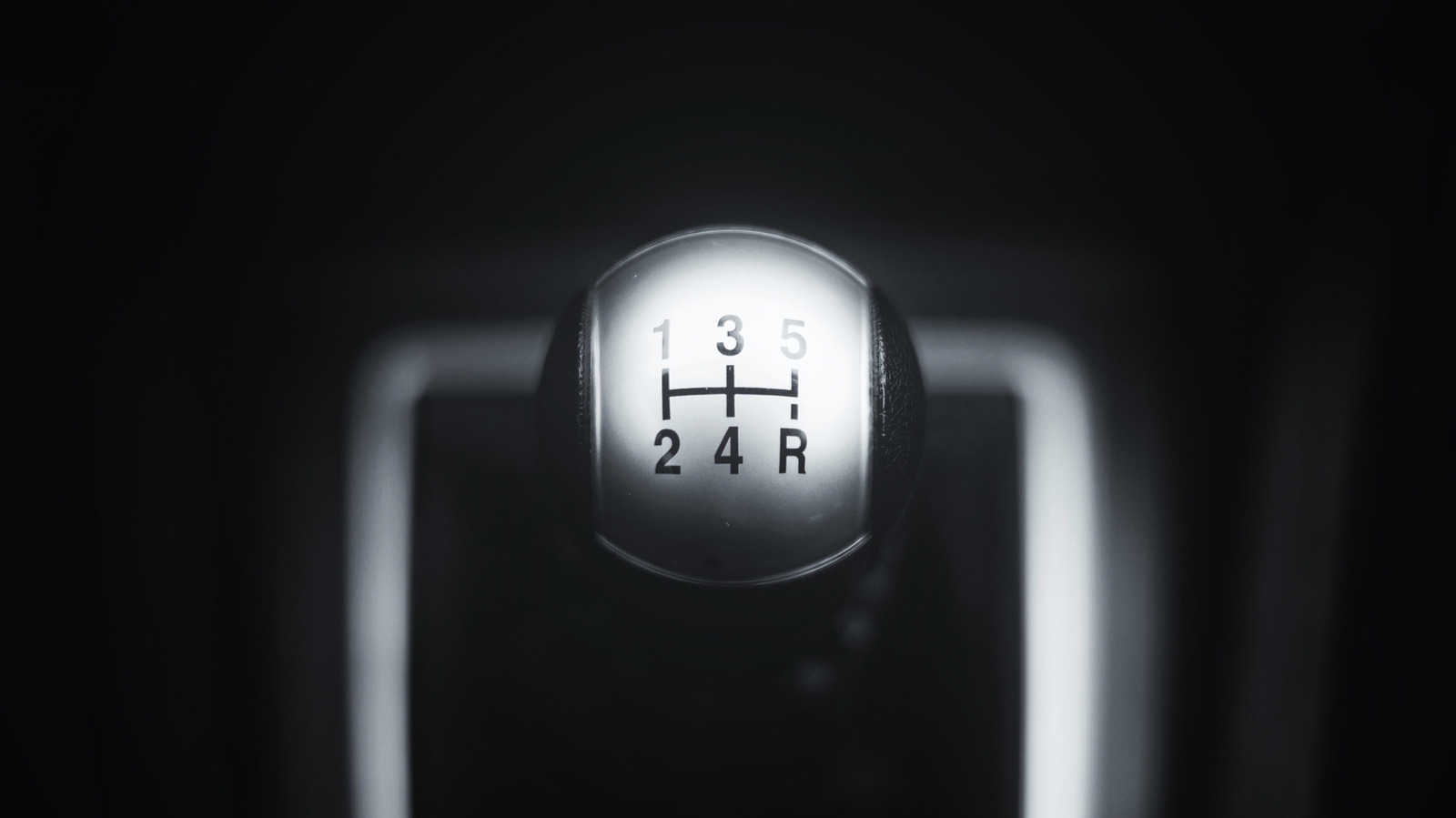

In 2025, there were roughly 30 cars you could buy with a manual gearbox, showing how the market has shifted toward quicker, more efficient, and easier-to-drive automatic transmissions. For a spot of context, back in the 1980s, roughly 35% of U.S. cars were produced with a manual transmission. However, between then and now, there was a period when automatic gearboxes were still relatively underdeveloped. This allowed vehicles equipped with manual gearshifts to deliver better zero to 60 times; early automatics typically had fewer gears, slower shift speeds, and higher losses through torque converters.
Automatic transmissions simply were not designed for speed but instead for comfort. This reduced power efficiency compared to a well-driven manual gearbox, and the benefit of choosing an automatic wasn’t as substantial as it is today, when automatics are much quicker. Plus, with wider market adoption of highly advanced dual-clutch transmissions, manuals simply couldn’t keep up. Here are five manual cars that leave their automatic counterparts in the dust, why people love them, and how they sit in today’s market.
ND Mazda Miata
The 2018/2019 model year of the Mazda Miata introduced the ND2 specification, meaning that the car had been revised with larger throttle bodies, an improved intake manifold, larger diameter tubes for the exhaust, and several additional modifications. This generation of the Miata also includes some of the best years for the vehicle because it was the quickest Miata at the time; reliability with the model had also been improved at that point as well. As is the case with Mazda’s current MX-5 Miata, this generation of the vehicle was also available with both a manual and an automatic.
Back when Car and Driver tested the hardtop version of the 2019 Miata, they noted that “manual-transmission RF delivers both the quickest acceleration and the most entertainment in terms of driver engagement.” Specifically, the automatic version of the Miata managed to reach 60 mph in 6.5 seconds. On the other hand, the manual managed a noticeably faster 5.8 seconds. In MotorTrend‘s testing, the soft-top manual Miata managed an almost identical 5.7 seconds. Overall, the Miata is a driver’s car through and through, meaning that beyond sheer speed, there is a lot of incentive to choose the manual over the automatic.
It must be said that it’s often easier to reach the quickest 60 mph times with an automatic as it requires less driver input; manual transmissions, in comparison, require quick shift times and better traction management. While we previously said that manuals are considered a dying breed among modern cars, with as many as 60% of all newer Miatas being bought equipped with a manual transmission, the MX-5 serves as a beacon of hope for fans of driving stick.
E36 BMW M3
The E36 generation of the BMW 3 Series was introduced in 1990, continuing production all the way until the year 2000 when it was replaced by the E46. The E36 ushered the 3 Series into a completely new era, improving upon the previous E30 generation in many aspects. The E36 M3 was the pinnacle of its range, offering the very first 3-liter six-cylinder engine in an M3. This was enough for 240 horsepower in both generations, while Euro-spec facelifted E36 M3s with their 3.2-liter six-cylinder managed 320 horsepower.
As far as transmissions were concerned, pre-facelift E36s used a five-speed manual with an optional SMG automated manual, while facelifted variants used six speed manuals and the aforementioned SMG. Although the E36 M3 was initially quite controversial, it has become a rising star in the car community in recent years. According to Car and Driverthe 240hp manual-equipped BMW E36 M3 was tested at approximately 6.0 seconds to 60 mph, while performance databases for the automatic 240 hp variant list 6.9 seconds to 60 mph.
Overall, a big part of the E36 M3 community leans heavily towards the manual variant because it feels better to drive, not necessarily because it is quicker. Moreover, the sentiment towards manuals is so strong that many people even opt to spend quite a bit of money to retrofit manuals into the E36 M3 chassis initially paired with an automatic from the factory.
Honda/Acura NSX
The first generation of the Honda NSX is an unique car. People loved it (and still do) because it is well-engineered, reliable, and feels great to drive. It also came out in 1990, much like the E36 M3, and it was in production until 2005. It is powered by a C30A 3-liter six-cylinder until 1997 when it was upgraded to a C32B 3.2-liter six-cylinder. Power-wise, earlier models were rated at 270 hp, while 3.2-liter models push 290 horsepower.
The NSX was available with either a five or six-speed manual or an optional four-speed automatic. When CarThrottle drove the automatic, they noted that “this NSX doesn’t feel anywhere near as quick as a manual version.” adding that “the four-speed NSX ends up feeling leaden and ponderous.” In sheer numbers, the manual Honda NSX is able to reach 60 mph from a standstill in about 5.6 seconds, nearly a whole second faster than the automatic’s 6.5-second time.
As is the case with most cars on this list, numbers only tell part of the story. Overall, most driving enthusiasts prefer the manual NSX over the automatic because it was more fitting to the car, and because it allows for better control. In terms of value, the manual NSX is also considerably more expensive.
C1 Chevrolet Corvette
The C1 generation of the Chevrolet Corvette was in production between 1953 and 1962, and over the decades this American icon has since evolved into the 2026 mid-engine Corvette ZR1X 1,250 hp hypercar. The C1 was powered by a wide range of V8 engines, with entry-level models starting from 150 horsepower. Probably the most coveted variant of the iconic C1 was the 327-cubic-inch 1962 C1 that offered 360 horsepower. It is also one of the clearest historical examples of how manual transmissions used to outperform early automatics.
When Car and Driver went through the entire Corvette lineage and covered the 1962 327 C1, they stated that the manual-equipped C1 was capable of a 0 to 60 mph time of 6.9 seconds. They also noted that this speed was only attainable with the four-speed manual, remarking that the “Vette needed nearly another two seconds when equipped with the automatic transmission.” In the 1960s, a gap of 2 seconds was significant. Because the C1 Corvette was one of the fastest American sports cars on the market at the time, it was the manual that allowed drivers to extract the maximum performance potential from the platform.
Porsche 911 (996 generation)
The 996 generation of the 911 lineage came about in 1997 and was available all the way until 2006. It is often viewed as the worst generation of the 911 because it suffered from annoying IMS bearing failures, it was the first water cooled 911, and the fried-egg headlights were never really accepted by the community. Yet besides these criticisms, the 996 moved the needle quite a bit in terms of overall performance.
The Porsche 911 (996 generation) gained a substantial power increase over its predecessor, the 993. The output rose from roughly 270–285 horsepower in the 993 to about 300-320 horsepower in the 996. The newer generation Porsche also introduced more modern engine management, an improved interior, and a more refined optional Tiptronic automatic transmission, which delivered quicker and smoother shifting compared to earlier automatics.
Still, this was not enough to outrun the manual. A 1999 Porsche 911 with a manual gearbox could reach 60 mph in about 4.6 to 4.9 seconds. On the other hand, the Tiptronic automatic version was closer to 5.6 or 5.7 seconds. Even at the top of the line, the 996 Turbo was also slower, with Car and Driver testing noting a 0.3 second gap between the manual and the Tiptronic.

Comments are closed.