
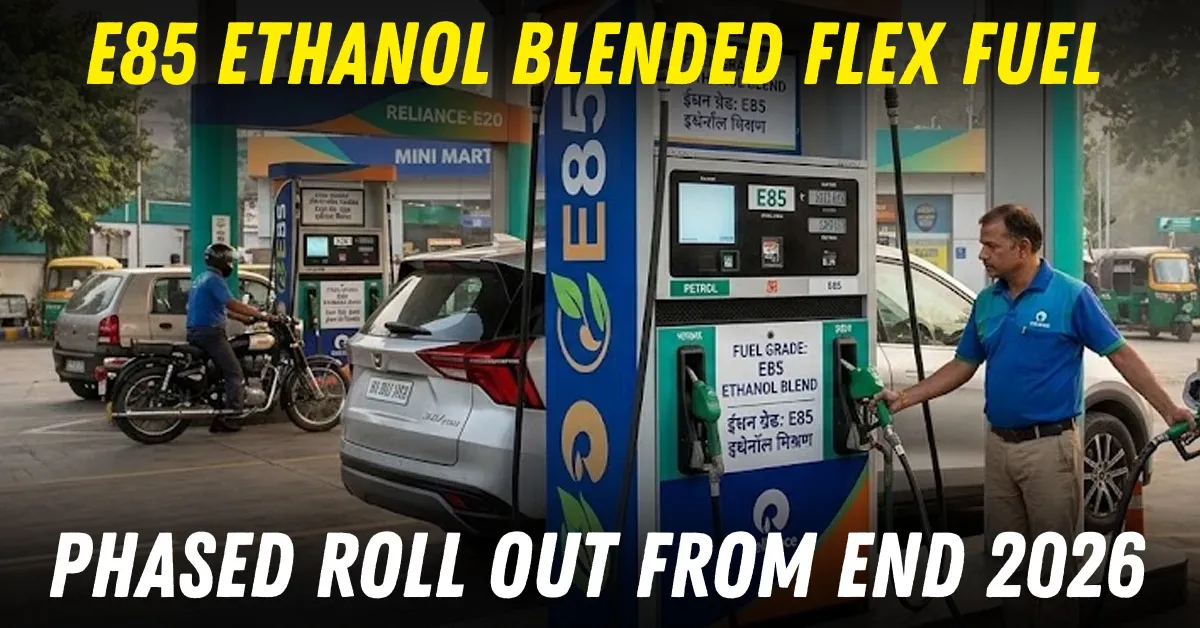

India achieved 20% ethanol blending in petrol in December 2025, five years ahead of schedule. That is the headline number. The less comfortable number, buried in a CareEdge Ratings report published this week, is that the country’s ethanol production infrastructure is now so oversized relative to current demand that utilisation rates are stuck at around 60%, and will stay there for the foreseeable future unless flex-fuel vehicles arrive in meaningful volumes fast. The assessment is that they will not.
India’s installed ethanol production capacity now stands at approximately 2,000 crore litres per year, with another 400 crore litres coming online by FY27. Against this, current demand under the 20% blending mandate is only around 1,100 crore litres, with non-fuel uses adding another 300 to 350 crore litres. Total demand is well under total supply, and the gap is structural rather than cyclical. CareEdge projects that utilisation rates will remain in the 65 to 75% range for the next three years in its base case.

The only scenario where demand catches up meaningfully is if flex-fuel vehicles, cars capable of running on high-ethanol blends like E85 or even pure ethanol, arrive in sufficient numbers to soak up the surplus capacity. CareEdge projects FFV penetration at around 5% of new vehicle sales by FY28, rising to 20% by FY30. Even that scenario, which assumes the flex-fuel rollout proceeds without significant delays, only raises demand to approximately 1,600 crore litres by ESY 2029-30, still below installed capacity.
If the rollout is delayed, demand stays capped at around 1,200 crore litres in the near term and reaches only 1,500 crore litres by ESY 2029-30. Under that scenario, the industry runs at a structural deficit of 20 to 35% of installed capacity for years. Tata Motors has confirmed a flex-fuel vehicle for end-2026, making it the first mainstream manufacturer to commit to a timeline. Others have not yet followed.
The MoRTH released draft amendments in late April 2026 proposing to enable fuel grades up to E85 and exclusive ethanol fuel. But the physical infrastructure needed to dispense them is not ready. I
ndia’s retail fuel network of over 1.03 lakh outlets is almost entirely configured for a single fuel grade. Storage capacity nationally is around 77.8 crore litres, served by approximately 313 centralised blending depots. CareEdge says this is adequate for E20 but is not set up for a multi-blend ecosystem where different stations might dispense E20, E85, and E100 simultaneously.
The regional imbalance makes this harder. Maharashtra has a surplus of up to 277 crore litres. Tamil Nadu faces a deficit of around 77 crore litres. Moving ethanol across state lines adds logistics cost and complexity. The report notes that inter-state supply chains are still developing, which keeps margins under pressure for distillers even in states with adequate capacity.
One relief valve exists. If the government raises the blending mandate from E20 to E25, CareEdge estimates utilisation could cross 80% by FY28, significantly improving the economics for the ethanol sector.
That decision is within the government’s control and requires no new infrastructure. Whether it moves before the FFV rollout gains momentum will determine how distillers weather the next three years.
Comments are closed.