
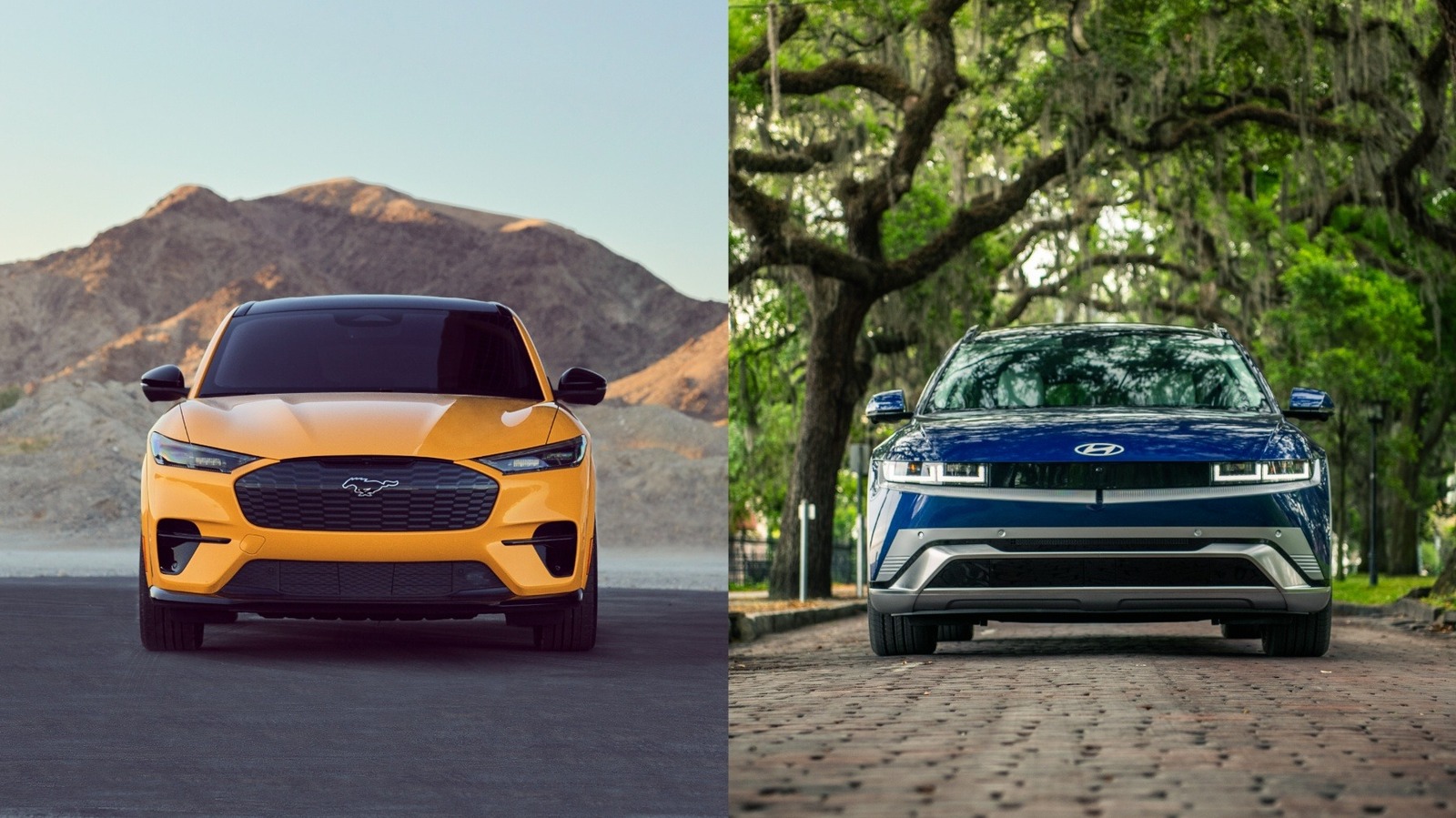
Ford Mustang Mach-E Vs Hyundai Ioniq 5: Which Electric SUV Offers More At Its Price Point?

Crossover EVs are a competitive market with several models vying for driver dollars. Among the choices are the Ford Mustang Mach-E and Hyundai Ioniq 5, which feature similar asking prices. Ford’s employee pricing campaign has the Mustang Mach-E starting at $35,818. Whereas the Ioniq 5 from Hyundai is bit less expensive with a starting price of $35,000 even.
In terms of what’s selling, Ford moved 51,620 Mach-E vehicles in 2025. Hyundai’s Ioniq 5 trailed behind at 44,789 units sold. However, Hyundai dropped its Ioniq 5 prices late in 2025 by as much as $10,000 in some cases, making its vehicles even more attractive. Ford offers four different Mach-E models with the top tier Rally starting at $54,469. Conversely, the Ioniq 5 comes in five different flavors with its highest-end XRT beginning at $46,275, an over $8,000 difference.
While the latest Mach-E features little change from previous iterations other than a California Special edition model, the team behind the Ioniq 5 have been busy. In 2025, Hyundai refreshed the model and the 2026 version has continued to up the ante. For instance, drivers will now get a combination charging cable that includes both level 1 and 2, an upgrade over previous offerings.
Range and charging
One of the biggest considerations for EV buyers is how far they can get on a charge. This figure can vary significantly depending on the battery and whether you opt for rear or all-wheel drive. You won’t find the best range estimates among either the Mach-E or Ioniq 5 because both models lean into performance over efficiency.
Ford’s Mustang Mach-E has a standard battery can get you around 260 miles in a rear-wheel drive configuration. However, this estimate drops to just 240 miles for the eAWD variants. Ford’s extended battery boosts range up to around 320 miles. The Ioniq 5s basic model can manage an estimated 245 miles on a single charge. While the more robust battery option can achieve around 318 miles (rear-wheel drive).
Ford restricts its standard range batteries to a 110-kW charging speed, whereas the Ioniq 5’s 63-kWh battery can utilize fast charging. When down to just 10% battery, the base Ioniq 5 can climb to 80% within 20 minutes with DC fast charging. Ford allows its extended battery to replenish at rates up to 150 kW, which could get you from near empty to an 80% charge in under 40 minutes with a level 3 charger.
Power output and acceleration
In terms of power, the Mustang Mach-E does not disappoint. There are a range of options from two single motor setups outputting 264 and 272 horsepower, to three dual motor configurations offering 325, 370, and 480 horsepower. This translates in the Rally trim achieving a 3.1-second 0 to 60 mph time. Although, as we noted in our 2023 Ford Mustang Mach-E review, these figures are more than enough for a compact crossover.
The Ioniq 5 isn’t quite as impressive in the horsepower department, unless you consider the separate Ioniq 5 N model. Single motor options output 168 horsepower and 225 horsepower, with 258-pound feet of torque. Dual motors bump up output to 320 horsepower and 446-pound feet of torque, which result in the XRT achieving a 0 to 60 mph time in 4.5 seconds. While the Mach-E may beat the Ioniq 5 in terms of output, the Ioniq 5 N produces 601 horsepower and 641 horsepower for short bursts with the Grin Boost feature enabled. As quick as the Mach-E Rally is off the line, the Ioniq N can manage a 0 to 60 mph time of just 2.8 seconds. However, the N starts at over $66,000, nearly $12,000 more than the Mach-E Rally. So, in terms of power and quick acceleration, you can get more from the Mach-E with fewer dollars.
Interior space and design
Both EVs can accommodate up to five passengers, but each features slight advantages over the other making it a bit of a tossup in terms of who comes out on top. For instance, the center console in the Ioniq 5 can slide forward for greater legroom in the second row or backward for more space up front. In terms of total passenger volume, the Ioniq 5 edges out the Ford, with 106.5 cubic feet, nearly 5 1/2 cubic feet larger than the Mach-E. However, Ford’s EV edges out Hyundai’s with 3.4 cubic feet more cargo space behind the second row. Under-hood space clearly favors the Mach-E’s front trunk at 2.6 cubic feet, versus Hyundai’s .85 cubic foot area, but Ford suddenly is charging drivers extra for it.
While the Mustang Mach-E provides a massive touchscreen, it’s otherwise fairly minimal in terms of design with darker colors. It features highlights like a faux carbon fiber piece running along the dash and materials that feel soft to the touch (depending on the trim). In keeping with the ‘Mustang’ motif, you’ll also notice the pony graphic centered on the steering wheel.
Unlike the Mach-E cabin which features a more rounded aesthetic, the Hyundai Ioniq 5 is boxy, in a sort of retro call-back to a previous era. Described by some as “retrofuture,” its interior is bright in tone, but perhaps not nearly on the same level of quality when comparing certain trims.
Features and technology
For those who have dreamed of an oversized media display stretched out longitudinally over the center dash, the Mustang Mach-E has you covered. Its touchscreen reaches 15.5 inches in length and features a physical knob at the bottom. While this layout may appeal to some, Hyundai opted for a two-screen display, each measuring 12.3-inches, with the center media console seamlessly adjacent to the driver instrument display. In our 2023 Hyundai Ioniq 5 review, we described the design as “stunning.”
On both the Select and Premium Mustang Mach-E models (for an extra $2,000) you can gain access to the BlueCruise Hands-Free Highway Driving technology. While Hyundai offers Highway Driver Assist 2 (HDA 2) — which is one of the automakers most advanced — on certain Ioniq 5 trims, it still requires the driver keep their hands on the wheel at all times.
Other nice touches from Ford include its Driver Recognition system, which remembers a number of personalized settings beyond seat position. The Mustang Mach-E will light up the door button, and automatically trigger ambient lighting preferences too. However, while Ford offers some attractive high-tech features, Hyundai isn’t far behind and is less expensive overall, potentially offering greater value.

Comments are closed.