
Foreign influence allegation to refund uncertainty: Key takeaways of Trump’s press conference over Supreme Court tariff ruling. world news

US President Donald Trump delivered a very detailed and combative news conference while responding to a Supreme Court ruling that curtailed his authority of using key tariffs and invalidated sweeping global tariffs, declaring that the measures were imposed without proper constitutional authority.
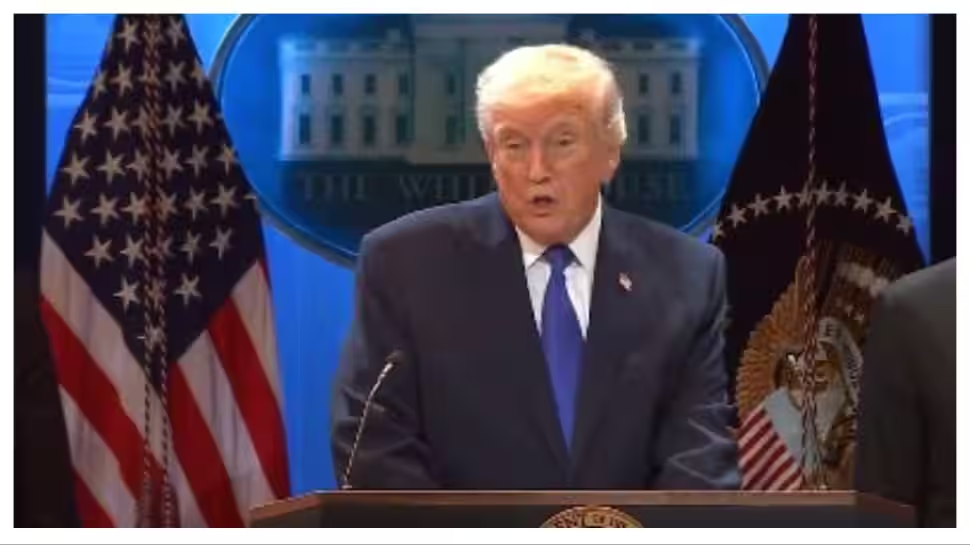
On Friday afternoon in the James S Brady Press Briefing Room, Donald Trump criticized the Supreme Court, dismissed Congressional opponents, hinted at potential tariff increases, defended his economic record, accused unspecified “foreign interests” of influencing justices, and portrayed tariffs not only as trade instruments but also as tools of diplomacy, border security, and national power.
The extensive press conference highlighted the continued centrality of tariffs to his presidency and suggested that the Supreme Court’s decision has done little to temper his approach.
Add Zee News as a Preferred Source
Key takeaways from the briefing include:
A new 10% global tariff
Trump announced that he has signed an executive order imposing “a 10% global under Section 122”, over and above US normal tariffs already being charged.
He stressed that national security tariffs under Section 232 and existing Section 301 tariffs would “remain in place, fully in place and in full force and effect”.
This move by POTUS does not signal giving up, but a major shift in legal strategy.
2. Tariffs may increase further
When questioned about the possibility of tariff rates rising above their current level, Trump said, “Potentially higher… It depends whatever we want them to be.”
He further said under alternative statutes, “we can judge much more than I was charging,” suggesting the Supreme Court’s judgment might lead to broader tax duties.
3. Authority to impose embargo
Donald Trump consistently empathized the extent of his powers beyond just tariffs. “I can embargo. I can do anything I want,” he said.
He added, “I’m allowed to destroy the country, but I can’t charge them a little fee.”
4. Vehement attack on the US Supreme Court
President Donald Trump described the Top Court’s judgment as “deeply disappointing”, saying he was “ashamed of certain members of the court”. While praising Justices Thomas, Alito and Kavanaugh for dissenting, he cited their “strength and wisdom and love of our country”.
Other Supreme Court Justices who invalidated the Trump’s tariff, including some he only appointed, Trump said the decision was “an embarrassment to their families”, though he declined to say whether he regretted nominating them.
5. Claims foreign influence on US justice system
In one of the most shocking moments, Donald Trump emphasized, “It’s my opinion that the court has been swayed by foreign interests.”
When asked about evidence supporting his claim, he replied, “You’re going to find out what?” but shared no specifics.
He highlighted outside forces had “undue influence” and there is possibility of it effecting Supreme Court Justices “through fear or respect or friendships”.
Trump’s allegation reflected a significant amplification of critical rhetoric aimed at the US courts.
6. POTUS dismisses Congress’ role in tariffs
President Trump very clearly dismissed the suggestions that he should work with lawmakers to craft a new tariff framework. He said, “You don’t need to — it’s already been approved.”
“I have the right to do tariffs. And I’ve always had the right to do tariffs.”
This remark by Trump highlighted his longstanding stance that existing statutes give the executive broad trade authority.
7. Intraparty friction
While addressing the Republican critics who just opposed elements of his tariff policy, Trump admitted losing “three votes”, however, he said they were “not good Republicans.”
At the same time, he stressed party unity, acknowledging that most of the Republican lawmakers supported his stand.
8. Tariff refund uncertainty
The US Supreme Court ruling raised the question of what happens to billion of dollars, which has already been collected under the challenged authority. “They don’t even discuss that point,” President Trump said of the opinion.
He predicted the matter would “get litigated for the next two years”, adding, “We’ll end up being in court for the next five years.”
9. Tariff as economic engine of US
President Trump clearly linked tariffs to economic performance, citing its positive impact on the stock market.
“Our stock market has just recently broken 50,000 on the Dow… and… broken 7,000 on the S&P,” he said. He also mentioned a jobs and inflation data, stating the January jobs report and consumer price numbers “beat expectations” and that “real wages are up”.
Remembering his visit to a Georgia steel plant, Trump said an executive told him, “Sir, I want to kiss you,” because tariffs had revived the business.
10. Tariffs funding farm aid
Trump stated that the revenue from tariffs had financed domestic support programs. “Last week I gave them $12 billion out of tariff money,” he said, referring to farmers.
11. Tariffs as a diplomatic instrument
President Trump once again characterized tariffs as instruments of foreign policy. “Tariffs have likewise been used to end five of the eight wars that I settled,” he said.
He described warning both sides of “a 200% tariff,” adding, “I did it largely with tariffs.
12. Trade framework with India
On being questioned about a pending trade framework with India, he said, “Nothing changes.”
He added that “they’ll be paying tariffs and we will not be paying tariffs”, describing it as a reversal from prior arrangements.
13. Fentanyl and China
President Trump said he had imposed “a 20% tariff” on China “as a penalty for sending fentanyl in,” claiming that fentanyl inflows were down “more than 30 per cent”. He credited tariffs along with what he called a “strong border”.
14. Criticises Europe
President Trump said “Europe has gone woke” and cautioned that energy, immigration policies killed Europe. This remark highlighted how Trump connects trade dispute to broader cultural and geopolitical narratives.
15. Federal Reserve criticism
He criticized the Federal Reserve Chair as “very incompetent” and urged that interest rates “should come down very substantially”, stating the US should pay “the lowest interest rates on the planet”.
16. Assertion of “Certainty”
Despite the judicial setback, President Trump consistently presented the Supreme Court ruling as elucidating, rather than limiting, executive authority.
“There will no longer be any doubt,” he said.
“Great certainty has been brought back to the economy of the United States and actually the economy of the world.”
The press conference highlighted the US President’s tendency to transform institutional resistance into political leverage.
Instead of moderating his tariff agenda following the Supreme Court’s ruling, President Trump framed it as confirmation of a broader strategy—one that combines economic nationalism, diplomatic pressure, and an assertive use of executive power.
The White House’s message was clear: the tariff campaign is not slowing; it may simply be entering a new stage.

Comments are closed.