
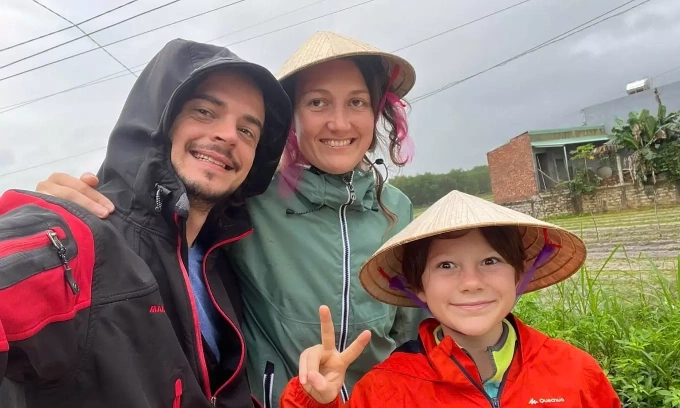

At 6 a.m. one day in early March Polish traveler Agata Klabińska changed into work clothes, grabbed a bamboo stick and herded cattle into the field at a farm in Que Son Trung Commune in Da Nang City. After that she joined a group of fellow foreigners to cut grass and water crops.
“This is my third time in Vietnam, and this time I chose to live like a farmer,” the 26-year-old says. “I want to understand local life rather than just go sightseeing.”
Klabińska originally planned to stay at the farm for one week, but it stretched into a month. She was named a team leader, responsible for more than 10 other foreign volunteers and helping coordinate activities ranging from planting trees and herding cattle to cleaning barns.
At the beginning the temperature differences with her home country left her exhausted, and she even experienced heat exhaustion. But she gradually adapted to the slower pace of life in the countryside.
In the afternoon she taught English to children in the village free of charge.
“Some classes had nearly 60 students, making me overwhelmed but happy,” she says. “Teaching in the middle of a farm was something I never imagined.”
Her evenings were often spent around a fire in the Da Nang farm with fellow volunteers and the host family, sharing simple meals of vegetable soup and braised fish, feeling warm and familial.
In February 35-year-old Turkish man Hurkan Gokkaya arrived at a fruit farm in Da Lat in central Vietnam, asking to work without pay. In return for free lodging, he helps collect food waste, cares for animals and films promotional videos for the farm.
Sharing a dormitory room with four or five others, he has quickly adapted to the communal lifestyle, which contrasts with the fast-paced city travel he previously preferred, he says.
On a farm, he feels more connected to nature, he says. He recalls being especially excited to taste dragon fruit and passion fruit freshly picked from the garden.
“We don’t have these fruits in my country. Life here starts early every day and is extremely peaceful.”
The trend of foreigners coming to Vietnam to “work for accommodation,” often referred to as “workaway,” has existed for several years. Since the beginning of 2026, however, the number of people seeking such opportunities in Vietnam through agricultural volunteer groups has skyrocketed.
Tran Thanh Ha, owner of Hygge Farm in Da Nang, says hundreds of people have contacted him this year asking to volunteer but he can accept no more than 20 at a time.
“About 80% of the volunteers are under 30 and come from Europe, the U.S. and Australia,” Ha says. “They want to experience authentic local culture instead of typical sightseeing tours.”
At Ha’s farm, visitors live communally in shared houses or tents, eat meals with the host family and spend two to three hours a day helping with education programs or farm work. Since 2021 the farm has accepted more than 2,000 international volunteers.
Foreign tourists and local residents transplant rice seedlings at Tran Thanh Ha’s farm in Da Nang, Vietnam. central Photo courtesy of Ha |
The arrival of foreign volunteers has brought new energy to rural communities.
Le Hoai Thuong, secretary of the Youth Union in Da Nang’s Que Son Trung Commune, says the local government has worked with farms to organize free English classes.
“Residents are learning how to communicate with foreigners to sell agricultural products and introduce local culture.”
The initiative is also attracting more foreign visitors, helping support local economic development. Similar programs are also growing in places such as Hoi An, Ninh Binh and Ha Giang.
Nguyen, the owner of a fruit orchard in Da Lat, says she hosts dozens of international visitors each month, many from Finland, Australia and the U.S., many of them young travelers, freelancers or YouTubers seeking authentic content.
Nguyen Tien Dat, vice chairman of the Hanoi Tourism Association, says Vietnam attracts visitors thanks to its safe environment, rich culture and scenic landscapes.
“Workaway offers a dual benefit: It supports local education while naturally promoting Vietnam’s image to the world.”
The experience is not limited to young travelers. Some foreign families also see “workaway” in Vietnam as a form of experiential education.
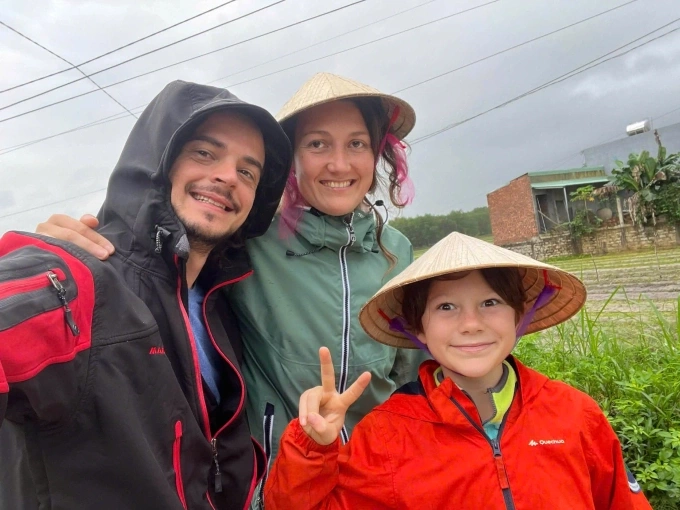 |
Ariane Triconnet (C), from France, her husband and their son in a farming experience in Da Nang, central Vietnam. Photo courtesy of Triconnet |
Last year Ariane Triconnet, a 33-year-old from France, spent a vacation in Vietnam with her 10-year-old son, helping chop bananas, make tofu and clean cattle sheds.
She quickly came to understand local customs after being surprised to see how cows in Vietnam are tied up rather than allowed to roam freely like in Europe.
“We came to learn, not to judge. I want my son to understand where food comes from and appreciate the value of labor.”
After a month living in the Da Nang farm, Klabińska says she has “fallen in love” with Vietnamese culture, especially enjoying early morning motorbike rides through rice fields and simple farewell gatherings organized by villagers.
“I truly feel the hospitality of Vietnamese people,” she says before continuing her journey to northern Vietnam.
“Those are values you cannot buy with money.”
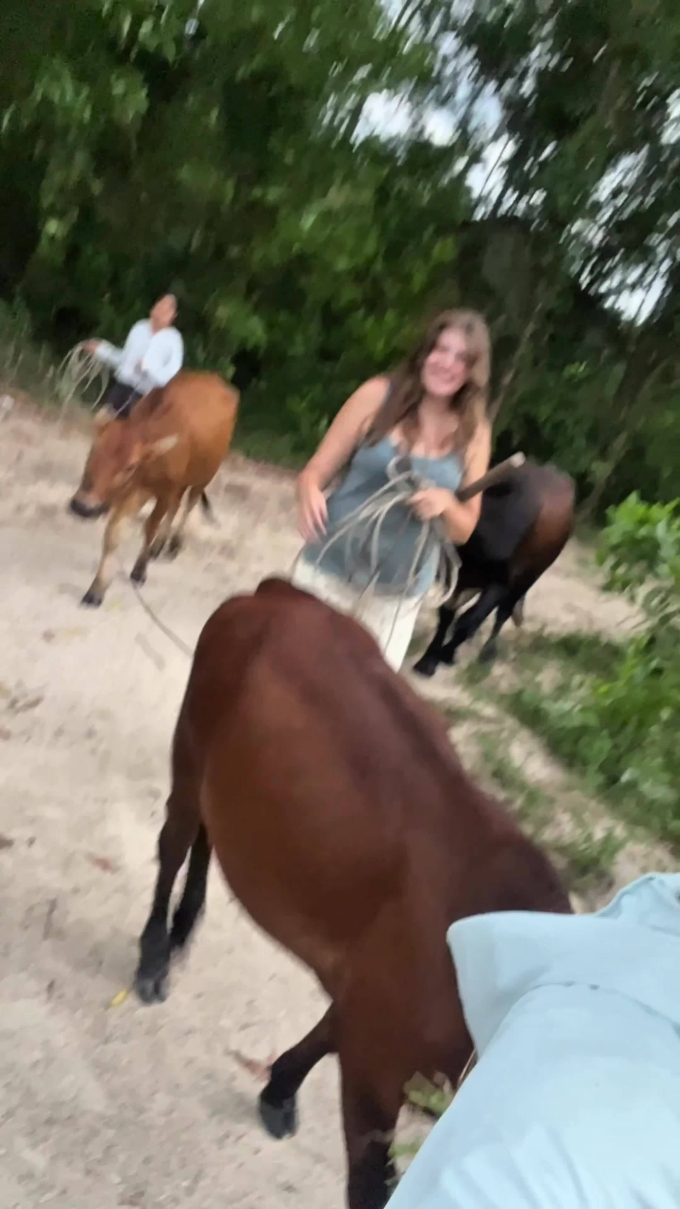
Agata Klabińska, from Poland, helps with farm work at a farm in Que Son Trung Commune, Da Nang, central Vietnam. Video courtesy of Klabińska

Comments are closed.