
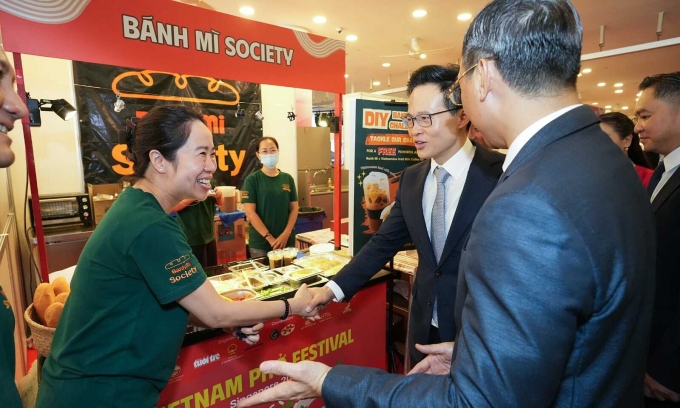

At midday in Clarke Quay, the entertainment hub along Singapore’s riverfront, Banh Mi Society is bustling. In its 40-square-meter space, the scent of pate and grilled meats fills the air.
Four months after opening Quynh, a former communications and public relations lead for Google Vietnam, rarely gets a day off.
“Business has been busier than expected, and so my team and I are working from morning until late at night,” she says.
In its first two months the shop got a 4.9/5 rating on Google. The flood of reviews was so fast that Google blocked new posts, suspecting there were fake reviews.
Quynh had to reach out to her former colleagues at Google Maps to fix the problem.
“The system flagged it for verification because a new place shouldn’t get so many reviews so quickly,” she explains.
Four months after opening a Singaporean media company added the shop as a catering provider. For Quynh, it is a promising sign. Instead of rushing, her shop focuses on growth, aiming for long-term success.
Ha Lam Tu Quynh (L) learned banh mi-making in Vietnam under master Nguyen Hoang Phu. Photo courtesy of Ha Lam Tu Quynh |
Over a year ago she had made a decision that surprised both family and colleagues: leaving a position at Google to sell food.
In her 40s, and financially and professionally secure, Quynh chose to step out of her comfort zone.
The Big Tech layoffs in 2024 – 2025 made her decision easier.
She says: “No one can be sure about the future working for someone else. I wanted to build something of my own, even if it’s risky.”
She chose banh mi as her flagship because it is internationally known and requires simple ingredients. She believes Vietnamese banh mi is more appealing than the items sold at fast-food chains like Subway.
After resigning, she planned her business, sampling banh mi in Singapore and Vietnam and studying how shops operated. She also sought advice from Vietnamese chefs and F&B experts.
Banh Mi Society opened in July at a place that has among Singapore’s most expensive real estate. The menu had classic fillings such as pate, pork sausage, and beef in betel leaves.
A banh mi costs S$12 (US$9.30), about twice the price as at hawker centers and 20-30% higher than at fast-food chains like Subway.
Quynh explains that her goal was to elevate Vietnamese street food to a mid-to-premium level.
“Many foreigners think Vietnamese food is cheap. I want to change that with quality ingredients and careful preparation”.
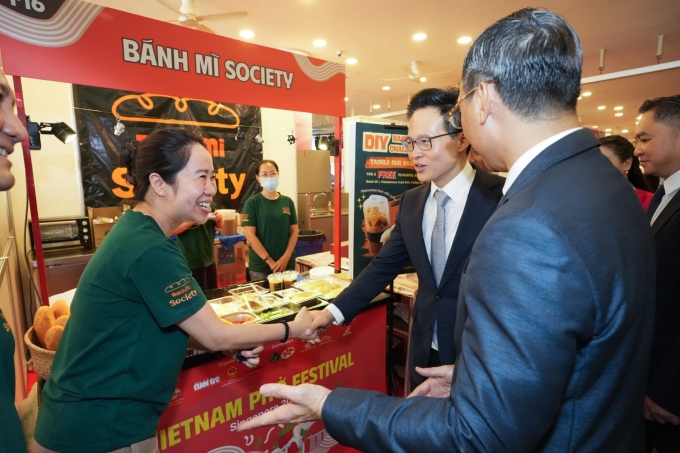 |
Vietnamese ambassador to Singapore Tran Phuoc Anh and Singaporean Minister of State for Defense Desmond Choo at Quynh’s shop in October 2025. Photo courtesy of Ha Lam Tu Quynh |
Every step is controlled: pate is made daily, the egg-butter spread is fresh and no industrial mayonnaise or sauce is used.
Nguyen Ngoc, a tourist from Hanoi, says the banh mi is balanced with a crispy crust, soft inside, tender roasted pork, fragrant pate and mildly spicy chili that ties everything together.
“The biggest difference is the vegetables and pickles; they’re much better than many banh mi shops in Vietnam.”
Bringing authentic flavors to Singapore means dealing with strict rules, especially for the bread.
In Vietnam, baguettes are fully baked and kept warm, but Singapore’s Food Agency requires sealed packaging meaning they can only be baked 75% before shipping.
This makes the bread lose shape and become soggy. To retain quality, Quynh uses hard-carton packaging and discards 20% of loaves that do not look right after reheating.
Rent is another challenge. In areas like Clarke Quay, it costs S$15 – 25 per square foot per month, meaning a shop might need to pay over S$10,000 ($7,746) a month, not including other fees.
To secure the location, Quynh had to go through several bids and present a business plan to show a long-term vision. Her preparation and data-driven management experience from years in tech helped convince the landlord, who agreed to a 1-5% revenue share and lower fixed rent.
“They were betting on the shop, which gave me more confidence,” she says.
Food safety rules were another challenge. The kitchen needed easy-to-clean surfaces, separate sinks for meat and vegetables, and fridges with real-time temperature tracking. Before opening, Quynh submitted six technical drawings, each costing S$2,000 ($1,550).
Despite this, she kept strict standards, knowing success in Singapore could open other markets. Two months after opening, people asked about franchising, but she declined.
Quynh aims to perfect her operations before expanding, with plans for up to five Singapore outlets to solidify the brand. She sees high growth potential in Vietnamese cuisine, noting that Thai, Korean and Japanese cuisines are already saturated.
“I don’t want to open many stores fast but to work with like-minded partners and take Vietnamese banh mi to the world”, Quynh concludes.

Comments are closed.