
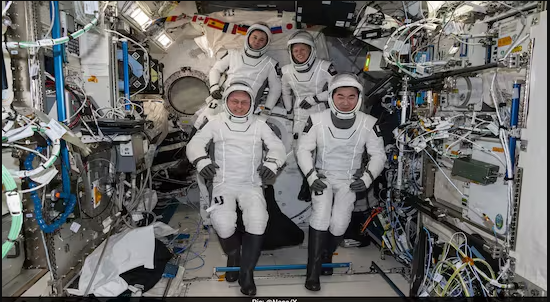

NEW DELHI, Jan 15: After the first ever medical evacuation in the orbital lab’s history, four International Space Station crew members splashed down in the Pacific Ocean on Thursday, NASA footage showed.
A video feed from NASA showed the capsule carrying American astronauts Mike Fincke and Zena Cardman, Russian cosmonaut Oleg Platonov and Japanese astronaut Kimiya Yui land off the coast of San Diego at 12.41 am (0841 GMT).
Live infrared video of the splashdown showed deployment of the two sets of parachutes from the nose of the free-falling capsule, slowing its rate of descent to about 25 kilometers per hour before it gently hit the water.
A health issue prompted their mission to be cut short, after spending five months in space. The US space agency has declined to disclose any details about the health issue but stressed the return was not an emergency situation.
Crew-12 is expected to launch to the space station in mid-February with four more astronauts. In the meantime, the orbiting laboratory remains occupied by NASA astronaut Christopher Williams and two cosmonauts who flew to the ISS aboard a Russian Soyuz spacecraft in November.
In less than an hour post the splash down, SpaceX recovery teams had secured their heat-scorched capsule and hoisted it onto the deck of a retrieval vessel, then helped the astronauts out of the spacecraft for their first breath of fresh air in nearly 24 weeks.
Each of the crew members, still garbed in helmeted white-and-black space suits, smiled and gave a thumbs-up as they emerged and were helped to their feet. It was not evident from their appearance which one was ailing.
Unable to bear their own weight on Earth after spending months in microgravity, the four were each assisted onto special gurneys and escorted to an onboard medical station for routine checkups at sea. Afterward they were to be flown to a local hospital for further medical exams, SpaceX said.
NASA officials have not identified the crew member of concern or described the nature of the medical issue, citing privacy requirements. The affected crew member “was and continues to be in stable condition,” NASA official Rob Navias had said on Wednesday.
Fincke, the SpaceX Crew-11 pilot, said in a social media post earlier this week: “First and foremost, we are all OK. Everyone on board is stable, safe, and well cared for.” “This was a deliberate decision to allow the right medical evaluations to happen on the ground, where the full range of diagnostic capability exists. It’s the right call, even if it’s a bit bittersweet.”
The Crew-11 quartet arrived at the ISS in early August and had been scheduled to stay on-board the space station until they were rotated out in mid-February with the arrival of the next crew. James Polk, NASA’s chief health and medical officer, said “lingering risk” and a “lingering question as to what that diagnosis is” led to the decision to bring back the crew earlier than originally scheduled.
American astronaut Chris Williams and Russian cosmonauts Sergey Kud-Sverchkov and Sergei Mikaev, who arrived at the station in November aboard a Russian Soyuz spacecraft, remained on the ISS. The Russian Roscosmos space agency operates alongside NASA on the outpost, and the two agencies take turns transporting a citizen of the other country to and from the orbiter — one of the few areas of bilateral cooperation that still endure between the United States and Russia.
Continuously inhabited since 2000, the International Space Station seeks to showcase multinational cooperation, bringing together Europe, Japan, the United States and Russia. Located some 400 kilometers (248.5 miles) above Earth, the ISS functions as a testbed for research that supports deeper space exploration — including eventual missions to return humans to the Moon and onwards to Mars.
(Rohit Kumar)

Comments are closed.