

If you thought Frankenstein’s monster was the ultimate outsider crashing the party of polite society, wait until you meet his better half in Maggie Gyllenhaal’s bold and imaginative sophomore film, The Bride!, loosely inspired by James Whale’s classic Bride of Frankenstein (1935), the first sequel to his own 1931 film, Frankenstein. Whale (1889-1957), known for other horror films like The Old Dark House (1932) and The Invisible Man (1933), adapted Frankenstein, about a deranged scientist who creates a living being out of the remains of the dead, from the 1927 play, Frankenstein: An Adventure in the Macabre by Peggy Webling, which was, in turn, based on Mary Shelley’s novel Frankenstein; or, The Modern Prometheus (1818).
At the height of his career as a director, Whale directed The Road Back (1937), a sequel to All Quiet on the Western Front (1930), based on Erich Maria Remarque’s definitive anti-war novel of the same name, which chronicles the harrowing experiences and disillusionment of young German soldiers in the WWI trenches; it was adapted for the third time by Swiss-Austrian director Edward Berger in 2022. Studio interference, possibly spurred by political pressure from Nazi Germany, led to the film’s being altered from Whale’s vision, and it was a critical failure.
A run of box-office disappointments followed and, while he would make one final short film in 1950, by 1941 his film directing career was effectively over. He continued to direct for the stage and also rediscovered his love for painting and travel. His investments made him wealthy and he lived a comfortable retirement until suffering strokes in 1956 that robbed him of his vigour and left him in pain. He took his own life on May 29, 1957, by drowning himself in his swimming pool.
Also read: What makes Iranian filmmaker Jafar Panahi’s film, It Was Just an Accident, a riveting watch
Whale was openly gay throughout his career, something that was very rare in the 1920s and 1930s. As knowledge of his sexual orientation has become more widespread, some of his films, Bride of Frankenstein in particular, have been interpreted as having a gay subtext and it has been claimed that his refusal to remain in the closet led to the end of his career. Some commentators have argued, however, that his retirement was provoked by a succession of poorly received projects with which Whale was growing personally dissatisfied; particularly deleterious to his career was The Road Back.
Revisiting the monster
Whale’s Frankenstein made Boris Karloff one of cinema’s defining horror figures through his portrayal of the monster in the 80-second screen appearance. The performance transformed him into an international horror icon and remains one of the most recognisable characterisations in film history. Karloff later reprised the role in the sequels Bride of Frankenstein and Son of Frankenstein (1939). He also played the ancient Egyptian priest Imhotep in The Mummy (1932), and decades later lent his distinctive voice to popular culture once again by narrating and voicing the Grinch in the animated television adaptation of Dr. Seuss’ How the Grinch Stole Christmas! (1966), a performance that earned him a Grammy Award.
The creator of Frankenstein, Mary Shelley (1797-1851), was born into an extraordinarily intellectual family. She was the daughter of two thinkers: the pioneering feminist philosopher Mary Wollstonecraft and the political philosopher and novelist William Godwin, who was among the earliest exponents of utilitarian ideas and one of the first modern advocates of anarchism. Wollstonecraft died shortly after Mary’s birth, and she was raised in London by her father. At 16, she eloped with the poet Percy Bysshe Shelley, and three years later, during the famously wet summer of 1816 on Lake Geneva, she wrote Frankenstein, the novel that would become her masterpiece. Her marriage brought to her repeated tragedy, including the deaths of three of their four children, and in 1822, Percy Shelley drowned in Italy. After his death, Mary Shelley returned to England, where she continued to travel and write until her own death at the age of 53.
Also read: Hamnet review: Chloé Zhao’s masterly, intimate portrait of William Shakespeare’s grief
Two centuries after Mary Shelley imagined a scientist who stitched life from dead flesh, Gyllenhaal revisits the story not merely as a tale about scientific hubris alone but also as an inquiry into loneliness, identity, and the politics of companionship. Though the film draws its immediate inspiration from Bride of Frankenstein, its sensibility belongs unmistakably to the present. The monster (Christian Bale, who never ceases to amaze) seeks what Shelley’s original creature desired but never received: a partner.
A portrait of Mary Shelley. Two centuries after Mary Shelley imagined a scientist who stitched life from dead flesh, Maggie Gyllenhaal revisits the story as an inquiry into loneliness, identity, and the politics of companionship. Photo: Wikimedia Commons
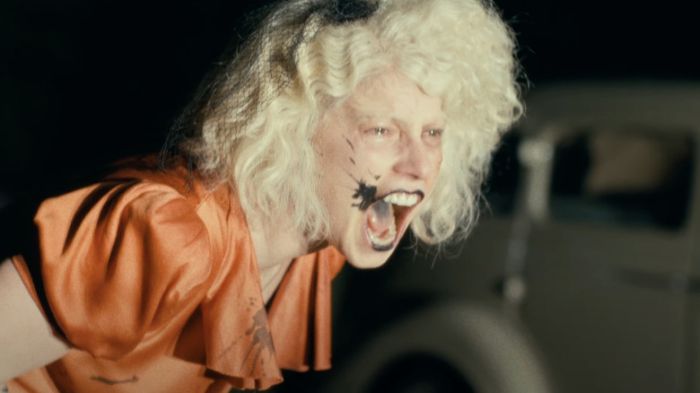
He sweet-talks Annette Bening’s mad scientist Dr. Euphronius into pushing the ethical and scientific boundaries to create life; a companion for the “carnal pleasures,” as Dr Euphronius puts it. A murdered woman’s (named Ida) body is revived and presented as his bride (the incredibly talented Jessie Buckley, who is riding high on all the acclaim coming her way for Chloe Zhao’s Hamnet; the film has received eight Oscar nominations). The story begins in black-and-white before exploding into colour as the Bride awakens, coughing up inky bile that stains her lips like macabre lipstick.
The premise carries echoes of the Gothic origin of resurrection stories, but the film displaces the action to 1930s Chicago, where gangsters, jazz, corruption, and unspoken cruelties coursed through the city’s streets. The result is a hybrid genre work — a potpourri of horror and noir romance — which just shows that the Frankenstein myth can migrate across eras without losing its emotional core. What distinguishes Gyllenhaal’s approach is her emphasis on subjectivity, particularly that of the Bride herself. The bride becomes the film’s centre of gravity, struggling to understand a life that has been literally assembled for her. The film’s structure — at times chaotic, at times dreamlike — makes you wonder about this existential dislocation. If you find that the film feels “stitched together,” you have to understand that it’s in line with the monster’s own patchwork body.
The ethics of creation
Thematically, The Bride! explores the ethics of creation. Shelley’s original novel posed a simple but devastating question: what obligations does a creator have toward the being he brings into existence? Gyllenhaal reframes the question through a modern lens. The Bride! is not merely the product of an experiment; she is a person forced to inhabit a story written by others: by scientists, by men, and even by the cultural mythology surrounding Frankenstein itself. Her struggle becomes a metaphor for the way identities are constructed and imposed. Gyllenhaal, fresh off her Academy Award-nominated debut The Lost Daughter (adapted from Elena Ferrante’s novel about motherhood’s dark undercurrents), skewers patriarchy like a shish kebab at a monster barbecue.
Men (barring Bale’s adorably goofy Frank) are painted as entitled ogres, from hyper-macho cops to dismissive bosses, while Penelope Cruz’s sharp detective battles workplace sexism like a one-woman crusade. The Bride, unbound and unbowed, erupts with “brain attack” rants that spark insurrection, her primal fury a punk anthem against conformity. It’s heavy-handed at times — described by some as “bludgeoning” feminist spin — but when you’re smashing glass ceilings with a hammer made of stitched flesh, subtlety takes a back seat. Creation flips from male hubris to a thorny tango of consent and power: Who gets to play God, and along what gendered fault lines? The Bride seizes her narrative, turning Frank’s quest for a mate into a romance of equals, where he loves her wild mind amid the “outrageous” chaos.
Also read: How Sam Mendes’ quartet of films on The Beatles aims to tell Fab Four’s whole story
To me, one of the film’s wildest jolts (and joys) is its playful, possessive nod to Mary Shelley herself. Buckley pulls triple duty here, playing not just the Bride and Ida but a wisecracking, seething Shelley straight out of limbo’s chiaroscuro. She’s no prim literary ghost; this Mary is a cackling overseer, throwing her head back in fury, channelling a scorched Marianne Faithfull vibe as she proclaims the Bride “my monstah!” with gleeful malice. Gyllenhaal fantasises her as a frustrated visionary with unpublishable rage: women’s agency in 1818? Unthinkable!
The Bride, unbound and unbowed, erupts with “brain attack” rants that spark insurrection, her primal fury a punk anthem against conformity.
In the film, Shelley haunts from hell, dropping F-bombs like confetti to punk up her persona, surveying her creation with black-and-white dead-lady flair. She’s referred to as the ultimate creator, a possessing spirit that “gets into” the Bride, a meta-narrator seething over her truncated life and downplayed legacy. At one point, she’s the Bride’s spectral hype woman. It’s a fun, if overwrought, layer: Buckley’s Shelley is part puppet-master, part pissed-off poltergeist. You are inclined to think that perhaps behind every monster is a woman who dared to dream big!
Despite its flaws, The Bride! is visceral, and plunges into the abyss of sexual violence with unflinching brutality. Imagine Ida, Buckley’s pre-death persona, her laughter echoing through smoke-filled speakeasies, only to be hurled into oblivion for daring to resist the groping hands of mobster predators, her plummeting body a chilling emblem of women’s daily descent into peril under a veil of systemic misogyny.
Awakened as the Bride, she stumbles into a world still hungry to devour her spirit: an assailant’s leering advance is met with her desperate grip on a pistol, her lips sputtering “Me too! Me too!” in a guttural howl that reverberates like a collective exorcism of buried traumas. The Bride’s primal shrieks rally a nation of women to daub their faces with inky war paint, mimicking the bile that stains her mouth, a cult of “ink splots” rising like ghosts from the grave, their smeared visages a badge of unbreakable solidarity.

Comments are closed.