
From chemistry to OpenAI: Vietnamese engineer driven by ChatGPT’s impact on rural communities

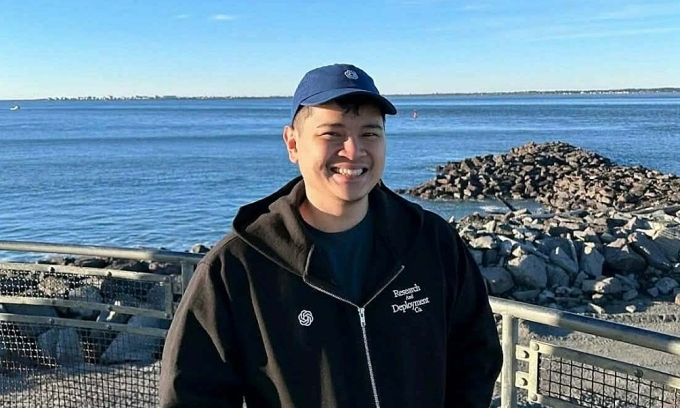
Ngo Vinh Hung, 29, now works as a software engineer at OpenAI’s Bellevue office in Washington State, where he helps build and improve AI systems used by hundreds of millions of ChatGPT users worldwide.
“The environment here moves at an extremely fast pace,” Hung said. “Many of my colleagues are former executives at major corporations or startup founders, all working toward the shared goal of building AI that benefits humanity.”
Ngo Vinh Hung in a photo he provided. |
Hung’s path into technology was not straightforward. A former student at Phu Nhuan High School in Ho Chi Minh City, he initially pursued chemical engineering after moving to the United States to study at Northern Virginia Community College, driven by his interest in the natural sciences.
His direction shifted after taking general education courses that introduced him to programming. Drawn to the field, he switched to computer science and was later admitted to the University of Washington in Seattle.
Alongside his studies, Hung actively participated in research projects. He co-developed SoundWatch, a smartwatch-based sound recognition system designed to assist visually impaired users. While his teammate focused on algorithms, Hung built the system architecture and optimized performance for resource-constrained wearable devices.
“Working on projects helps you absorb knowledge faster and more deeply, turning theory into real products,” he said, noting the project’s potential social impact as a key motivation.
He followed a disciplined schedule, completing coursework within three days each week and dedicating the rest of his time to research, an approach he said helped him achieve strong academic results and secure interviews with major tech companies.
After graduating, Hung joined Amazon, where he worked on systems supporting Fire TV, a platform serving hundreds of millions of users. His role included leading backend and machine learning projects, as well as supporting operating system transitions for devices.
The experience helped him build expertise in large-scale system design and responsible AI deployment, leading to further opportunities from companies such as Microsoft, Coinbase and Upstart.
However, his decision to join OpenAI was sparked by an unexpected moment while watching “Gia dinh Haha,” a reality TV show featuring celebrities living and working alongside rural communities in Vietnam.
In an episode filmed in Ban Lien Commune in Lao Cai Province, Hung saw a woman from an ethnic minority community using ChatGPT to better understand English-language content.
“I was surprised. AI can truly empower people regardless of age or geography,” he said. “That was the turning point that led me to choose OpenAI.”
Hung went through four to six rounds of interviews, where candidates were tested not only on technical expertise but also on real-world problem-solving and strategic thinking under pressure.
Pham Quang Vu, a software engineer at Reddit and a former engineer at Meta and Google who mentored Hung, said that while Hung had a strong technical foundation from Amazon, he initially needed to strengthen his long-term system design thinking.
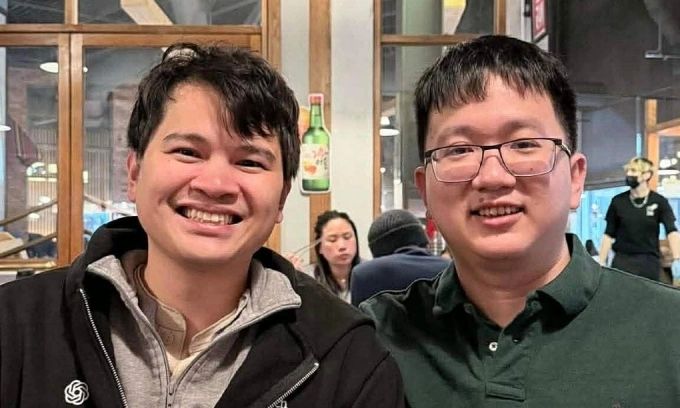 |
Ngo Vinh Hung (L) and his mentor Pham Quang Vu, a software engineer at Reddit and a former engineer at Meta and Google. Photo courtesy of Hung |
“He showed a strong willingness to learn and improved significantly throughout the process,” Vu said, adding that success in the U.S. tech job market also requires candidates to clearly articulate their career narratives.
Hung noted that language barriers and a lack of confidence in explaining complex technical concepts in English remain key challenges for many Vietnamese candidates. He advises aspiring engineers to contribute to open-source projects, quantify achievements in their resumes, and actively build professional networks.
Hung aims to deepen his expertise in AI while exploring applications in healthcare and finance. He also hopes to give back to Vietnam by helping make AI more accessible.
“I want to contribute through teaching and by building stronger connections with the tech community back home,” he said.
Comments are closed.