
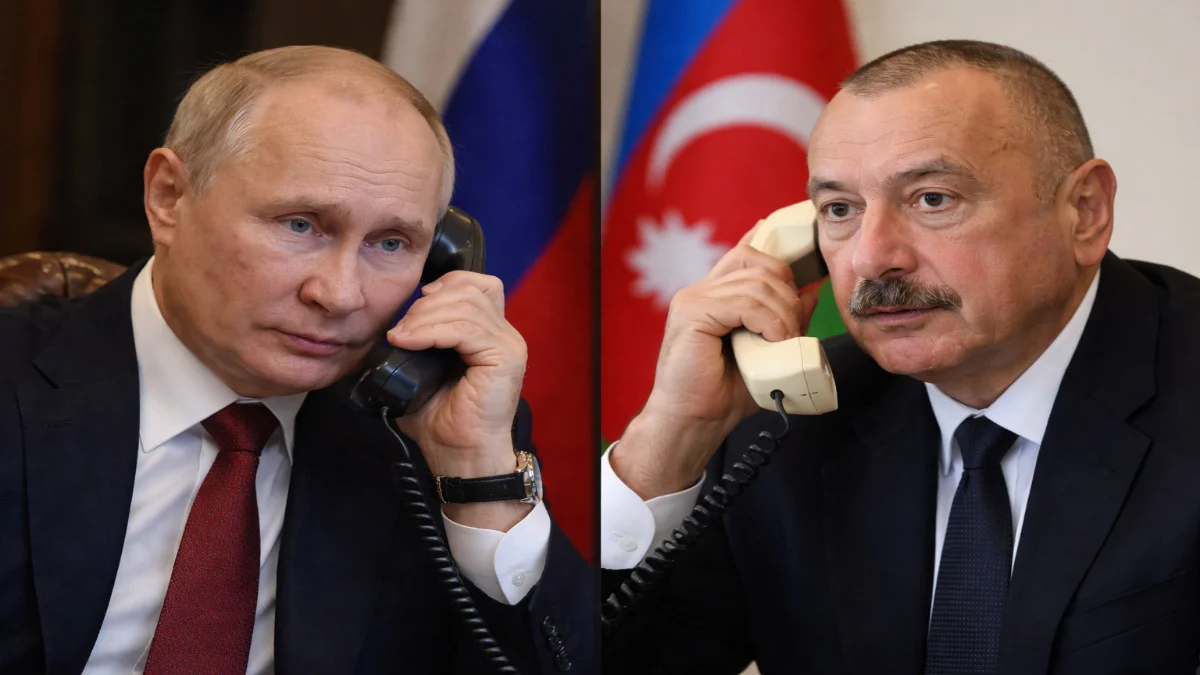

A recent telephone call between Vladimir Putin, President of the Russia and Ilham Aliyev, President of Azerbaijan emphasized on humanitarian collaboration as well as mutual resources on the mounting conflict in the Middle East. The meeting that was held on March 11 revolved around emergency evacuation and humanitarian transit as well as the wide stability of the region. In the very course of the call, Putin thanked Aliyev to Azerbaijan, which has been helping Russia evacuate its citizens out of Iran fairly quickly, as the regional tension was increasing. With the increased military action in the area, there was a high demand of evacuation routes by the foreign nationals. Azerbaijan helped Russian citizens to safely cross its borders, which the two heads referred to as the power of their strategic partnership.
Besides evacuation assistance, Azerbaijan gave allotment to transit of humanitarian aid of Russia to Iran by the Azerbaijan territory. This military cooperation helped Moscow provide humanitarian support even under the problematic regional conditions. This and other humanitarian corridors and transit arrangements are very vital in times of crisis, when aid supplies and civilians can safely cross the borders.
Legally, the evacuation of foreign nationals and the delivery of humanitarian transit are based on international law values. In accordance with the usual international law and the humanitarian conventions, states are in most cases supposed to help evacuate the civilians safely during emergencies when they can. Although the third-party states are not legally obligated to give transit corridors, this kind of cooperation is consistent with generally accepted humanitarian principles and diplomatic good will.
Legal meaning is also associated with the transit of humanitarian aid. The international humanitarian law promotes ease of conducting relief to civilians who are victims of war. By allowing aid delivery into its territory to reach a crisis region, a state will help to achieve the more general international goal of civilian suffering alleviation. The work of Azerbaijan facilitating these deliveries is an example of how neutral transit countries could help humanitarian actions without taking part in the conflict.
In addition to the humanitarian coordination, the two leaders talked of the overall geopolitical context in the Middle East. Both Putin and Aliyev pointed at the necessity of a rapid termination of military conflicts and the necessity to overcome the local conflicts with the help of political and diplomatic means instead of a long-standing military conflict.
The bilateral relations between Russia and Azerbaijan were also discussed during the conversation. The two presidents reiterated their desire to enhance collaboration in the economy, political, and security sectors. Their discussion was based on the paradigm of a strategic partnership that has evolved over the last few years notably in regional trade, energy relations, and security coordination. Altogether, the call highlighted the role of diplomatic communication and regional cooperation in the stabilization of the situation in the time of international crisis: humanitarian intervention and the greater political discourse on the decrease of the tensions.

Comments are closed.