
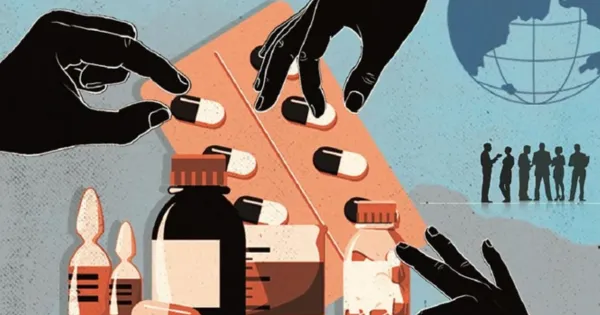
From Generic to Innovation: Target of $500 billion by 2047… Innovation journey of Indian pharmaceutical industry will start from 2026

New Delhi. The year 2026 marks the beginning of a crucial five-year period to create the necessary environment for India’s pharmaceutical industry to establish itself as an innovation hub and achieve its target of becoming a $500 billion sector by 2047. The effort comes amid near-term challenges such as tariff fluctuations and global trade restructuring. The country’s pharmaceutical industry, mainly based on generic drugs, has grown from $3 billion to $60 billion in the last 25 years. Now progress is being made in the direction of innovation in next generation medicines. The industry will also look to take advantage of the opportunity to acquire more than $300 billion worth of drugs whose exclusivity is set to expire over the next seven years.
Indian Pharmaceutical Association General Secretary Sudarshan Jain said, “Today the Indian pharmaceutical industry stands at a turning point and the next 25 years will be decided on the basis of innovation, quality and access.”
He said that the ‘agenda’ of innovation in indigenous pharmaceutical companies is gaining significant momentum. Jain said, “The next five years from 2026 will be critical in terms of implementation to translate policy momentum into concrete achievements so that India can achieve its goal of becoming a $450-500 billion industry by 2047 and emerging as a global life sciences innovation hub.”
Welcoming the supportive policies, he said that the Pharmaceutical Research and Innovation Promotion Plan (PRIP) has received a strong response from the industry, which marks an important start. “The newly announced Research Development Incentive Scheme, which makes bio-production a key area…is particularly timely, especially as drugs worth over $300 billion are set to lose exclusivity over the next seven years,” Jain said.
He said encouraging signs of India’s move towards innovation can be seen as major Indian pharmaceutical companies are buying high-value products, entering into licensing agreements and obtaining regulatory approvals for next-generation medicines. The Indian Pharmaceutical Association (IPA) comprises 23 major pharmaceutical companies including Sun Pharma, Cipla, Aurobindo Pharma and Dr. Reddy’s Laboratories. Another industry body, Organization of Pharmaceutical Producers of India (OPPI) also acknowledged that the Indian pharmaceutical industry is currently at a turning point.
OPPI Secretary General Anil Matai said, “While external challenges such as tariff fluctuations and global trade restructuring pose difficulties in the near term, they also further reinforce the strategic importance of creating a robust and high-quality production environment.”
He said the government’s refocusing on upgrading production standards, strengthening intellectual property protection for continued investment in research and innovation, and aligning with global quality standards is not only timely, but also transformative. Amira Shah, President, Net Health, India’s leading healthcare platform, said that the healthcare industry is also entering its most decisive decade starting from 2026.
“With patents on key treatments expiring, new care models emerging and the government taking forward negotiations on several free trade agreements, India has an opportunity to expand both reach and global leadership,” he said. Bharat Shesha, Managing Director, Indian Subcontinent, Philips, said policy reforms such as the Goods and Services Tax (GST) in the medical technology sector have boosted the sector and signaled India’s ambition to become a global medical technology innovation hub.

Comments are closed.