
From selling insurance to bringing McDonald’s, Starbucks to Malaysia: How tycoon Vincent Tan built his fortune

Tan, 74, has been trimming his stake in his flagship Berjaya Corporation, with the most recent disposals in late May reducing his holdings from 23% to roughly 15%, as reported by Bloomberg.
The conglomerate, which has interests spanning property, retail, financial services, telecommunications and gaming, was founded by Tan in 1984.
It is also the cornerstone of the rags-to-riches rise of Tan, who grew up in a poor family in Malaysia’s southernmost state of Johor and went on to become a prominent tycoon.
Bringing McDonald’s, Starbucks to Malaysia
After finishing high school at 17, Tan wanted to pursue a law degree, but his parents could not afford the tuition fees.
So he entered the workforce instead, taking a job as a bank clerk before moving into the insurance industry, where he rose through the ranks to become AIA Insurance’s then-youngest agency manager at the age of 21.
Tan has credited two major opportunities with helping launch his business empire.
“My two big breaks were buying the McDonald’s franchise when I was 28 years old and then later getting the government to allow me to privatize (gaming company) Sports Toto,” he said in a 2014 talk sharing his business experience, as quoted by The Star.
His pursuit of the McDonald’s franchise began in 1973 when, while working in insurance, he read a TIME magazine article titled “The Burger That Conquered The World” as he waited for a client.
Over the next seven years, Tan repeatedly wrote letters to the U.S. giant until it eventually invited him to the opening of its first restaurant in Singapore.
“When they visited Malaysia and interviewed many other people, they finally decided that I was the most enthusiastic and determined to be their franchisee,” Tan recalled in a 2008 Forbes interview.
Tan invested RM250,000 (US$62,000) while McDonald’s provided the other half of the capital, giving him a 51% stake. With that, the first McDonald’s outlet in Malaysia opened in 1980 on Kuala Lumpur’s Jalan Bukit Bintang.
Tan has credited his command of English with helping him secure the McDonald’s franchise in Malaysia.
“I can honestly say this would not have been possible if not for my proficiency in English that allowed me to convince the people at McDonald’s that I was the right person to help introduce and grow McDonald’s in Malaysia,” he said in a 2014 speech to students at his former secondary school, as quoted by Named.
The breakthrough led to more ventures. Tan acquired a controlling stake in Berjaya Kawat Berhad, a listed steel wire manufacturer, in 1984 for $8 million, most of it financed through bank loans. The company was later rebranded into what is now his flagship Berjaya Corp.
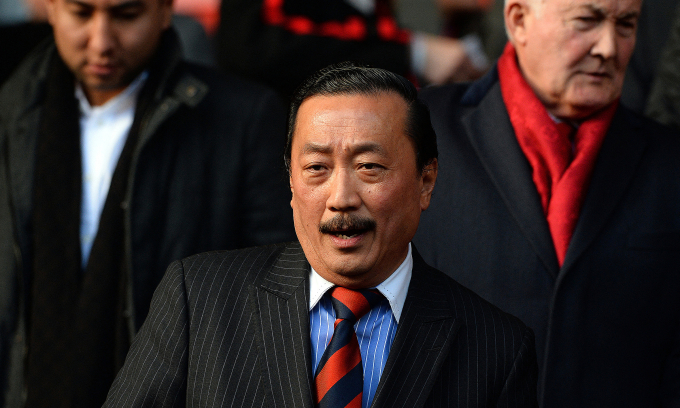
Cardiff City’s Malaysian owner Vincent Tan is shown to his seat before the English Premier League football match between Liverpool and Cardiff City at Anfield stadium in Liverpool, northwest England, on Dec. 21, 2013. Photo by AFP |
Within a year, Berjaya acquired the national lottery, Sports Toto, from the government. It later secured a license to operate the country’s gaming outlets, becoming one of Malaysia’s largest numbers-betting operators.
Tan went on to expand into a range of other businesses, including the Malaysian franchises for 7-Eleven and Starbucks, as well as a Mazda dealership.
The group also pursued joint ventures in countries including Vietnam, China, South Korea and Thailand, where it developed property, infrastructure, hotel and resort projects.
His business empire earned him a spot on the Forbes billionaires list in 2010 with an estimated net worth of $1.6 billion.
But his journey was not without setbacks. During the 1997 Asian financial crisis, he sold his stakes in Digi (now mobile service provider CelcomDigi) and insurer Prudential to support the construction of Berjaya Times Square, then his latest megaproject.
“I had to. I did not want people to see a half completed building when they drive down Jalan Imbi and then think ‘Oh that Vincent Tan is a failure!” he said during the 2014 talk.
The sprawling development eventually opened in 2003, featuring an indoor theme park, 700 shops and 45 restaurants.
In 2016, he lost his billionaire status after what Forbes described as “a difficult year” marked by a weaker ringgit and a declining Malaysian stock market.
More recently, McDonald’s and Starbucks have faced boycotts in Malaysia, which weighed on their performances.
Leaving a mark
When Tan turned 60 in 2012, he stepped down and handed leadership of Berjaya Corp to his eldest son, Robin Tan, only to return to the helm five years later.
He said in a statement cited by Nikkei Asia that he wanted to take a more active role in board-level decisions and show “commitment and accountability” to stakeholders.
He stepped down again in 2023, when Tunku Tun Aminah Sultan Ibrahim Ismail, daughter of Malaysia’s billionaire king Sultan Ibrahim Iskandar, succeeded him as non-independent non-executive chairman. He remains an advisor to the board.
During both resignations, he said he wanted to devote more time to his philanthropic work, which he is also widely known for alongside his business career.
His charity, Better Malaysia Foundation, supports a range of social causes including education, healthcare and housing for underprivileged communities.
He also founded another foundation, Yayasan Rumah Ku (Yayasan My First Home), which provides assistance to individuals struggling with homebuying.
He has also pledged to donate half of his wealth to charity and is a signatory of the Giving Pledge, the global charity initiative founded by Bill and Melinda Gates and Warren Buffett.
“I didn’t become rich because I invented something important for humanity,” Tan told The Peak in 2021. “Instead, I was lucky to receive many opportunities. (…) Thus, it is only right that I give half of my wealth back to the people and this country. I think it is a wise and right thing to do.”

Comments are closed.