
From the challenge of vermillion to China’s friendship… a tough test for India’s diplomacy in 2025

New Delhi. 2025 was a year of big test for India’s diplomacy in many ways. It had to deal with the geopolitical fallout of the deadliest military confrontation with Pakistan in decades, tariffs imposed by US President Donald Trump and worsening relations with Bangladesh.
The horrific terrorist attack in Jammu and Kashmir’s Pahalgam in April that killed 26 people sparked global outrage and India showed countries around the world that it has the right to respond by taking a tough stance against cross-border terrorism from Pakistan. Following the terrorist attack, India announced several punitive measures against Pakistan, including suspension of the 65-year-old Indus Water Treaty.
Prime Minister Narendra Modi said, “Water and blood cannot flow together.” Just two weeks after the terrorist attack, India launched ‘Operation Sindoor’ and on May 7 carried out air strikes on nine terrorist hideouts in Pakistan and Pakistan-occupied Kashmir, killing at least 100 terrorists.
Following these attacks, Pakistan retaliated, although the Indian Army foiled most of these attacks. As the situation deteriorated rapidly, there was a fear of a full-scale war between the two nuclear-armed countries and many countries of the world appealed to them to exercise restraint and contacted New Delhi and Islamabad to stop the military confrontation.
After talks on the ‘hotline’ between the military officials of India and Pakistan, an agreement was reached on May 10 to stop the military confrontation, but first of all, US President Trump announced the ceasefire by sharing a post on social media, which created a new challenge for India’s foreign policy experts.
In the months that followed, Trump publicly stated several times that he had stopped the military conflict between India and Pakistan and saved millions of lives, while New Delhi consistently maintained that the cessation of military conflict had been agreed after talks between India and Pakistan and that the US had no role in it. This stand of India displeased the Trump administration. Amidst the tension in relations between India and America, Trump hosted a closed-door lunch for Pakistan Army Chief Field Marshal Asim Munir at the ‘White House’ (the official residence and office of the US President) on June 18, which gave a significant boost to the relations between America and Pakistan. Trump met Munir for the second time on October 1.
As talks on a bilateral trade deal with India dragged on, Trump in August imposed 50 percent tariffs on Indian goods, including an additional 25 percent duty on purchases of Russian crude. America’s new immigration policy and decision to increase the H-1B visa fee to US$100,000 also appeared to be the reason for the deterioration in relations. This sharp deterioration in relations between the two leaders surprised many foreign policy experts as Trump’s first term as President had seen cordial relations between him and Modi.
In another major development, Pakistan signed a strategic defense agreement with Saudi Arabia in which it was said that “an attack on either of the two countries will be considered an attack on both.” Tension also increased in the relations between India and Bangladesh, mainly due to the increasing activities of extremist elements targeting minorities including Hindus in Bangladesh. Bangladesh’s increasing contacts with Pakistan and China also led to the deterioration in relations. Relations started declining after ousted Bangladesh Prime Minister Sheikh Hasina visited India in August 2024.
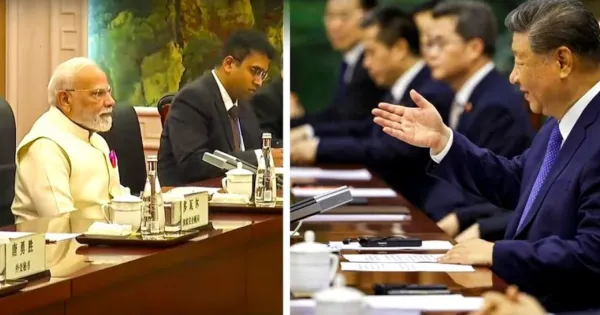
However, India-China relations improved significantly in 2025 and after the deterioration during the eastern Ladakh border dispute, several steps were taken to strengthen the relationship again, including Kailash Mansarovar Yatra, resumption of direct flights and relaxation in visa norms. Modi and Chinese President Xi Jinping agreed in August to deepen bilateral ties and find a “proper” solution to the border issue. At a meeting in Tianjin, China, on the sidelines of the Shanghai Cooperation Summit, Modi and Xi also pledged to expand trade and investment ties to stabilize global commerce.
Relations with Russia also strengthened in many areas including energy. At the end of the year, Russian President Vladimir Putin visited India and a five-year plan was agreed upon to strengthen the trade partnership between India and Russia. India and Britain signed a historic free trade agreement in July. India and Canada also made efforts to improve relations after the 2023 dispute. Concerns related to the Indo-Pacific and expanding cooperation with the Gulf region to enhance energy security were also the main focuses of the year’s diplomacy.

Comments are closed.