
From Tunnels To Airbases: How India Is Fortifying Himalayas To Face Any Clash With China | world news

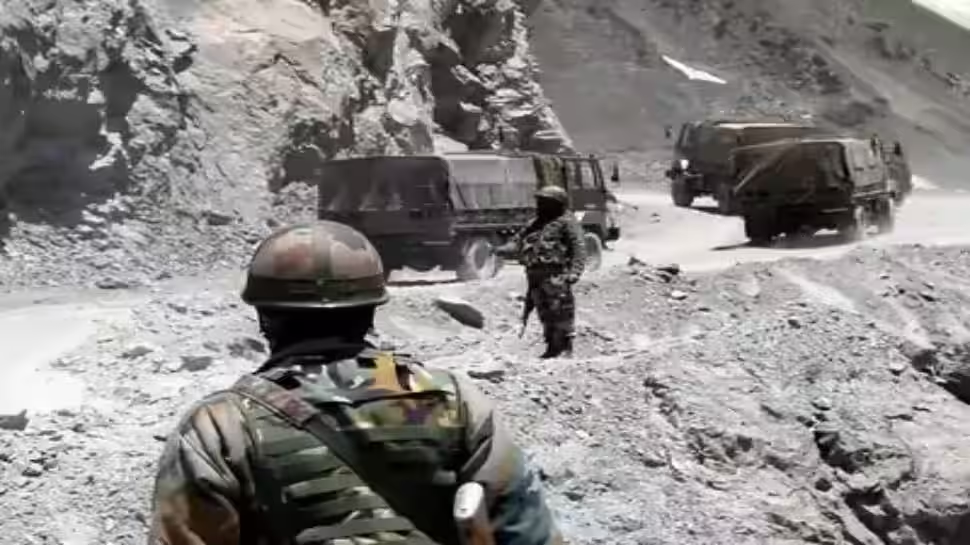
New Delhi: High in the Himalayas, with icy peaks and unforgiving valleys, India is changing its frontier with China. Roads are being constructed in the mountains, tunnels are piercing through rock, bridges are rising over gorges and airstrips are taking built where only silence once existed. This massive construction drive is not routine development. It is preparation, which is born out of hard lessons from the 2020 Galwan Valley clash. It is aimed at ensuring India is never caught off guard again.
According to a recent report by The Wall Street Journal, India is spending hundreds of millions of dollars to strengthen infrastructure along the Line of Actual Control (LAC). It signals a change in the country’s defense posture. The goal is faster movement of troops, reliable supply lines and the ability to respond immediately to any escalation on the border with China.
The backbone of this effort is the Border Roads Organization (BRO). By 2025, its budget has climbed to around $810 million. Thousands of kilometers of roads are under construction, along with dozens of helipads and multiple airfields. Engineers and workers are operating in extreme conditions (thin air, sub-zero temperatures and treacherous terrain), pushing machines and bodies to their limits.
Add Zee News as a Preferred Source
Lessons From Galwan
The turning point came in June 2020, when Indian and Chinese troops clashed in the Galwan Valley of eastern Ladakh. Twenty Indian soldiers were killed, and China also suffered casualties.
It was the first deadly confrontation along the border in 45 years, fought without firearms but with brutal hand-to-hand combat. The incident laid bare a critical imbalance.
China had spent decades building dense networks of roads, railways and military facilities across Tibet and Xinjiang. This allowed the People’s Liberation Army to move troops and equipment to the frontier within hours. On the other hand, India struggled with poor connectivity, often taking days to reach forward positions.
Former operational logistics chief Major General Amrit Pal Singh described the aftermath as a moment of reckoning. “It was a dramatic change in thinking. We had to change our entire approach,” he said.
For years, India had avoided building roads near the border, fearing they could help an invading force. Galwan shattered that assumption.
Mega Projects In The Mountains
One of the most ambitious projects is the Zoji La tunnel, being built at an altitude of nearly 11,500 feet. Stretching 14 kilometers and costing over $750 million, the tunnel will provide all-weather access to Ladakh.
Until now, heavy snowfall has cut the region off from the rest of the country for months each year. Once completed, the tunnel will reduce travel time and ensure uninterrupted movement of military supplies and civilian essentials.
Air connectivity is also expanding rapidly. Located at nearly 14,000 feet and just 19 miles from the Chinese border, the Nyoma airbase in Ladakh is being developed to handle large aircraft like the C-130J. Its location gives it immense strategic value. Across the border regions, more than 30 helipads have been built, and several airstrips are being constructed or upgraded.
In Arunachal Pradesh, Sikkim and Uttarakhand, new roads and bridges are improving access to remote areas. Recently, 125 BRO projects were inaugurated, including the strategically important Shyok tunnel and multiple high-altitude bridges.
Supplying Soldiers At The Roof Of The World
Despite these advances, logistics at extreme altitudes is a challenge. The Wall Street Journal reports that supplies are transported by rail and trucks to depots in Jammu and Kashmir and then moved in convoys to Leh. From there, smaller vehicles take over, and the final leg (often above 20,000 feet) is covered by porters and pack animals.
Former Northern Army Commander Lieutenant General (Retd) DS Hooda explained the scale of the effort. “This is a massive logistical operation carried out year after year,” he said.
Each soldier needs around 220 pounds (nearly 100 kilograms) of supplies every month. A small forward post consumes about 13 gallons of fuel daily, and almost all of it has to be carried by hand or mule through hostile terrain.
From ‘Red Carpet’ Fears To Firm Deterrence
For years, Indian strategic thinking was influenced by the fear that building large roads near the border would amount to laying a red carpet for an enemy advance. The change in the mindset began in the mid-2000s, especially as China rapidly expanded infrastructure in Tibet and Xinjiang.
The risks are still there. Greater patrols and better access can increase friction in contested areas such as Pangong Tso, where disengagement agreements exist but both armies maintain a presence. Even so, Indian officials view the build-up not as a race with China, but as a deterrent.
“We are not going overboard,” Major General Amrit Pal Singh has said, highlighting the official line that the objective is stability through strength.
A Strategic Shift With Wider Impact
This Himalayan construction push signals a fundamental change in India’s defense strategy. It is not only about military readiness, but also about integrating border regions into the national economy and improving the lives of local communities. At the same time, it highlights the reality of rising tensions between two nuclear-armed neighbours.
As tunnels bore deeper into mountains and aircraft land closer to the frontier, India is giving out a message that it is determined to ensure that, along the LAC, it will never again be slowed by terrain or unprepared for a confrontation.

Comments are closed.