

Shipments amounted to $750 million in December alone and $7.75 billion in the first 11 months, up 17.3% year-on-year, customs data show.
The figures indicate sustained global demand for Vietnamese fruit and vegetables, providing a solid foundation for the trade to soon surpass the $10-billion milestone.
Growth has been driven largely by six key fruits, namely durian, banana, mango, jackfruit, coconut and grapefruit.
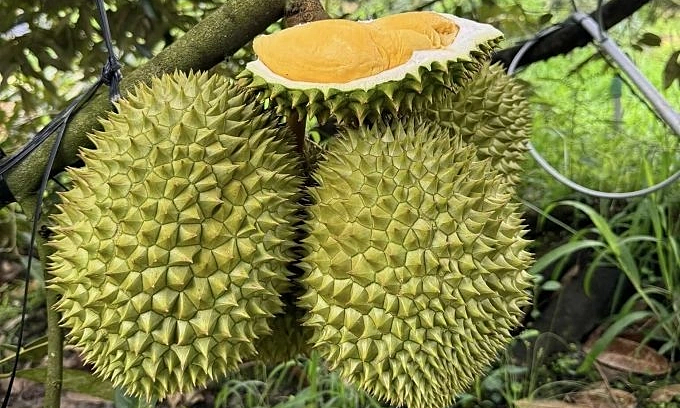
Durian remains the standout product, particularly in the Chinese market where demand has surged. Exports of the fruit were estimated at more than $4 billion this year.
Durians in an orchard in the Mekong Delta city of Can Tho. Photo by VnExpress/Manh Khuong |
The Ministry of Agriculture and Environment’s Department of Planning and Finance reported that average export prices for many key agricultural items rose towards the end of the year, boosting export earnings.
Fruit and vegetable shipments rebounded in September and October as bottlenecks affecting durian exports were resolved.
Exports to China were worth nearly $5 billion in the first 11 months, about 15% higher than a year ago and already surpassing the full-year record of $4.63 billion set in 2024. Exports to the U.S. reached $499.2 million, up 56%, while those to South Korea totaled $284.2 million.
Vietnam is now the second-largest supplier of fresh and processed fruit and vegetables to China, with shipments growing by 26.9% year-on-year. Its market share rose to 22% in October, compared with 18.5% a year earlier.
The broader agricultural exports reached nearly $70 billion this year, marking a turning point as growth is no longer driven solely by volume but also by quality, deep processing and sustainable development.
The Vietnam Fruit and Vegetable Association noted strong growth in exports of processed items including canned and dried products. The segment recorded double-digit growth and is now worth an estimated $1.65 billion, supported by greater investment in modern processing facilities and raw material zones.
Exports of fruit and vegetables have risen sharply over the last three years, climbing from $3.34 billion in 2022 to $5.6 billion in 2023, largely driven by durian shipments to China, and to $7.2 billion last year.
To meet increasingly strict import requirements, the agriculture ministry will pilot a traceability system for durian from Jan. 1 to June 30, 2026.
The scheme will establish a unified traceability platform covering production, purchasing, processing, packaging, transport and distribution. Products will carry QR codes or other electronic authentication such as NFC or RFID, enabling real-time tracking to enhance transparency, quality control and food safety.

Comments are closed.