
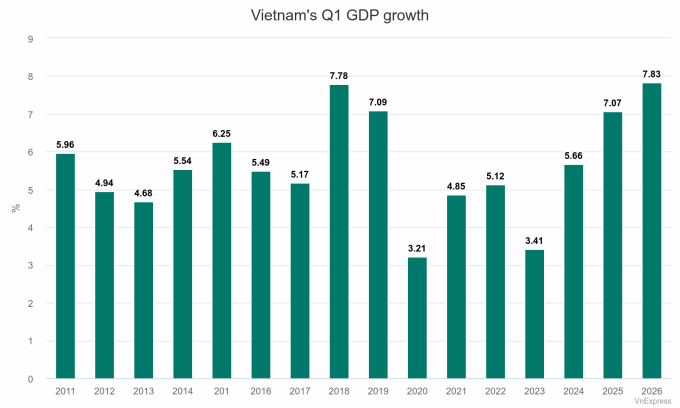

The industry–construction and services remained the key pillars of the economy, with services contributing the most to the economy’s added value at more than 50.32%, according to the General Statistics Office.
Consumer demand during the Lunar New Year and a surge in international visitors to Vietnam supported strong growth in trade and services. As a result, value added in services rose 8.18% year-on-year.
Industry and construction maintained a positive growth trend, with construction activity improving thanks to accelerated public investment disbursement.
Total industrial value added rose 9.01%, with manufacturing and processing serving as the main growth driver, expanding 9.73%.
The agriculture, forestry and fisheries sector recorded stable growth, with value added rising 3.36% in the first quarter.
In terms of economic structure, agriculture, forestry and fisheries accounted for 10.89%, industry and construction 37.15%, and services 43.45%. This was largely unchanged from a year earlier.
The first quarter also saw vibrant trading activities, totaling more than $249.5 billion, up 23% year-on-year.
Exports increased 19.1%, while imports rose 27%, resulting in a trade deficit of $3.64 billion.
In the first three months, 96,000 enterprises were newly established or resumed operations nationwide, up 31.7% year-on-year. On average, more than 32,000 enterprises were established or resumed operations each month.
However, the number of businesses shutting down or dissolving also rose sharply, with an average of 30,600 exiting the market each month.
Total additional registered capital injected into the economy reached more than VND1.3 quadrillion, down 5.1%.
A business sentiment survey of the manufacturing and processing sector, a key driver of the economy, showed that more than 23.8% of respondents reported improved business conditions compared to the previous quarter.
Over 40% said conditions were stable, while the remainder reported difficulties.
The Consumer Price Index in the first three months rose 3.51% compared to the same period in 2025, with March recording the highest CPI for the period in the past five years.
Assessing Q1 growth performance, Nguyen Thi Huong, head of the General Statistics Office under the Ministry of Finance, described it as “positive” amid increasingly unpredictable global developments and escalating armed conflicts.
“Statistical indicators show that domestic macroeconomic conditions remain stable, with inflation kept under control at an appropriate level,” she said.
However, the economy is expected to face continued challenges in the coming quarters. As a highly open economy, Vietnam is exposed to intertwined economic and political fluctuations globally.
To achieve double-digit growth this year, the statistical agency said Vietnam must maintain macroeconomic stability, ensure major economic balances, secure goods supply, and keep prices and markets under control.
Huong emphasized that policymakers need to promptly update growth and inflation scenarios and enhance the economy’s self-reliance to respond effectively to external shocks.
“It is necessary to manage fuel prices flexibly through tax, fee and stabilization fund tools to limit domestic fuel price increases. At the same time, the roadmap for adjusting state-managed prices, such as electricity, healthcare, education and public services, should be reviewed to avoid simultaneous inflationary pressure,” she added.
She also noted that authorities should adopt appropriate support measures for sectors directly affected by fuel price volatility and logistics costs, including transport, fisheries, agriculture and logistics.
During difficult periods, businesses should be supported with policies to defer, delay or reduce certain taxes and input fees to stabilize production and sustain employment.

Comments are closed.