
German Embassy Closed, US Issues Alert – What’s Really Happening In Bangladesh On Dec 25? , world news

New Delhi: Unusual diplomatic moves in Dhaka have raised questions about what is expected to happen in Bangladesh on December 25, a date that has caused heightened caution from Western missions.
Germany’s embassy in Bangladesh has announced that it will remain closed on December 24 and 25. At the same time, the US Embassy in Dhaka has issued an advisory for December 25, sensing potential disruptions and urging caution.
While the German mission has not explained the reason behind its decision to shut operations for two days, the American embassy has offered a detailed explanation.
Add Zee News as a Preferred Source
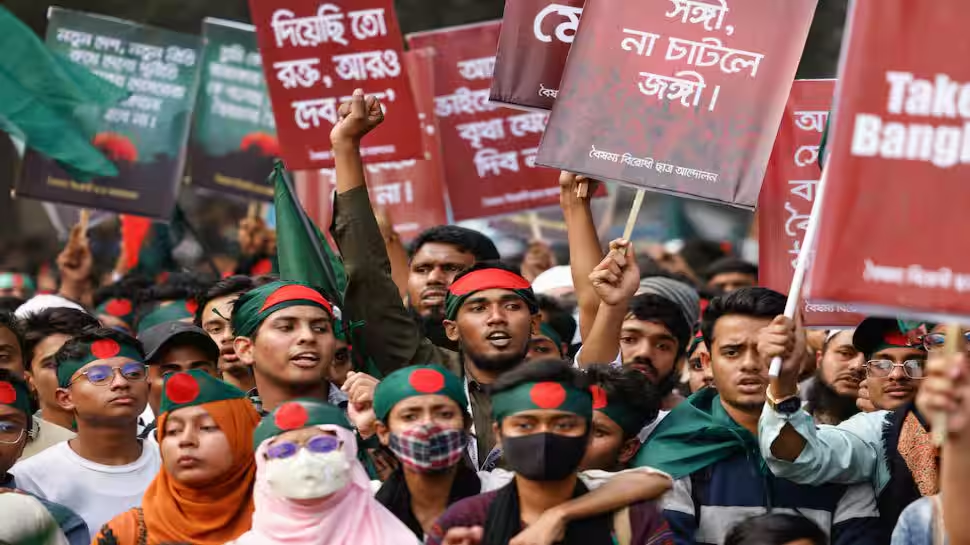
The developments come days after several Western countries, including the United States, the United Kingdom and members of the European Union, issued condolence statements following the death of student leader Sharif Usman Hadi. Questions are being raised over why Germany and the United States appear particularly alert about December 25 in Bangladesh.
In a post on
The US Embassy, in its advisory, referred to media reports that the Bangladesh Nationalist Party has planned a massive gathering in Dhaka to celebrate the return of its acting chairman, Tarique Rahman.
According to the advisory, the rally is scheduled to begin at 11:45 am on December 25 and will stretch from Hazrat Shahjalal International Airport to Gulshan, covering the Purbachal Expressway and other important routes.
“Due to this, heavy traffic congestion is expected,” the advisory said. It urged people traveling in and around Dhaka to allow extra time and consider alternative routes. The embassy also advised passengers heading to the airport to carry their air tickets and travel documents and to be prepared to show them at police checkpoints.
During this period, US Ambassador to India Sergio Gor also spoke with Bangladesh’s Chief Advisor Muhammad Yunus. Their discussion covered recent developments in Bangladesh and the upcoming elections.
Rahman’s Return After 17 Years
Media reports say BNP’s Acting Chairman Rahman has applied for a travel pass to return to Bangladesh on December 25. He submitted the application at the Bangladesh High Commission in London.
In a Facebook post dated December 18, the BNP said, “Tarique will arrive at Hazrat Shahjalal International Airport at 11:45 am on December 25.”
He is the eldest son of BNP founder Ziaur Rahman and party chairperson Khaleda Zia. He was arrested in 2007 during the Army-backed caretaker government. In 2008, he traveled to the United Kingdom for medical treatment and has lived there since.
His wife, Zubaida Rahman, returned to London on December 20 after traveling to Bangladesh.
Zia has played a central role in Bangladesh’s politics for more than four decades. After the assassination of her husband, she took charge of the BNP. Ziaur Rahman was serving as Bangladesh’s president when he was killed in 1981.
Khaleda Zia has been a supporter of multi-party democracy in Bangladesh. She became the country’s first woman prime minister in 1991 after the BNP won the elections. She returned to power in 2001 and was in office until 2006.
The BNP boycotted the last three elections. Zia supported the movement launched in 2024 against Sheikh Hasina. The BNP is Bangladesh’s largest political party, and there is growing speculation that it could return to power in next year’s elections.
During Hasina’s tenure as prime minister, Zia was in jail. Courts had convicted her son Tarique Rahman in multiple cases. The interim government later acquitted both the mother-son duo.
Western Embassies, The Usman Hadi Factor
On December 12, Hadi, a leader of the Inqilab Manch, was shot by unidentified attackers in Bangladesh. He was taken to a hospital in Singapore for treatment, where he later died.
He had emerged as a popular face of the 2024 uprising that led to the ouster of former Prime Minister Hasina.
Following news of his death, violence broke out in parts of Bangladesh. The Indian High Commission also came under attack after rumors spread that Hadi’s killers had fled to India.
On the day of Hadi’s funeral, European embassies issued condolence messages, and the German Embassy lowered its flag as a mark of respect. India did not issue any official reaction to his death.
Former Indian Foreign Secretary Kanwal Sibal has questioned the response from Western countries. In a post on
He added, “What is even more interesting is that Hadi had Islamist links. His Inqilab Manch aimed to Islamise nominally secular Bangladesh. His conduct was deeply hostile to India, and he laid claim to India’s northeast. A particular message is therefore being sent to India in the regional context.”
Sibal also wrote that Hadi’s organization had campaigned to ban the Awami League and block it from contesting upcoming elections.
“Western countries complained that Sheikh Hasina was not democratic enough. Mourning a person whose organization sought to impose Sharia law in Bangladesh goes against democracy and minority rights. His followers repeatedly burned buildings associated with Sheikh Mujibur Rahman while rejecting Bangladesh’s liberation struggle,” he said.
He went on to ask, “Do these Western embassies endorse all this? Is this another example of Western double standards and hypocrisy? Official statements of this nature are usually issued when the individual has international significance.”
Amid these developments, Russia’s Ambassador to Bangladesh Alexander Grigoryevich Khozin said on Monday that tensions between Bangladesh and India should be reduced as soon as possible. He said he was not interfering in bilateral relations but felt it was wise to find a way to prevent tensions from rising beyond the present level.
Strain In India-Bangladesh Ties
Relations between India and Bangladesh have been strained since last year’s unrest in Bangladesh. Anti-India sentiment intensified after the violence that followed Hadi’s death.
Last week, a Hindu youth was beaten to death in the country. Days later, India and Bangladesh faced off diplomatically after an alleged protest outside the Bangladesh High Commission in New Delhi on December 20.
Following the incident, India’s Ministry of External Affairs spokesperson Randhir Jaiswal said India had said what he described as “misleading propaganda” circulating in sections of the Bangladeshi media.
In an official statement, he said, “The fact is that around 20-25 people gathered outside the Bangladesh High Commission in New Delhi on December 20. They raised slogans against the killing of Dipu Chandra Das in Mymensingh and demanded protection for all minorities in Bangladesh.”
Dhaka reacted strongly to the statement, protesting against the demonstration outside its mission in New Delhi. It said that the incident could not be dismissed simply as “misleading propaganda”.
The country said the “untoward incident” at its High Commission residence on December 20 was regrettable. Calling it misleading propaganda was unacceptable, it said. In a statement, Bangladesh’s Foreign Ministry described the episode as an “inappropriate incident”, highlighting the growing tension between the two neighbors as December 25 approaches.

Comments are closed.