
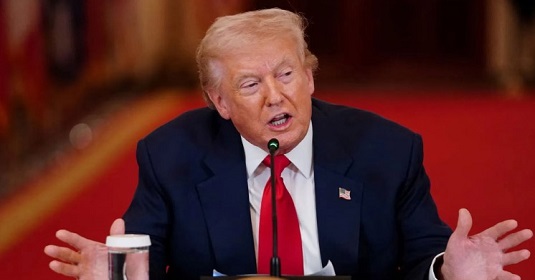
Global tension increased on Hormuz Strait: Why did Trump ask for help from 7 countries?, increased concern about oil supply and prices, know complete information

Washington. Amid the ongoing war in West Asia, concerns about the world’s oil supply are increasing. Meanwhile, US President Donald Trump has said that he has demanded to keep the Strait of Hormuz open and safe by sending warships from about seven countries. However, till now no country has made a clear commitment on this.
Speaking to reporters while returning to Washington from Air Force One, Trump said that this sea route is especially important for those countries which import large quantities of oil from West Asia. He said that the countries concerned should themselves take responsibility for the security of their region as it is more important for them.
Important route of world oil trade-
The Strait of Hormuz is counted among the most important sea routes in the world. Under normal circumstances, about one-fifth of global oil trade passes through this route. Due to the current war, concerns about the security of this route have increased and oil prices are also rising in the international market.
Less need for America, more impact on China-
Trump says that America does not need this route as much because it has enough sources of oil of its own. He claimed that China gets about 90 percent of its oil through this route, whereas America’s dependence level is very low.
Trump has already appealed to countries like China, France, Japan, South Korea and Britain for cooperation in this mission. While talking to Trump, British Prime Minister Keir Starmer said that it is necessary to normalize this sea route to keep global shipping safe, although Britain has not yet decided to send its warships.
Iran’s different stance-
Meanwhile, Iran’s Foreign Minister Abbas Araghchi has claimed that many countries have contacted Tehran to allow their ships to pass safely. He told that some ships have also been given permission, but which countries have got this permission, it was not disclosed.
Iran says that this sea route is open to all countries, but not to America and its allies.
Many countries still cautious-
US Energy Minister Chris Wright said that continuous talks are going on with many countries and it is expected that China will also cooperate in ensuring the security of this route. South Korea has said that it is monitoring the situation and coordinating with America.
German Foreign Minister Johann Wadephul clarified that Germany was not planning to become actively involved in the conflict.
Attempt to control oil prices-
To keep the global oil market stable, the International Energy Agency has decided to release emergency oil reserves. According to the agency, about 412 million barrels of oil will be released into the market so that rising prices can be controlled. Reserves from Asian countries will be released immediately, while reserves from Europe and the US will hit the market from the end of March.
Increasing human impact of war-
The effects of the war are visible throughout West Asia. According to the International Committee of the Red Cross, more than 1,300 people have died in Iran so far, including women and children.
At the same time, 12 people have lost their lives and many have been injured in Iranian missile attacks in Israel. Apart from this, the conflict has also intensified in Lebanon, where hundreds of people have been killed and lakhs have been forced to leave their homes.
Overall, the situation in West Asia is becoming increasingly serious and the possibility of its impact on the global economy and energy supply is increasing.

Comments are closed.