
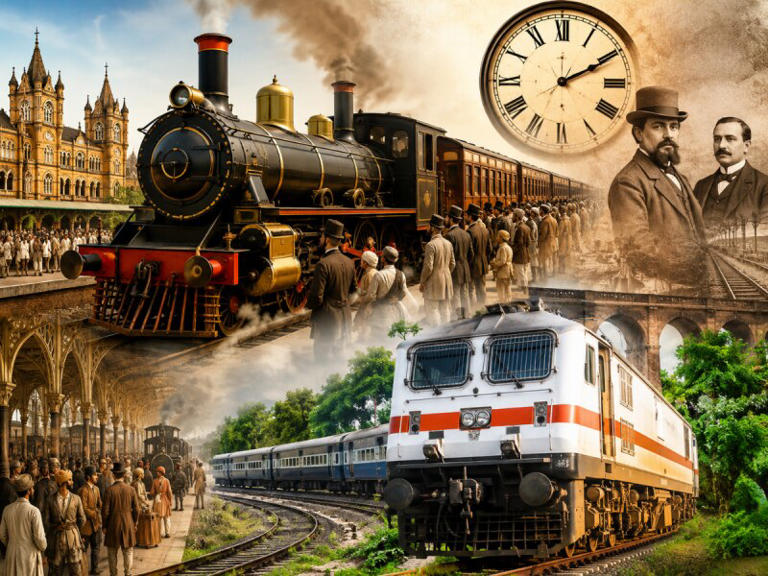
Glorious history of Indian Railways: When the country’s first passenger train ran on the tracks with a 21-gun salute

Nowadays, traveling by train is a very common thing for us. Every day lakhs of people use Indian Railways for work or travel. But have you ever wondered when and how this lifeline started? The day of 16 April 1853 is forever recorded in golden letters in Indian history. On the same day, at exactly 3:30 pm, the country’s first passenger train left from Mumbai (then Bori Bunder station) for Thane. About 400 passengers took part in this historic journey. The train covered the total distance of 34 kilometers in just 1 hour 15 minutes and reached Thane at 4.45 pm. How much was the train fare then? For this first and historic journey, Railways had fixed ticket rates according to different classes. This fare was considered a huge sum for those times: Three ‘magical’ steam engines were brought from Britain To pull this first passenger train, three very powerful steam engines were specially brought to India from Britain. These three engines were given very cute and Indian names – Sahib, Sindh and Sultan. Together, these three engines pulled train coaches and ushered in a new era of transportation in the country. The contribution of British engineer Richard Trevithick in popularizing this steam engine technology in India and laying a network of railway lines is still remembered. It started with a 21-gun salute. The main blueprint for running railways in India was prepared in the year 1848, when Lord Dalhousie became the Governor General of India. He presented the plan of Railways to speed up the development and transportation of the country. After this, ‘Great Indian Peninsula Railway Company’ was given the responsibility of laying the rail line between Mumbai and Thane. The work started in the year 1850 and after three years of hard work the first train hit the tracks. To celebrate this historic moment, the train was sent off with a 21-gun salute. The journey from the first train of 1853 to today’s huge network. This small journey that started in 1853 became India’s biggest strength with time. However, to reach today’s position, Railways had to see many ups and downs: Big shock of partition: When India was divided in the year 1947, more than 40 percent of the country’s railway network went to Pakistan’s part. Despite this, Indian Railways did not lose courage and maintained the pace of development on its own. First Superfast Train: The country’s first superfast train was started on 1 March 1969 between New Delhi and Howrah, which gave a new identity to the speed of Indian Railways. Today’s Vast Empire: Today, Indian Railways is one of the largest rail networks in the world. Its total length extends to approximately 1.67 lakh kilometers. There are more than 7,342 railway stations in the country, including small and big, from where about 2.3 crore passengers travel every day and lakhs of tonnes of goods are transported. Today, Railways is the strongest medium to connect all the 28 states and 8 union territories of the country.

Comments are closed.