
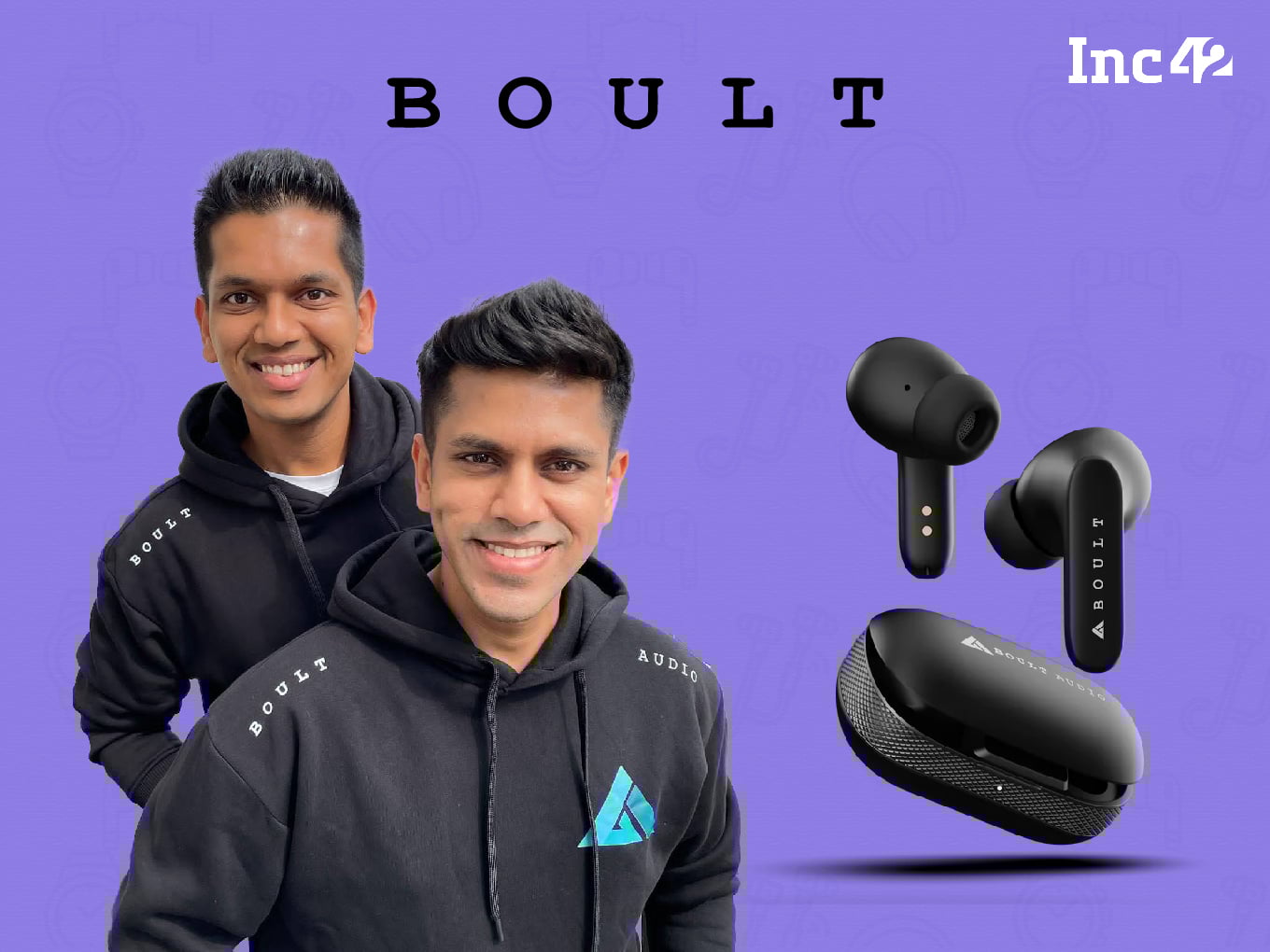

GoBoult is planning to file a DRHP with SEBI by October or November of this year, with plans to list publicly in the next 16 months
The startup is on track to achieve ₹1,000 Cr in revenue in FY26, after reporting a a 9.42% increase in FY25 to ₹762.9 Cr
GoBoult is not looking to expand into new product categories, and is instead sticking to the current offerings of audio products and smartwatches
Smart wearables startup GoBoult is planning to file a draft red herring prospectus (DRHP) with the Securities and Exchange Board of India (SEBI) by October or November 2026 with the aim of listing on public bourses by the summer of 2027, cofounder Varun Gupta told Inc42.
“We have started the IPO process already. We had three major objectives before we go for an IPO and we have achieved those. We also wanted to rebrand before an IPO because the risk appetite to rebrand afterwards is much higher. We have done that now, so we are all set and are looking at a summer 2027 listing,” he said.
For context, GoBoult rebranded from Boult in August 2025 to position itself as a younger and more upmarket brand in anticipation of its public listing. However, it was reported at the time that the company was facing copyright infringement accusations from its competitor boAtwhich might have influenced this decision. Important to note that boAt is also currently in the process of going public.
On the financial front, Gupta shared that the startup is targeting achieving a revenue of ₹1,000 Cr for FY26. He is also projecting another 15-20% growth in revenue in FY27.
In FY25, GoBoult reported an operating revenue of ₹762.9 Cr, a 9.4% increase from ₹697.2 Cr in the previous fiscal year. Its profit in FY25 stood at ₹24.2 Cr, a near 10X jump from ₹2.5 Cr PAT reported in FY24.
Other milestones set by GoBoult before the IPO include a push towards premiumisation, which it is building on by partnering with brands such as Mustang and Dolby. As per Gupta, this has led to an over 10% increase in the average selling price (ASP) of products sold by the startup, from around ₹1,100 earlier. It is targeting to increase the ASP to ₹1,500 in the next two years, as the share of its more premium priced products increases.
Additionally, the startup is focussing heavily on expanding in the offline presence in the run up to its public listing bid. As per Gupta, around 80% of GoBoult’s sales come via ecommerce platform, while over 15% come from quick commerce. The remaining sales are made through its website and offline channels.
“Ecommerce, as a channel, has unfortunately stagnated and the wearables category is degrowing, so we are only eating up more market share from our competition. The idea is to stay afloat, be profitable, and go heavy and deeper into channels such as offline and D2C and more into premiumisation, so that even if we are not able to sell a lot more units, we are able to increase the ASP so that our bottom line is much better,” Gupta said.
GoBoult currently has a presence in 3,000 offline stores across India, While it has partnered with modern trade outlet chains like Croma and Reliance Digital, it is also focussing on increasing its presence in brick and mortar general trade stores.
“Across the industry, offline sales currently stand at 25-30%, and we feel it is underpenetrated and it is very polarised toward the biggest player in the category. Occupying market share offline is a slower and more patient game,” Gupta said.
Competition in the wearables segment is heating up in India, with several new brands offering smartwatches and audio devices cropping up in recent years, even as growth of the market itself has stagnated.
To counter this, some brands have begun diversifying their offerings. For instance, GoBoult’s rival boAt recently forayed in the car-safety segment by launching a line of dashcams. Noise, on the other hand, has begun to diversify by introducing products like GaN chargers and power cables.
However, Gupta stressed that GoBoult is not looking to expand into new product categories, and is instead sticking to the current offerings of audio products and smartwatches. “We are staying in our categories. As a company, our philosophy is not to get into every category, but to go deeper into existing categories to build a global brand,” he said.

Comments are closed.