
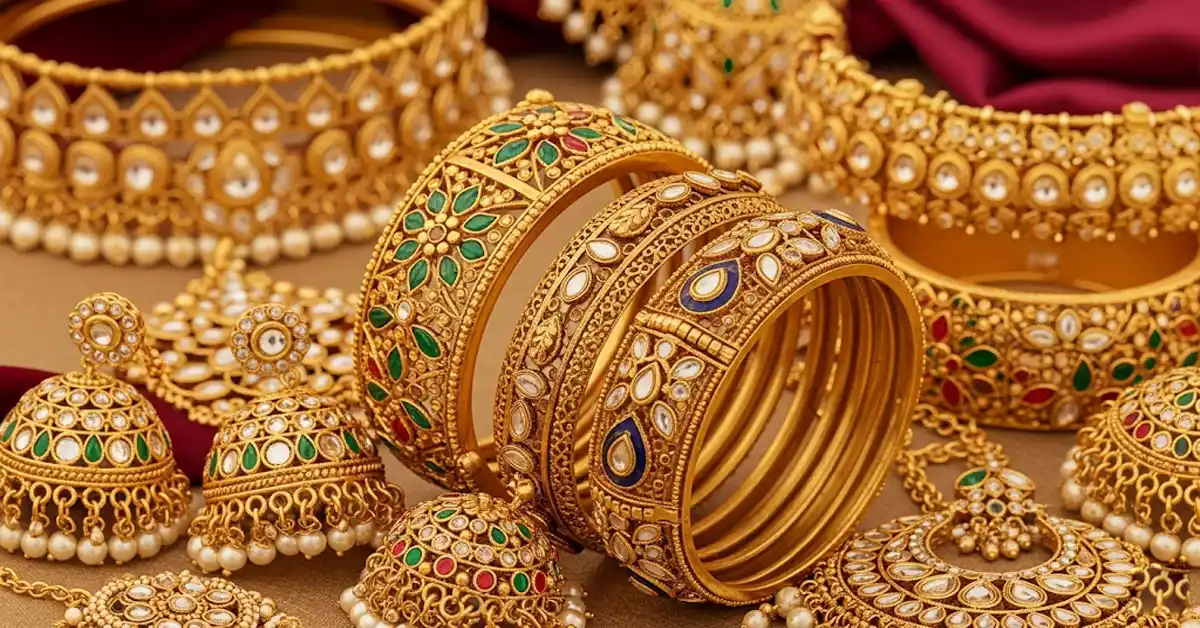
Gold Price Update: Jewelers’ new trick! Stop selling old gold, now you are getting huge benefits on exchanging it.

A major change is being seen in India amidst the ever increasing demand for gold and silver, global instability and increasing pressure on imports. The central government, jewelery industry and retail companies have now become very active in bringing back the idle (unused) gold lying in Indian homes and temples into the country’s economy.
In this context, the government took a big step on May 12 and directly increased the import duty on gold and silver from 6 percent to 15 percent. Its main objective is to control the continuously increasing imports and reduce the huge pressure on foreign exchange reserves. In this connection, Prime Minister Narendra Modi has also made a very special appeal to the citizens of the country. He has urged people to consider postponing new purchases of gold for at least a year, so that the unnecessary burden on the country’s economic condition can be reduced.
Gold import reached record level
Let us tell you that India is the second largest gold consumer country in the world. The biggest thing is that India imports almost its entire gold requirement from abroad. The country’s gold import has increased alarmingly to about $68.9 billion in the financial year 2025-26, whereas in the year 2016-17 this figure was only $9.7 billion. At the same time, silver import has also increased rapidly in the last decade and in 2025-26 it will exceed 11.4 billion dollars. On the other hand, its exports from India are very low, due to which the pressure on trade deficit and foreign exchange reserves is continuously increasing. At present, Switzerland, United Arab Emirates (UAE) and Peru are the major gold supplier countries to India, while silver is mainly sourced from Britain, Hong Kong and America.
All Jewelers have come up with a new scheme: Now don’t sell old gold, exchange it!
The jewelery industry believes that if even a small part of the idle gold deposited in Indian families and temples is brought back into the market through some transparent mechanism, India’s import dependence on foreign countries can be significantly reduced. Ashok Sonthalia, Chief Financial Officer (CFO) of Titan Company, said that the citizens and temples of India have the world’s largest ‘above ground gold reserves’. Titan had started the ‘Old Gold Exchange Program’ about 25 years ago and today about 50 percent of the company’s total gold requirement is being met by recycling this old gold.
Following the same path, Kalyan Jewelers has also announced a big initiative named “Nation First Gold for India”. The company has set a big target of reducing gold import by five tonnes in this financial year. Under this, the old gold exchange program will be promoted rapidly, light weight 18 carat jewelery will be encouraged and gold monetization schemes will be expanded. Kalyan Jewelers is going to set up special counters in its 342 stores, where customers will be able to exchange their old gold for new jewelery or cash with complete transparency. According to the company, the share of exchange of old gold in their total business has now reached more than 30 percent.
Emphasis on low-carat jewelry and recycling
On the other hand, the Gems and Jewelery Export Promotion Council (GJEPC) has also written a letter to the Prime Minister and given many important suggestions. The Council clearly says that by increasing the sale of low carat jewelery in the country, a huge reduction of 20 to 30 percent can be brought about in the import of gold. Along with this, it is very important to promote the culture of converting old gold into new jewelery in the Indian society. Malabar Gold and Diamonds has also proposed to the government to make the gold monetization scheme more attractive and effective. According to company president MP Ahmed, Indian families have a huge amount of gold locked in lockers. If even some part of it comes back into the formal system of the country, then there will be very little need to import new gold from outside.
Experts also believe that Indian families usually buy jewelery and gold coins and keep them safe in bank lockers. This gold remains inactive for a long time, whereas its recycling can act as a lifeline for the country’s economy. This is the reason why now the entire industry is emphasizing on promoting light and fashionable jewelery of 18 and 14 carats instead of 22 carats. Keeping this trend in mind, Titan has recently launched a completely new and grand collection of bridal jewelery in 18 carat (Bridal Jewelery Collection), which is being liked very much by the customers.
Along with this, rising prices of crude oil due to tension in West Asia is becoming a double problem for import dependent countries like India. India buys more than 85 percent of its crude oil needs from abroad. In such a situation, making huge payments for both gold and oil can increase the country’s current account deficit (CAD) and put pressure on the value of the rupee. This is why the government is now seriously appealing to its citizens to exercise some restraint in purchasing non-essential gold and silver.
Stirring in the international market and double whammy of oil
Amidst all this, huge fluctuations are being seen in the prices of gold in the international market also. Due to the increasing diplomatic tension between America, Israel and Iran and the ongoing war in West Asia, there has been a sudden rise in the prices of crude oil. Due to this, the fear of increasing inflation has deepened in the market and the possibility of cutting interest rates by central banks has reduced, due to which there has been upward pressure on gold prices. In recent days, a decline of more than 13 percent has been recorded in the prices of gold in the global market. Due to the strengthening of the dollar and increase in US bond yields, investors’ inclination towards gold has also shifted a bit.

Comments are closed.